

What yacht asset management fee structures actually look like in the US
Yacht asset management fees in the US follow two primary models: a fixed monthly retainer or a percentage of the vessel’s annual operating budget. For smaller yachts in the 15–24 meter range, fixed retainer fees typically run a predictable annual sum for smaller yachts, covering technical oversight and administrative support. Larger vessels in the 24–40 meter range more commonly use percentage-based pricing, with 7% of the operating budget is a widely cited benchmark for larger vessels.
Beyond the base fee, the picture gets more layered. Charter management commissions sit on top of base fees as a separate line item, typically 15–20% of gross charter revenue. For example, a yacht generating $400,000 in annual charter income might pay an additional $60,000–$80,000 in commissions. One-time setup fees covering crew payroll systems, registrations, and administrative infrastructure commonly range from €1,500–5,000 and are generally non-negotiable.
What’s included versus excluded matters as much as the headline rate. Most management contracts cover:
- Technical inspections and compliance monitoring
- Vendor coordination and procurement oversight
- Financial administration and owner reporting
- Crew payroll processing (though crew management itself often carries a separate 5–10% of annual crew payroll)
What they typically exclude: labor and parts costs, marina fees, insurance premiums, and emergency response surcharges. Understanding that boundary before signing is where the real financial discipline begins.
Table of Contents
- How your ownership structure shapes management fees and total costs
- Key financial considerations when managing yacht assets
- How to choose and negotiate yacht asset management services effectively
- Detailed examples of fee models in practice
- How US yacht management companies structure their fees
- How full management versus partial management affects what you pay
- Tax implications of yacht management fees in the US
- Key Takeaways
How your ownership structure shapes management fees and total costs
The ownership entity you choose for your vessel has a direct and often underestimated effect on the total cost of management. Individual ownership is the simplest structure, but it forecloses VAT recovery on operational expenses and complicates commercial chartering. A commercial entity, whether a US Delaware LLC, a Cayman company, or a Maltese corporate structure, unlocks input VAT recovery on the hull and operating costs, and that recovery can exceed 10% of annual operating expenses.
For a $30 million yacht, the right ownership structure can save a significant amount per year compared to personal ownership, with setup costs running in the tens of thousands of dollars for a straightforward single-entity structure. The math becomes unambiguous above roughly $5 million in vessel value. Owners who delay this decision or attempt to restructure after purchase face a more costly path: restructuring typically costs tens of thousands of dollars and takes several weeks to months, and in EU waters it can trigger VAT exposure on the transfer.
Key ownership decisions that directly affect management fees and compliance include:
- Entity type: A US LLC (Delaware or Florida) suits private-use yachts in US and Caribbean waters; Cayman structures suit global cruising above 30 meters; Maltese corporate structures suit charter-operated yachts in Mediterranean waters.
- Two-entity structures: Charter-operated yachts benefit from separating the owning entity from the operating entity, which provides cleaner VAT accounting and liability isolation.
- Flag state selection: Flag state must align with ownership structure; locking in financing before resolving structure often restricts available options.
- VAT registration: Commercial operators chartering from multiple jurisdictions may need VAT registrations in each departure country.
Owners often focus on comparing management fee quotes between providers while the ownership structure decision, made once and largely irreversible, carries far greater long-term financial weight.
Key financial considerations when managing yacht assets
Hidden costs are where management budgets quietly expand. Many contracts separate “management” from “additional services,” and those additional charges can push total costs 20–30% above the base fee. Administrative surcharges for handling crew travel, processing vendor payments, or coordinating customs clearances are common examples. None of these are unreasonable services, but owners who don’t anticipate them find their annual management spend materially higher than the quoted rate.
Refit periods carry their own financial exposure. Some management companies add a project management premium of 10–15% of the total refit cost on top of the ongoing monthly fee, which creates a double-charging problem: the owner pays the management retainer and a separate premium for the same management team overseeing the yard period. Negotiating a capped project fee agreement before the contract is signed is the most effective way to control this.
With effective management and supplier relationships, owners can reduce net management costs to closer to 3–7% of the operating budget after savings from supplier relationships and optimized expenditures. The firms that deliver this consistently share one characteristic: they provide live financial dashboards and detailed monthly owner statements that show budget versus actuals, charter income by leg, and a clear VAT summary. Transparency is not a courtesy; it is the mechanism by which costs stay controlled.
Financial administration best practices that protect owners:
- Require line-item monthly reporting, not summary totals
- Confirm which administrative tasks trigger surcharges before signing
- Separate refit project management fees from the base retainer in the contract
- Verify that supplier invoices are passed through at cost, not marked up
How to choose and negotiate yacht asset management services effectively
Evaluating a management company on fee quotes alone is the wrong starting point. The more revealing questions are about scope clarity, reporting infrastructure, and supplier relationships. A firm that charges 7% but provides real-time financial reporting and passes supplier invoices at cost will almost always deliver better value than one charging 5% with opaque billing.
When reviewing proposals, scrutinize the service scope with the same attention you’d give a yacht financing structure. Ask for a sample monthly owner statement and a sample contract. If the contract does not clearly distinguish between services covered by the management fee and those billed additionally, that ambiguity will cost you.
On negotiation, fixed fees offer predictability and are generally preferable for owners with stable, well-understood operating budgets. Percentage fees align the manager’s incentives with cost control, but only if the contract specifies that the percentage applies to actual operating costs, not to a padded budget estimate. For charter-operated yachts, negotiate the commission rate and the scope of marketing services it covers as a separate line item from the base management fee.
Pro Tip: During contract negotiation, specify a cap on project management fees for refit periods, expressed as a fixed dollar amount or a percentage ceiling of the yard invoice. Without this clause, a major refit can generate a project management premium that rivals the annual management fee itself.
Additional criteria worth applying when selecting a provider:
- Verify crew management capabilities and whether crew payroll is handled in-house or outsourced
- Confirm the firm’s familiarity with your vessel’s flag state and registration requirements
- Ask how emergency costs are authorized and billed
- Request references from owners with vessels of comparable size and usage profile
Detailed examples of fee models in practice
Three fee models dominate the US market, and each suits a different ownership profile.
Fixed monthly retainer works best for privately used yachts under 24 meters with modest crew. The owner pays a predictable annual sum, typically $18,000–$36,000, and the management company handles technical oversight and administration. The limitation is that the fee doesn’t scale with complexity, so if operational demands increase, the contract may need renegotiation.

Percentage of operating budget is the standard for larger, more complex vessels. At 7% on a $1.5 million operating budget, the annual management fee is $105,000. This model aligns the manager’s workload with actual operational scale, but it creates an incentive to allow operating costs to drift upward unless the contract includes cost-control benchmarks.
Success or commission fee applies specifically to charter operations. At 15–20% of gross charter revenue, this model rewards the management company for maximizing charter bookings and income. It works well when the manager has genuine marketing reach and charter network relationships. Owners should verify what marketing activities the commission actually funds before accepting the rate.
How US yacht management companies structure their fees
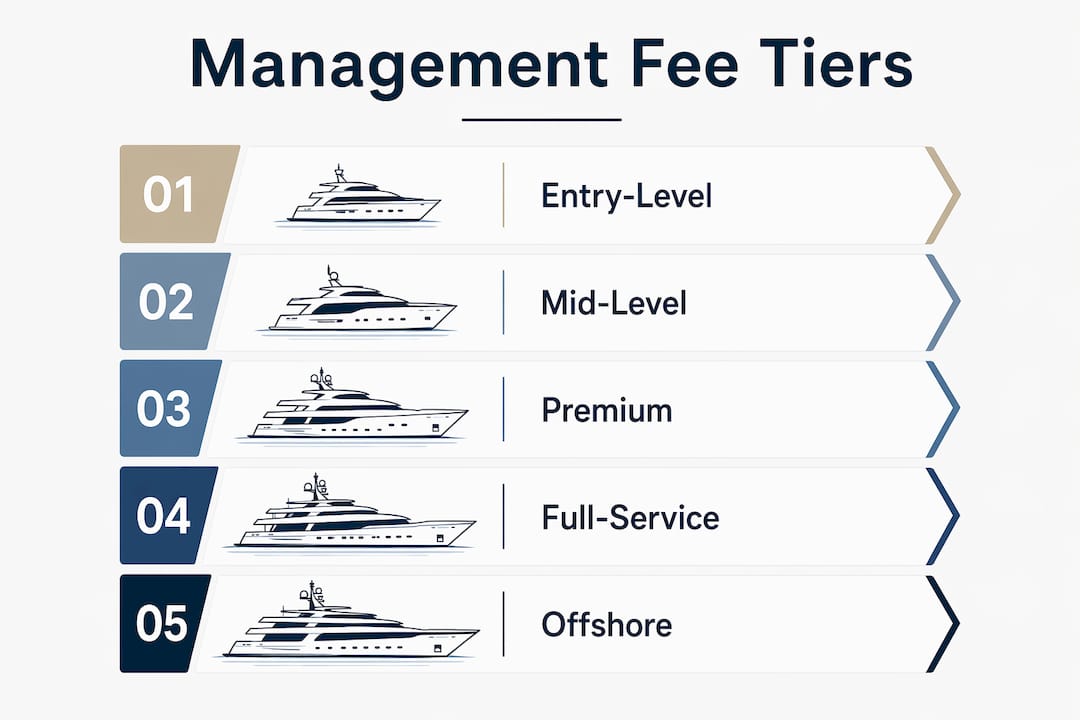
US-based management firms generally offer one of three pricing tiers, though the labels vary. Entry-level packages cover financial administration, compliance monitoring, and basic vendor coordination, typically priced as a fixed retainer. Mid-tier packages add full technical management, crew oversight, and flag state compliance, usually priced as a percentage of operating costs. Full-service packages layer in charter management, refit project oversight, and dedicated captain liaison, with fees combining a base percentage and charter commission.
The critical differentiator among providers is not the fee model but the billing methodology. Some firms pass all supplier invoices at cost; others apply a markup of 5–15% on procurement. That markup, applied across fuel, provisions, maintenance, and parts, can add tens of thousands of dollars annually to the true cost of management. Requesting a written confirmation of the firm’s supplier billing policy before signing is a straightforward protection.
For offshore-registered yachts, management firms with experience in Cayman, Marshall Islands, or Maltese flag administration add meaningful value through their familiarity with flag state survey requirements and compliance cycles.
How full management versus partial management affects what you pay
Full management means the provider handles every operational dimension: technical oversight, crew management, financial administration, compliance, provisioning, and charter coordination. Partial management, sometimes called technical-only or financial-only management, covers a defined subset of those functions. The fee difference is significant.
A full-management contract for a 30-meter yacht typically runs $105,000 annually when applying the standard rate of 7% to a $1.5 million operating budget. A technical-only arrangement for the same vessel might run $30,000–$50,000. The gap reflects the labor intensity of crew management, charter coordination, and financial reporting. Owners who self-manage crew or handle their own financial administration can reduce costs materially, but only if they have the time and expertise to do it well. Once a vessel requires full-time crew, class surveys, and flag state compliance cycles, the case for full management tends to pay for itself through early problem detection and supplier pricing leverage.
Tax implications of yacht management fees in the US
Management fees paid to a third-party management company are generally deductible as ordinary business expenses when the yacht is operated commercially and owned through a qualifying business entity. For US LLC owners, this means management fees flow through to the owner’s personal tax return as a business deduction, subject to the usual passive activity and at-risk rules.
Charter income is taxable, and the tax treatment depends on the ownership structure and the level of owner participation. Yachts chartered commercially through a corporate entity can offset charter income with management fees, crew costs, depreciation, and operating expenses. The IRS scrutinizes yacht-related deductions carefully, particularly when personal use is mixed with commercial use. Maintaining a clear log of commercial versus personal use days is not optional; it is the documentation that makes the deduction defensible.
VAT considerations apply primarily to yachts operating in European waters, where the ownership structure determines whether input VAT on the hull and operating costs is recoverable. For US owners operating domestically, sales tax on the vessel purchase and use tax in the state of primary use are the more immediate tax variables. Management fees themselves are generally not subject to sales tax in most US states, though the rules vary by state and service type.
Key Takeaways
Yacht asset management fee structures in the US follow fixed retainer or percentage-based models, with ownership structure and contract transparency determining the true total cost of management.
| Point | Details |
|---|---|
| Fee model by vessel size | Fixed retainers of $18,000–$36,000 suit yachts under 24 meters; percentage fees typically range from 5–10% (often around 7%) of the operating budget for larger vessels. |
| Ownership structure impact | The right commercial entity can reduce annual costs significantly on a $30M yacht through VAT recovery and tax efficiency. |
| Hidden cost exposure | Additional service charges can push total management costs 20–30% above the quoted base fee. |
| Refit fee protection | Negotiate a capped project management fee before signing to prevent double-charging during yard periods. |
| Transparency as cost control | Firms providing live financial dashboards and line-item monthly reporting consistently deliver net management costs of 3–7% of the operating budget after supplier savings. |
Recommended
Sold Listings


Design Your Yacht
"*" indicates required fields
Maximus III - PNW
As you step aboard MAXIMUS III, the first impression is her scale.
At 120 feet with an 8-meter beam and 294 GT of interior volume, this 2025 Crescent Custom tri-deck immediately feels open, balanced, and estate-like. A timeless look while still feeling fresh from the shipyard.
Currently Available


Get your yacht value Estimate
"*" indicates required fields