

A yacht qualifies as a legitimate business expense under U.S. tax law, but only when it serves a genuine commercial purpose and clears a series of demanding IRS requirements. The deduction is real, and for business owners in high income brackets, it can be substantial. The path to claiming it, however, demands the same operational discipline you would apply to any serious business asset.
Here is what the IRS requires at a minimum:
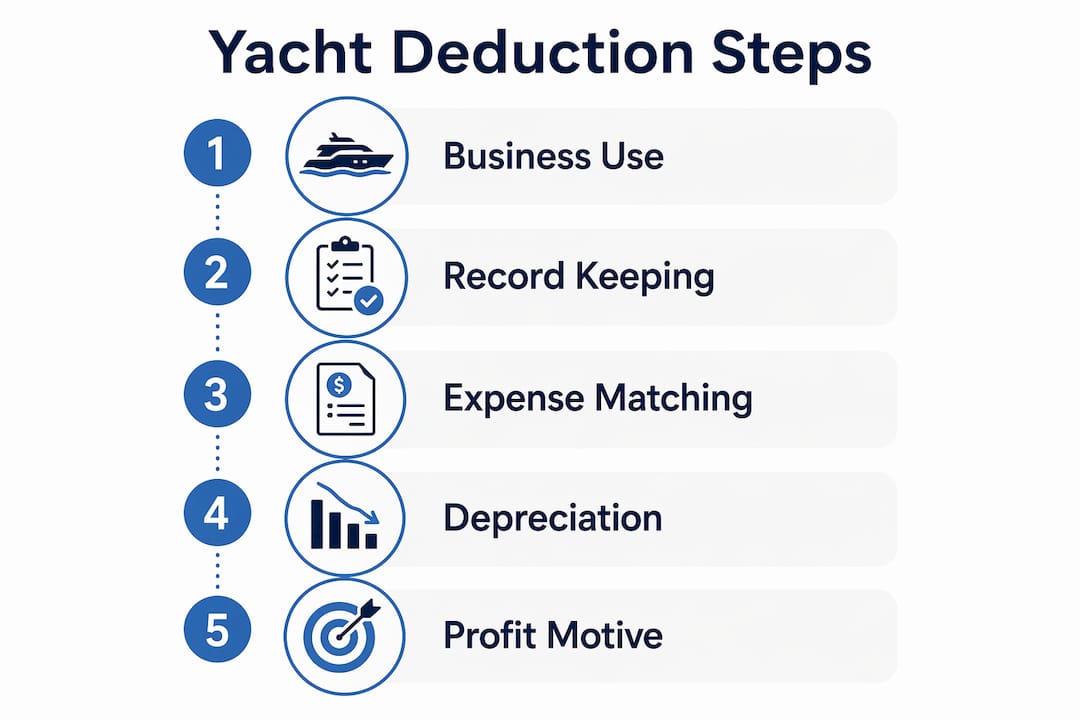
- Over 50% qualified business use every year throughout the entire depreciation recovery period
- Contemporaneous documentation of every trip, including dates, participants, and specific business purpose
- Legitimate commercial activities such as active charter operations open to the public, client meetings with documented business discussions, or transport directly tied to business operations
- A credible profit motive supported by a formal business plan, revenue records, and active management
- Proper ownership structure through an LLC or corporation, combined with genuine business substance
Failing any of these conditions does not just cost you the current year’s deduction. Under IRC Section 280F, the IRS can recapture all prior accelerated depreciation as ordinary income. The stakes are high, and the margin for error is narrow.

What IRS tax principles govern yacht business expense deductions?
Yachts fall into a category the IRS calls “listed property,” which subjects them to stricter substantiation rules than ordinary business equipment. Three code sections shape nearly every yacht deduction claim.
IRC Section 280F governs listed property and requires that business use exceed 50% before any accelerated depreciation is permitted. Drop below that threshold in any year during the recovery period, and the IRS mandates a switch to the Alternative Depreciation System, a straight-line method over 18 years. Every dollar of accelerated depreciation already claimed above the ADS amount becomes ordinary income recapture on Form 4797.
IRC Section 274 disallows deductions for entertainment facilities, and the IRS treats yachts as entertainment facilities by default. The Tax Cuts and Jobs Act eliminated most entertainment deductions entirely, which means a yacht used primarily to entertain clients produces no deduction, regardless of how much business gets discussed on board. There are narrow exceptions, including bona fide charter operations open to the public, but each exception demands that the vessel operate almost entirely for the stated commercial purpose.
IRC Section 183 addresses profit motive. If the IRS determines that your yacht activity lacks a genuine intent to generate profit, it reclassifies the activity as a hobby and disallows all losses beyond limited statutory allowances. The practical effect is that years of deductions can be wiped out retroactively.
Key principles to keep in mind:
- Bonus depreciation and Section 179 expensing are available only when the 50% business-use test is met and fully documented
- Personal use is never deductible, even when the owner is also a shareholder or officer of the owning entity
- Entertainment facility disallowance under Section 274 applies broadly, with narrow exceptions for genuine commercial operations
- Recapture risk persists for the entire depreciation recovery period, not just the first year
How do you meet the 50% business-use threshold and substantiate it?
The 50% qualified business use rule is not a target to aim for once. It is a floor you must stay above every single year for the full depreciation recovery period. The IRS enforces this through listed property substantiation rules, which require contemporaneous records, meaning logs kept at the time of each use, not reconstructed later from memory.
Qualifying business activities include active charter operations with paying, unrelated customers; documented client meetings where specific business matters are discussed and recorded; and transport directly connected to business operations. A trip where the owner and a client discuss a potential deal over dinner does not automatically qualify. The business purpose must be the primary reason for the trip, and the log must reflect that clearly.
What your records must capture for every trip:
- Date and duration of use
- Point of departure and destination
- Names and business relationships of all passengers
- Specific business purpose discussed or conducted
- Gross income generated, if applicable
Pro Tip: Keep a dedicated digital log using a timestamped app or spreadsheet updated immediately after each trip. Courts have consistently rejected reconstructed logs, and the Tax Court case Nicholls, North, Buse Co. v. Commissioner is a clear example: the yacht’s log listed guests and their business affiliations but failed to document actual business discussions, leading to disallowed deductions and a constructive dividend assessment against the controlling shareholder.
If personal use exceeds 14 days in a tax year, or more than 10% of the total days the yacht is chartered at fair market rates, the IRS may classify the vessel as a second home. That classification limits rental expense deductions to no more than the rental income generated, eliminating the ability to use charter losses to offset other income.
How does ownership structure affect your deduction and liability position?
Holding a yacht through an LLC or corporation creates a legal firewall between the vessel’s liabilities and your personal assets. In the event of a maritime accident, that separation can protect your personal wealth from claims. For that reason alone, most advisors recommend against holding a yacht in your own name.
What an LLC or corporation cannot do is manufacture a tax deduction on its own. The IRS applies substance over form in every case. A single-member LLC is disregarded for federal income tax purposes by default, meaning the IRS treats you as directly owning the yacht. Multi-member LLCs default to partnership treatment, and C corporations introduce their own complexity around constructive dividends. None of these classifications change the central question the IRS is asking: does this yacht operate as a genuine business asset?
Practical considerations for ownership structure:
- An LLC or S corporation holding a charter yacht can allow material participation by the owner, which is essential for treating losses as non-passive and deducting them against ordinary income
- A shell company with no real business operations elevates audit visibility without providing any tax benefit
- Corporate ownership of a yacht used primarily for personal purposes can trigger a constructive dividend, as it did in Nicholls, North, Buse Co., where the controlling shareholder was taxed on the fair rental value of personal use
- Offshore entities do not eliminate U.S. tax obligations; the IRS focuses on beneficial ownership and control, not legal title
For a deeper look at how entity location and registration interact with U.S. tax obligations, Baranofyachts has published a detailed guide on offshore yacht registration that addresses the substance-versus-structure question directly.
What expenses can you actually deduct, and how are capital costs treated?
Once business use is established and documented, the deductible expenses fall into two categories: operating costs and capital costs.
Operating costs are deductible in proportion to the business-use percentage. If the yacht is used 70% for business, then 70% of each qualifying operating expense is deductible. These include:
- Fuel and oil
- Insurance premiums
- Dockage and slip fees
- Routine maintenance and repairs
- Crew salaries and related payroll costs
Accurate invoices matched to your usage log are required for every line item. The IRS expects each expense to tie directly to a documented business activity.
Capital costs are handled through depreciation. Under the One Big Beautiful Bill Act of 2025, 100% bonus depreciation was restored for qualifying business property, including yachts used primarily for legitimate commercial purposes, for vessels acquired and placed in service between January 19, 2025, and December 31, 2029. Section 179 expensing allows an additional immediate write-off, with a 2026 deduction limit of approximately $2.56 million, phasing out dollar-for-dollar once total qualifying property placed in service exceeds roughly $4.09 million.
| Expense Category | Deductible? | Conditions |
|---|---|---|
| Fuel, oil | Yes, proportional | Business-use percentage applies |
| Insurance premiums | Yes, proportional | Business-use percentage applies |
| Dockage and slip fees | Yes, proportional | Business-use percentage applies |
| Crew salaries | Yes, proportional | Business-use percentage applies |
| Purchase price (depreciation) | Yes, subject to limits | Over 50% business use required |
| Client entertainment on board | No | Section 274 disallowance |
| Business meals on board | 50% deductible | Must meet “directly related” test; food cost separated from vessel operating cost |
| Personal use costs | No | Never deductible |
One nuance worth understanding: the cost of a business meal served on the yacht can remain 50% deductible if it meets the “directly related to” or “associated with” tests for business meals. The food and beverage cost must be separated from the vessel’s operating costs, because the fuel to reach the location is not deductible when the trip itself is personal or entertainment-driven.
How do you demonstrate profit motive and satisfy IRS compliance standards?
The IRS evaluates profit motive under IRC Section 183 using a facts-and-circumstances approach. No single factor is decisive, but the weight of evidence must point toward a genuine commercial enterprise, not a lifestyle asset dressed up as a business.
Objective indicators the IRS examines include:
- Whether the owner carries on the activity in a businesslike manner, with separate accounts, formal contracts, and professional management
- The time and effort the owner personally devotes to the activity
- Whether the owner depends on the income for their livelihood
- Whether losses are due to startup conditions or factors beyond the owner’s control
- The owner’s history of income or losses in the activity over multiple years
A formal business plan is not optional. It should outline revenue strategies, target charter markets, projected operating costs, and a realistic path to profitability. Pair that plan with actual revenue records, marketing materials, and evidence of active management. Courts have disallowed losses from yacht charter activities where the owner could not demonstrate that the activity was conducted with the same rigor applied to their other businesses.
Material participation matters here as well. For high-income owners who want to use charter losses to offset W-2 wages or active business income, the activity must be non-passive. That requires meeting one of the IRS’s material participation tests, which generally means spending more than 500 hours per year in the activity or being the only person who materially participates. Passive losses can only offset passive income, which limits their immediate value for most affluent owners.
Yacht business expense justification: insights from Baranofyachts
At Baranofyachts, we work with clients who are building or acquiring vessels with both lifestyle and business goals in mind. The tax dimension of yacht ownership comes up in nearly every serious conversation, and the patterns we observe are consistent.
The most common pitfalls we see:
- Minimal charter activity with heavy personal use. A yacht that spends most of its time at the owner’s private dock, with occasional charters arranged informally, will not satisfy the IRS’s “substantially all” standard for charter exceptions under Section 274.
- Logs that document presence but not purpose. Listing guests and their company names is not enough. The Nicholls, North, Buse Co. ruling made clear that the log must show what business was actually conducted, not just who was on board.
- Relying on entity structure alone. We consistently advise clients that an LLC holding a yacht used primarily for personal enjoyment does not create a deduction. The IRS looks through the entity to the actual pattern of use.
- Ignoring recapture risk. Owners who take large first-year deductions under Section 179 or bonus depreciation sometimes reduce charter activity in later years without realizing that dropping below 50% business use triggers full recapture of those deductions as ordinary income.
The business case for a well-structured yacht operation goes beyond tax savings. A vessel used for corporate hospitality and client engagement can meaningfully strengthen relationships and reinforce a brand’s positioning in ways that a conference room simply cannot. When that activity is documented properly and tied to genuine revenue generation, it supports both the deduction and the broader business rationale. Baranofyachts can help you think through how a custom build or acquisition aligns with your business objectives from the outset, so the operational and tax foundations are built in from day one.

If you are considering a yacht acquisition with business use in mind, explore how corporate image and yacht ownership work together to create a defensible, value-generating business asset.
Key Takeaways
Justifying a yacht as a business expense requires consistent business use above 50%, meticulous contemporaneous records, a credible profit motive, and operational discipline that mirrors any legitimate commercial enterprise.
| Point | Details |
|---|---|
| 50% business use is the floor | Business use must exceed 50% every year of the depreciation recovery period, or recapture applies. |
| Documentation must show purpose, not just presence | Logs must record specific business discussions and activities, not just passenger names and dates. |
| Entity structure does not create deductions | An LLC or corporation provides liability protection, but the IRS looks through the entity to actual use patterns. |
| Section 179 limit for 2026 is approximately $2.56 million | The phase-out begins when total qualifying property placed in service exceeds roughly $4.09 million |
| Profit motive requires a credible business plan | Revenue records, active management, and a formal plan are essential to avoid hobby loss reclassification under IRC Section 183. |
The real discipline behind yacht ownership as a business investment
The tax benefits of yacht ownership are genuine, but they are not passive rewards for structuring a purchase cleverly. They are the result of running a real business with real customers, real revenue, and real records. That distinction is where most owners either succeed or fail.
What concerns me about the way this topic is often discussed is the implicit suggestion that the right entity structure or the right accountant can transform a lifestyle asset into a tax shelter. The IRS has seen every variation of that approach, and the case law is unambiguous. Nicholls, North, Buse Co. lost its deductions not because the yacht was never used for business, but because the records could not prove it. The court found business use in exactly one documented instance out of an entire season of trips.
The owners who get this right treat the yacht the way they treat any other income-producing asset. They set charter rates at fair market value, market to unrelated customers, track every expense against a usage log, and involve their CPA from the acquisition stage forward. They also understand that the Section 179 and bonus depreciation benefits are front-loaded rewards for a commitment that must be sustained for years. Taking a large first-year deduction and then quietly shifting the vessel to personal use is not a gray area. It is a recapture event waiting to happen.
For affluent business owners, the more productive framing is not “how do I justify this expense?” but “how do I build a yacht operation that genuinely earns its deductions?” When the operation is structured correctly, the tax treatment follows naturally. When it is structured to look like a business while functioning as a personal asset, the IRS eventually catches up.
Recommended
Sold Listings


Design Your Yacht
"*" indicates required fields
Maximus III - PNW
As you step aboard MAXIMUS III, the first impression is her scale.
At 120 feet with an 8-meter beam and 294 GT of interior volume, this 2025 Crescent Custom tri-deck immediately feels open, balanced, and estate-like. A timeless look while still feeling fresh from the shipyard.
Currently Available


Get your yacht value Estimate
"*" indicates required fields