
Yacht insurance is a specialized marine policy that protects your vessel, your liability exposure, and your financial position as an owner. Think of it as the foundation beneath every other decision you make about your yacht. Premiums typically run between 1% and 5% of the yacht’s insured value annually, meaning a $500,000 vessel carries an annual premium somewhere between $5,000 and $25,000 depending on risk factors. For superyachts, the range shifts considerably: rates as low as 0.28% to 1.20% of insured value apply to high-value vessels with professional crew and clean claims records. Understanding what drives that percentage, and how deductibles and valuation methods compound the real cost, is where yacht insurance moves from a line item into a genuine investment decision.
Key elements that define yacht insurance as an investment cost:
- Premium range: 1% to 5% of insured value annually for most cruising yachts
- Standard deductible: typically 1% to 2% of insured value per claim
- Named-storm deductible: often 5% to 10% of insured value for storm-related losses
- Valuation basis: agreed value or actual cash value, each producing very different claim outcomes
- Risk transfer: insurance shifts catastrophic financial exposure from owner to insurer, preserving liquidity
What coverage types do luxury yacht owners actually need?
Yacht insurance is not a single product. It is a program assembled from multiple coverage lines, each addressing a distinct category of financial exposure.
- Hull and machinery (H&M): Covers physical damage to the vessel itself, including the engine, mechanical systems, and onboard equipment. This is the core of any policy and the line most directly tied to your vessel’s insured value.
- Protection and indemnity (P&I): Broad liability coverage for third-party bodily injury, property damage, and maritime law obligations. P&I is where the largest potential claims live, particularly in collision or environmental incidents.
- Personal property coverage: Protects onboard belongings, electronics, artwork, and tender equipment. For luxury vessels, this line can carry meaningful limits given the value of what owners bring aboard.
- Crew liability: Required when paid crew are aboard. This coverage addresses Jones Act and USL&H exposures that do not exist on pleasure-use vessels.
- War risk: A separate line covering damage from acts of war, piracy, or political violence, typically required for vessels operating in certain international waters.
- Charter use endorsement: If the vessel generates charter revenue, this endorsement must be declared and rated. Omitting it creates a coverage gap that voids claims during charter operations.
Bundling these lines under a single yacht-form policy generally produces better pricing and cleaner claims coordination than sourcing each line separately.
What factors drive your annual premium up or down?
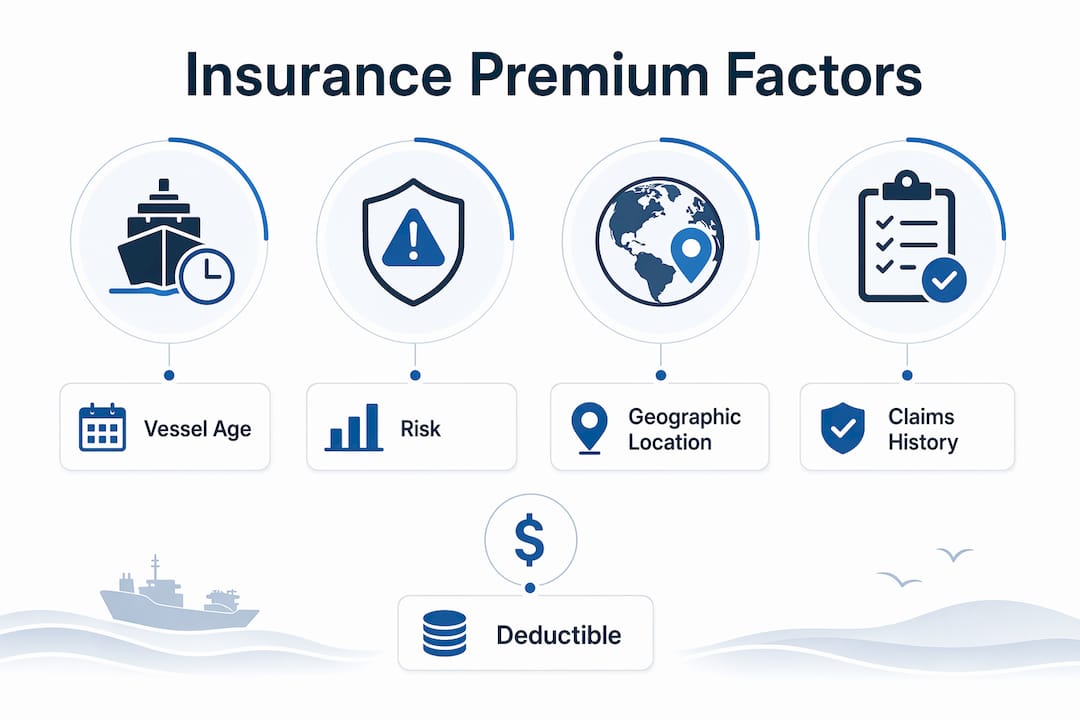
Yacht insurance pricing is not a fixed rate applied to hull value. Underwriters build a rate from a specific set of variables, and each one can move the percentage meaningfully.
- Navigation territory: Vessels cruising protected inland waters pay less than those operating in the Bahamas or Caribbean during hurricane season. Florida and Gulf Coast yachts typically have higher premium percentages than the national average, reflecting increased hurricane risk.
- Hull value, age, and construction: Newer fiberglass hulls with documented maintenance histories rate better than older vessels or those with deferred work. Custom builds may require additional underwriting.
- Owner and operator experience: A first-time yacht buyer stepping up to a 50-foot motor yacht carries more underwriting risk than an owner with a decade of comparable vessel experience. A licensed captain endorsement can close that gap on larger yachts.
- Charter use: Declared charter activity raises premiums meaningfully because the exposure profile changes across multiple coverage lines.
- Hurricane plan: A documented storm plan, including haul-out deadlines and professional captain authority to move the vessel, often unlocks material discounts for storm-zone yachts.
- Claims history: A clean record over the prior three to five years matters. The type of any prior loss also factors in; a single weather-related total loss reads differently than a pattern of small claims.
- Larger yachts, lower percentage: Larger vessels often pay a lower premium percentage than smaller ones, reflecting underwriting economies of scale and the better risk management that typically accompanies professional crew and formal hurricane protocols.
Pro Tip: Never evaluate a yacht insurance quote on premium alone. Model the named-storm deductible against your most likely claim scenario. A policy with a 10% named-storm deductible on a $1,000,000 vessel leaves you holding $100,000 before coverage responds, which can easily exceed the premium savings from choosing that policy.
How does policy structure protect your vessel investment?
The two most consequential structural decisions in any yacht policy are the valuation basis and the deductible arrangement. Getting either wrong costs real money at claim time.
- Agreed value vs. actual cash value (ACV): An agreed value policy locks in a specific settlement amount at policy inception. On a total loss, the carrier pays that amount minus the deductible, with no depreciation argument. An ACV policy pays the depreciated market value at the time of loss, which can leave a significant gap. On a $400,000 yacht after three years, that gap can reach $110,000 or more.
- Why agreed value is standard for luxury vessels: Agreed value coverage eliminates the most contentious part of a total-loss claim and gives owners certainty about what they will receive. The premium difference over ACV is often modest, frequently in the 5% to 15% range on top of the ACV premium.
- Named-storm deductibles: These apply separately from the standard deductible and are calculated as a percentage of insured value, typically 5% to 10%. On a $2,000,000 vessel, a 10% named-storm deductible means $200,000 in self-retention before the policy responds to a hurricane claim.
- Marine surveys: Underwriters require a current marine survey to establish insured value and confirm vessel condition. The survey adds an upfront cost to the insurance acquisition process but also protects the owner by documenting the vessel’s value and condition before a loss occurs. A yacht survey is not just a lender requirement; it is the foundation of a defensible agreed value.
- Post-refit updates: A major systems refit or electronics upgrade that adds significant value to the vessel should trigger an agreed value adjustment. Letting that lapse leaves real investment exposed.
Viewing yacht insurance as capital preservation, not just overhead
The most useful reframe for affluent yacht owners is to stop treating insurance as a recurring expense and start treating it as a capital preservation mechanism. The premium is the cost of transferring catastrophic financial risk to an insurer. The deductible is the portion of that risk you retain.

Small changes in risk profile produce outsized premium effects. Moving a vessel from the Chesapeake to South Florida, adding charter use, or losing a professional captain endorsement can shift the annual cost by a full percentage point or more of hull value. On a $3,000,000 yacht, one percentage point is $30,000 per year.

The named-storm deductible deserves particular attention as a liquidity planning variable. A policy that appears cheaper because it carries a 10% named-storm deductible may actually represent a worse financial position than a policy with a 5% deductible and a higher annual premium. The math only becomes clear when you model it through an actual storm scenario rather than comparing premium lines.
Strategic considerations for evaluating insurance within your overall yacht investment plan:
- Match the valuation basis to the vessel type: agreed value for custom builds, refitted yachts, and any vessel over $100,000
- Model deductible scenarios against realistic claim events, not just the annual premium
- Declare all use accurately, including charter activity, to avoid coverage gaps
- Review and update the agreed value after any major refit or equipment upgrade
- Work with a licensed marine insurance broker who specializes in yacht-form policies, not a generalist
How yacht insurance protects your investment over the long term
Yacht insurance costs typically fall between 1% and 5% of insured value annually, but the real measure of its value is what it prevents. A single uninsured total loss, a major liability judgment, or an environmental incident can exceed the cumulative cost of years of premiums.
- Agreed value policies eliminate depreciation disputes and deliver settlement certainty
- Deductible choices determine how much liquidity risk you retain versus transfer
- Tailored policies that reflect actual vessel use and navigation territory avoid both overpaying and underinsuring
- Charter use, crew arrangements, and geographic changes all require policy updates to maintain full protection
- A licensed marine insurance broker aligned with your investment objectives is the most reliable path to coverage that actually fits
What typical claims look like and how they affect long-term costs
Claims history is one of the most durable factors in yacht insurance pricing. A single large claim can affect your premium for three to five renewal cycles, and the type of claim matters as much as the dollar amount.
Weather-related losses, particularly those triggered by named storms, are the most common source of significant yacht claims in the United States. For a vessel with a 5% named-storm deductible, even a partial loss from a hurricane can produce a five-figure out-of-pocket cost before the policy responds. Collision and grounding claims tend to be smaller but more frequent, and a pattern of small claims often draws more underwriting scrutiny than a single large weather event.
Liability claims under the P&I line carry the highest potential severity. A collision that injures a third party or damages another vessel in a marina can generate claims that dwarf the hull value of the insured yacht. Maintaining adequate P&I limits, typically well above the minimum, is where the investment protection argument for insurance is clearest.
How yacht insurance compares to other marine asset protections
Yacht insurance is the most comprehensive marine protection available, but it operates alongside other mechanisms that owners sometimes confuse with it or treat as substitutes.
A marine warranty or builder’s warranty covers manufacturing defects for a defined period after delivery. It does not cover operational damage, liability, or storm losses. A marina liability waiver protects the marina, not the vessel owner. Neither replaces the coverage that a properly structured yacht policy provides.
For owners exploring yacht financing, lenders typically require agreed value insurance as a condition of the loan, with the lender named as a loss payee. This requirement exists precisely because ACV policies create settlement uncertainty that lenders cannot accept as collateral protection.
How to obtain yacht insurance coverage in the U.S.
The process for securing yacht insurance in the United States follows a defined sequence, and starting it before you take delivery of the vessel is the right approach.
- Engage a licensed marine insurance broker who specializes in yacht-form policies. A generalist broker rarely has access to the specialist markets that write large yacht risks.
- Commission a current marine survey from a certified marine surveyor. Underwriters require this for vessels above a certain value threshold, and it establishes the agreed value foundation.
- Prepare your vessel profile: hull value, year, construction, navigation territory, intended use, captain credentials, and claims history for the prior five years.
- Obtain quotes from multiple underwriters. Yacht insurance rates are negotiated individually, not listed publicly, so broker access to multiple markets produces meaningfully different results.
- Bind coverage before delivery or transport. The vessel needs to be insured from the moment it leaves the seller’s or builder’s care.
The full process from initial broker engagement to bound coverage typically takes one to three weeks for straightforward vessels, longer for superyachts or vessels with complex use profiles.
What the total annual cost actually includes beyond the base premium
The base premium is the largest line, but it is not the only cost in the insurance budget for a luxury yacht owner.
- Named-storm deductible reserve: Not a premium cost, but a liquidity reserve you should maintain if your vessel operates in storm-exposed waters
- Marine survey fees: Required at policy inception and typically every three to five years for renewal. Survey costs vary with vessel size and complexity.
- State surplus lines taxes and fees: Yacht insurance in the U.S. is often placed through surplus lines markets, which carry state-specific taxes and stamping fees added to the premium. These vary by state but add a percentage to the total cost.
- Endorsement costs: Charter use, war risk, and crew liability endorsements each carry their own premium component on top of the base hull and P&I lines.
- Broker fees: Some marine brokers charge a placement fee separate from the carrier premium, particularly for complex or large-value risks.
Modeling the true annual cost of yacht insurance coverage means adding all of these components, then layering in the deductible exposure you retain. That total, not the base premium alone, is the honest investment cost figure.
At Baranofyachts, we work with owners at every stage of the yacht ownership lifecycle, from initial acquisition through custom builds and long-term management. Protecting the investment you have made in your vessel starts with understanding exactly what your insurance program covers and what it costs in full. If you are evaluating a new build or acquisition and want to understand how yacht ownership enhances corporate value alongside its financial obligations, we are ready to guide you through every decision.

Key Takeaways
Yacht insurance functions as a risk-transfer mechanism that protects your vessel’s full capital value, with annual premiums between 1% and 5% of insured value and deductible structures that determine how much financial exposure you retain.
| Point | Details |
|---|---|
| Annual premium range | Premiums typically run from 1% to 5% of insured value, with superyachts sometimes qualifying for rates as low as 0.28% to 1.20%. |
| Named-storm deductible risk | Storm deductibles of 5% to 10% of insured value can produce six-figure out-of-pocket costs before coverage responds. |
| Agreed value vs. ACV | Agreed value policies eliminate depreciation disputes; the premium difference over ACV is often only 5% to 15%. |
| Charter use impact | Declaring charter activity is required; undeclared charter use voids coverage and can raise premiums by 25% to 50% or more. |
| Total cost modeling | The true investment cost includes the base premium, endorsements, survey fees, surplus lines taxes, and your retained deductible exposure. |
Recommended
Sold Listings


Design Your Yacht
"*" indicates required fields
Maximus III - PNW
As you step aboard MAXIMUS III, the first impression is her scale.
At 120 feet with an 8-meter beam and 294 GT of interior volume, this 2025 Crescent Custom tri-deck immediately feels open, balanced, and estate-like. A timeless look while still feeling fresh from the shipyard.
Currently Available


Get your yacht value Estimate
"*" indicates required fields