
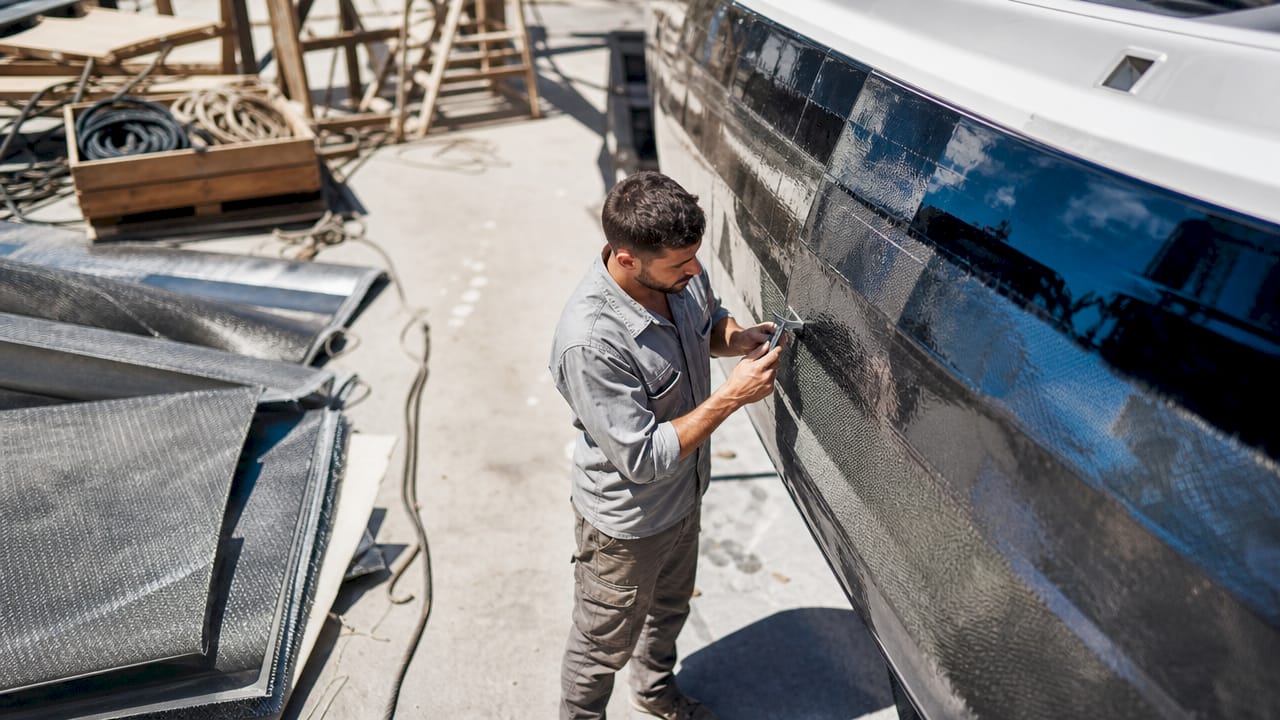
Composite materials in yacht construction are defined as engineered fibers embedded in resin matrices, delivering a combination of strength, low weight, and corrosion resistance that no single traditional material can match. Understanding composite materials yacht builds means grasping why fiber-reinforced polymers have replaced steel, aluminum, and wood as the preferred structural choice for performance-driven and luxury vessels alike. Carbon fiber, fiberglass, and Kevlar each serve distinct roles, while resin systems including polyester, vinyl ester, and epoxy determine how those fibers perform under load and exposure. At Baranofyachts, we work with these material systems daily, and the decisions made at the laminate schedule stage shape every performance and comfort outcome a client experiences at sea.
What types of composite materials are used in yacht building and why?
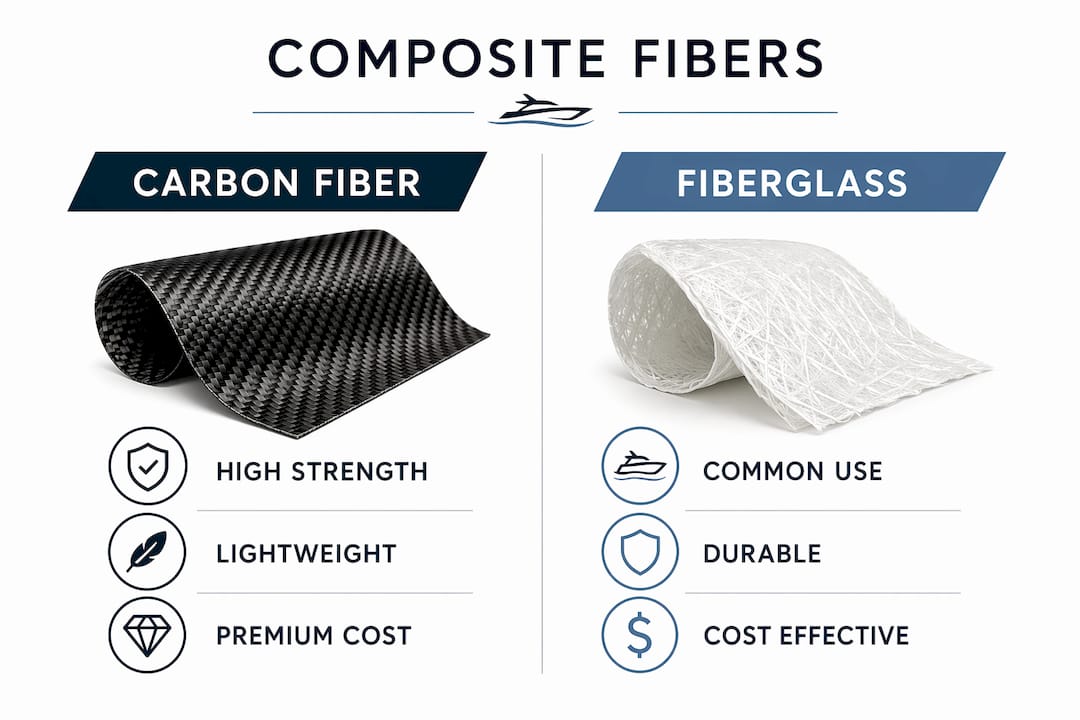
Composite yacht construction relies on three primary fiber types, each chosen for a specific structural purpose. Selecting the wrong fiber for a given application wastes money and compromises safety. The right choice depends on load paths, budget, and the performance envelope the yacht must meet.
Carbon fiber delivers the highest strength-to-weight performance available. Carbon fiber composites provide roughly five times the strength-to-weight ratio of mild steel. That advantage translates directly into lighter hulls, faster acceleration, and reduced fuel consumption over the life of the vessel.
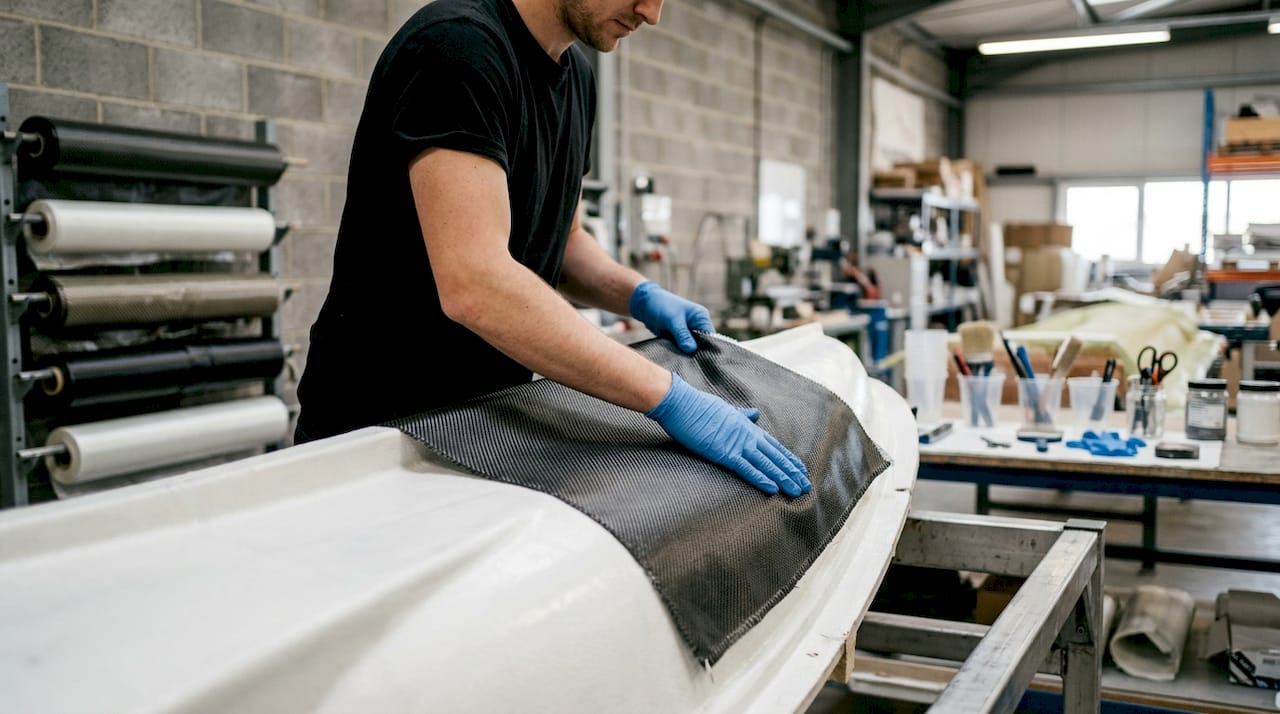
Fiberglass (glass fiber reinforced polymer, or GFRP) remains the most widely used material in production yacht building. It costs significantly less than carbon fiber and offers good tensile strength, impact resistance, and ease of fabrication. Most mid-range production yachts use fiberglass as their primary structural fiber, often combined with a foam or balsa core to increase panel stiffness without adding mass.
Kevlar (aramid fiber) excels in impact resistance and is commonly used in keel areas, bow sections, and anywhere the hull faces collision risk. Kevlar does not perform as well in compression as carbon fiber, so builders use it selectively rather than as a primary structural fiber.
Resin systems bind these fibers and transfer loads between them. The three systems in common use are:
- Polyester resin: The lowest-cost option, widely used in production boatbuilding. It absorbs more water over time than other resins, which can lead to osmotic blistering in hulls left in the water for extended periods.
- Vinyl ester resin: A step up in performance. Vinyl ester offers improved strength and significantly better resistance to water absorption, making it the preferred choice for hull skins and structural bulkheads in quality builds.
- Epoxy resin: The highest-performing option. Epoxy bonds more effectively to fibers, absorbs almost no water, and produces laminates with superior mechanical properties. It is standard in carbon fiber builds and high-performance racing yachts.
Hybrid laminates combine fibers to balance cost and performance. A typical luxury build might use carbon fiber in the keel structure and high-stress bulkheads, fiberglass in secondary panels, and Kevlar in the bow. The laminate schedule, which specifies fiber orientation, ply count, and resin type for each zone, is the document that separates a well-engineered yacht from a compromised one.
| Fiber type | Primary strength | Best application | Cost level |
|---|---|---|---|
| Carbon fiber | Highest strength-to-weight | Structural frames, masts, bulkheads | High |
| Fiberglass | Good tensile, impact resistance | Hull skins, decks, secondary panels | Low to moderate |
| Kevlar | Impact and puncture resistance | Bow sections, keel areas | Moderate to high |
How do composites improve yacht performance and longevity?
Composites outperform metals and wood in three critical areas: structural efficiency, fatigue life, and corrosion resistance. Each of these advantages compounds over the life of a vessel, reducing both operating costs and maintenance demands.
Metals distribute strength equally in all directions, a property called isotropy. Composites are anisotropic. Fiber orientation along load paths allows engineers to place material exactly where stress concentrates and remove it where it is not needed. The result is a structure that is lighter than an equivalent metal design while meeting or exceeding the same load requirements.
Fatigue life is where composites show their most dramatic advantage over metals. Carbon fiber reinforced polymers endure millions of stress cycles with minimal stiffness loss. Steel and aluminum develop microscopic cracks under repeated loading, and those cracks propagate until failure. A composite hull that is correctly designed and fabricated will outlast a metal hull of the same initial strength in cyclic loading conditions, which is exactly what a yacht faces at sea.
Corrosion resistance is the third pillar. Composites resist rust, galvanic corrosion, and rot, eliminating the maintenance burden that steel and wood hulls carry. A steel yacht requires regular blasting, priming, and coating to prevent structural degradation. A composite hull needs none of that. The lifecycle cost advantage is substantial, particularly for owners who keep their yachts in saltwater year-round.
Pro Tip: When evaluating a composite yacht’s longevity, ask for the laminate specification and resin system documentation. A build using epoxy resin over vinyl ester will have measurably better long-term water resistance, and that difference shows up in osmotic blister surveys 10 to 15 years into the vessel’s life.
Fuel efficiency gains from composite construction are real and measurable. A lighter hull requires less power to reach and maintain speed. For a long-range cruising yacht, that weight reduction can extend range significantly without increasing tank capacity. For a luxury yacht upgrade, switching from a heavier material to a composite structure is one of the highest-return modifications available.
What are the key manufacturing processes for composite yacht construction?
The fabrication method determines how well the fiber and resin system performs in practice. A premium material combination can be undermined by poor manufacturing technique. The four primary methods used in composite yacht construction are hand lay-up, vacuum infusion, resin transfer molding, and automated fiber placement.
-
Hand lay-up is the oldest and simplest method. Workers apply resin to dry fiber by hand, building up plies in a mold. It requires minimal equipment but produces inconsistent fiber-to-resin ratios, which means heavier laminates with variable mechanical properties. Hand lay-up is still used for small production runs and repair work.
-
Vacuum infusion is the current standard for quality composite yacht hulls. Dry fiber is laid into a sealed mold, a vacuum draws resin through the laminate under controlled pressure, and the result is a uniform, well-consolidated structure. Vacuum infusion delivers consistent resin distribution without dry patches or excess weight, producing hulls that are stronger and lighter than hand lay-up equivalents.
-
Resin transfer molding (RTM) uses matched molds with resin injected under pressure. RTM produces excellent surface finish on both sides of the laminate and is well-suited to complex shapes. It is more capital-intensive than vacuum infusion but delivers high repeatability across production runs.
-
Automated fiber placement (AFP) uses robotic heads to lay pre-impregnated fiber tape at precise angles. AFP and RTM improve structural consistency but add process complexity and capital cost. AFP is increasingly used in high-performance and large-format yacht builds where structural precision justifies the investment.
Mold preparation is the foundation of all these processes. Vacuum infusion requires airtight mold sealing using membranes and tubing networks. A single small leak compromises resin distribution and creates a dry patch in the laminate, which becomes a structural weak point. Quality control at the mold stage is not optional. It is the difference between a hull that performs as designed and one that fails prematurely.
Pro Tip: When visiting a shipyard, ask to see the vacuum infusion setup before any resin is introduced. A well-run operation will have a documented leak-check protocol and will hold vacuum for a defined period before infusion begins. Shortcuts at this stage are a reliable indicator of broader quality control problems.

The industry is moving toward automated composite manufacturing as the standard for premium builds. AFP and RTM reduce human variability in fiber placement, which directly improves structural predictability. For clients commissioning a custom yacht, understanding which fabrication method a shipyard uses is as important as understanding the material specification.
How are composite materials applied in modern yacht design?
Composite materials appear in every structural zone of a modern luxury yacht, from the hull skin to the interior modules. The applications have expanded significantly as fabrication technology has matured, and the design possibilities now available to naval architects were not achievable with traditional materials.
The hull is the most consequential application. Composite hulls infused as a single monocoque structure achieve greater stiffness and strength than traditional separate hull and deck assemblies. A continuous mold eliminates the joint between hull and deck, which is historically one of the most maintenance-intensive areas of any production yacht. Monocoque construction also distributes loads more evenly across the entire structure.
Specific applications in a well-designed composite yacht include:
- Carbon fiber bulkheads: Carbon fiber bulkheads reduce weight while increasing rigidity, making them standard in high-performance builds where every kilogram saved improves handling and speed.
- Composite deck structures: Sandwich panels with foam or balsa cores provide excellent stiffness-to-weight performance for deck surfaces, reducing the structural load on the hull.
- Mast and rigging components: Carbon fiber masts on sailing yachts reduce topside weight dramatically, lowering the center of gravity and improving stability.
- Interior modules: Composite panels form cabin liners, furniture bases, and structural partitions, allowing complex curves and integrated hardware mounting points that wood cannot replicate.
The design flexibility composites offer is particularly valuable in luxury yacht builds where the client’s aesthetic vision must coexist with structural requirements. A naval architect working in composites can shape a hull with compound curves that would be prohibitively expensive in metal, then specify fiber orientations that make those curves structurally sound. The material follows the design rather than constraining it.
Customization at the laminate level also allows builders to tune a hull’s flex characteristics. A long-range cruising yacht benefits from a slightly more compliant hull that absorbs wave energy. A performance day yacht needs maximum stiffness for speed. Both outcomes are achievable with the same fiber and resin systems by adjusting ply orientation and core thickness. That level of hull material selection precision is unique to composite construction.
Key Takeaways
Composite materials are the definitive structural choice for modern yacht builds because they deliver superior strength-to-weight ratios, corrosion resistance, and design flexibility that traditional materials cannot match.
| Point | Details |
|---|---|
| Fiber selection drives performance | Carbon fiber, fiberglass, and Kevlar each serve specific structural roles; the laminate schedule determines outcomes. |
| Resin system affects longevity | Epoxy and vinyl ester resins resist water absorption far better than polyester, reducing osmotic damage over time. |
| Vacuum infusion sets the quality standard | Consistent resin distribution under vacuum produces lighter, stronger hulls than hand lay-up methods. |
| Composites outlast metals in fatigue | Carbon fiber reinforced polymers endure millions of stress cycles with minimal stiffness loss, unlike steel or aluminum. |
| Monocoque construction maximizes stiffness | Single-mold hull infusion eliminates the hull-to-deck joint and distributes structural loads more evenly. |
What I’ve learned about composites that most articles get wrong
The conversation around composite materials in yacht building tends to focus on the materials themselves. What gets less attention is the engineering judgment required to use them correctly.
Composites have entirely different failure modes than metals. A metal structure under overload will deform visibly before it fails, giving you a warning. A composite structure can fail suddenly and without visible deformation, because the damage accumulates internally at the fiber-matrix interface. That is not a reason to avoid composites. It is a reason to take the design and fabrication process seriously. Selecting composites is a structural decision, not a trend. The benefits are real, but they require advanced engineering to unlock.
The fabrication quality gap between shipyards is wider than most buyers realize. Two yachts built to the same material specification can have dramatically different structural performance depending on whether the laminate was infused under proper vacuum, whether the mold was correctly sealed, and whether fiber orientations were verified before infusion. I have seen builds where the specification was excellent and the execution was poor. The result was a hull that met no one’s expectations.
The industry’s move toward automated fiber placement and RTM is the right direction. Automation removes the human variability that creates inconsistency in hand lay-up and even in manually managed vacuum infusion. For clients investing in a custom build, asking a shipyard about its quality control documentation is not an intrusive question. It is the most important question you can ask.
The future of composite yacht construction points toward tighter integration between design software and fabrication. Finite element analysis tools now allow engineers to model fiber orientations and predict failure modes before a single ply is cut. That capability, combined with automated fabrication, will produce yachts that are lighter, stronger, and more predictable than anything built even a decade ago. We are at the beginning of that transition, not the end.
— Jason
Baranofyachts and composite construction expertise
At Baranofyachts, composite material selection and fabrication oversight are central to every custom build we manage. We work with shipyards that use vacuum infusion and advanced fiber placement as standard practice, not as premium upgrades.

Our project management approach treats the laminate schedule as a foundational document, reviewed alongside hull design and systems integration from the earliest planning stage. Clients who want to understand how next-generation yacht design uses composite technology to achieve both performance and luxury will find that the two goals reinforce each other when the material decisions are made correctly. We bring the conductor’s eye to every subsystem, so the final vessel performs as a well-rehearsed whole. Contact Baranofyachts to discuss how composite construction can be applied to your build brief.
FAQ
What are composite materials in yacht construction?
Composite materials in yacht construction are fiber-reinforced polymers, typically carbon fiber, fiberglass, or Kevlar embedded in a resin matrix, used to build hulls, decks, and structural components. They deliver a higher strength-to-weight ratio than steel or wood while resisting corrosion and rot.
Why is vacuum infusion preferred for composite yacht hulls?
Vacuum infusion draws resin evenly through dry fiber under controlled pressure, producing consistent laminate quality without dry patches or excess resin weight. The process requires airtight mold sealing, and even small leaks compromise structural integrity.
How does carbon fiber compare to fiberglass in yacht builds?
Carbon fiber provides roughly five times the strength-to-weight ratio of mild steel and outperforms fiberglass in stiffness and fatigue resistance, but costs significantly more. Fiberglass remains the standard for production hulls and secondary panels where cost efficiency matters more than maximum performance.
What resin system is best for a luxury yacht hull?
Epoxy resin delivers the best mechanical properties and the lowest water absorption of the three common systems, making it the preferred choice for high-performance and luxury builds. Vinyl ester is a strong alternative where epoxy’s cost is prohibitive, offering substantially better water resistance than polyester.
How do composite materials affect yacht maintenance costs?
Composites do not rust, corrode galvanically, or rot, eliminating the recurring blasting, priming, and coating cycles that steel and wood hulls require. Over a vessel’s lifetime, that reduction in maintenance labor and materials represents a significant cost advantage for the owner.
Recommended
Sold Listings


Design Your Yacht
"*" indicates required fields
Maximus III - PNW
As you step aboard MAXIMUS III, the first impression is her scale.
At 120 feet with an 8-meter beam and 294 GT of interior volume, this 2025 Crescent Custom tri-deck immediately feels open, balanced, and estate-like. A timeless look while still feeling fresh from the shipyard.
Currently Available


Get your yacht value Estimate
"*" indicates required fields