

Custom hardware in yacht construction refers to bespoke, marine-grade components precisely engineered to meet each vessel’s structural, aesthetic, and functional demands. Off-the-shelf fittings cannot replicate this level of fit or finish. Understanding why custom hardware matters in yacht builds means recognizing that every pulpit, handrail, radar arch, and flush pull ring carries real consequences for durability, safety, and the owner’s experience at sea. Custom-fabricated marine hardware ranges from $450 to $3,500 per piece depending on design and materials. That range reflects the true scope of engineering decisions made long before a yacht ever touches water.
Why does custom hardware improve yacht durability and performance?
Standard hardware fails in marine environments. The combination of salt air, constant humidity, and galvanic corrosion attacks fittings that were never designed for open-water conditions. A stainless steel fitting rated for a kitchen or a commercial building will pit, seize, and fail within seasons aboard a working yacht. Custom hardware solves this by specifying the right alloy, finish, and geometry from the start.
Marine environments accelerate galvanic corrosion in ways that destroy standard non-marine-grade fittings. The ABYC E-11 standard exists precisely because the consequences of hardware failure at sea are not cosmetic. They are structural and, in some cases, life-threatening. Custom hardware built to ABYC E-11 and equivalent marine-grade certifications carries load ratings, corrosion resistance data, and traceability that mass-produced fittings simply do not provide.
The performance advantages of bespoke components include:
- Alloy selection: Grade 316 and 316L stainless steel resist chloride-induced pitting far better than the more common 304 grade used in general hardware.
- Geometry control: Custom fittings are shaped to exact clearances, eliminating stress concentrations that cause fatigue cracking over time.
- Finish integrity: Mirror-buffed or powder-coated surfaces seal the base material against moisture ingress, extending service life significantly.
- Load path design: Bespoke structural fittings distribute force across the hull or deck in ways that generic brackets cannot replicate.
- Traceability: Custom components come with documented material certifications, which matter during surveys, insurance assessments, and resale.
Pro Tip: When specifying stainless steel for deck hardware, always request mill certificates confirming 316L grade. The “L” designation indicates lower carbon content, which reduces sensitization during welding and dramatically extends corrosion resistance in saltwater.
The difference between a yacht that holds its structural integrity for 20 years and one that requires constant refit work often traces back to hardware specification decisions made during the design phase. Choosing key yacht building materials with the same rigor applied to hull construction is not optional on a serious build. It is the baseline.
What role does customization play in the luxury yacht experience?
Bespoke hardware is the physical language a yacht speaks to its owner and guests. Every surface they touch, every fitting they operate, and every visual detail they register contributes to a perception of quality that no software upgrade or interior styling choice can replicate. Designers at Morrama have identified custom physical hardware as “the new moat” in luxury product differentiation, precisely because software features are now commoditized while tactile interfaces remain genuinely difficult to copy.
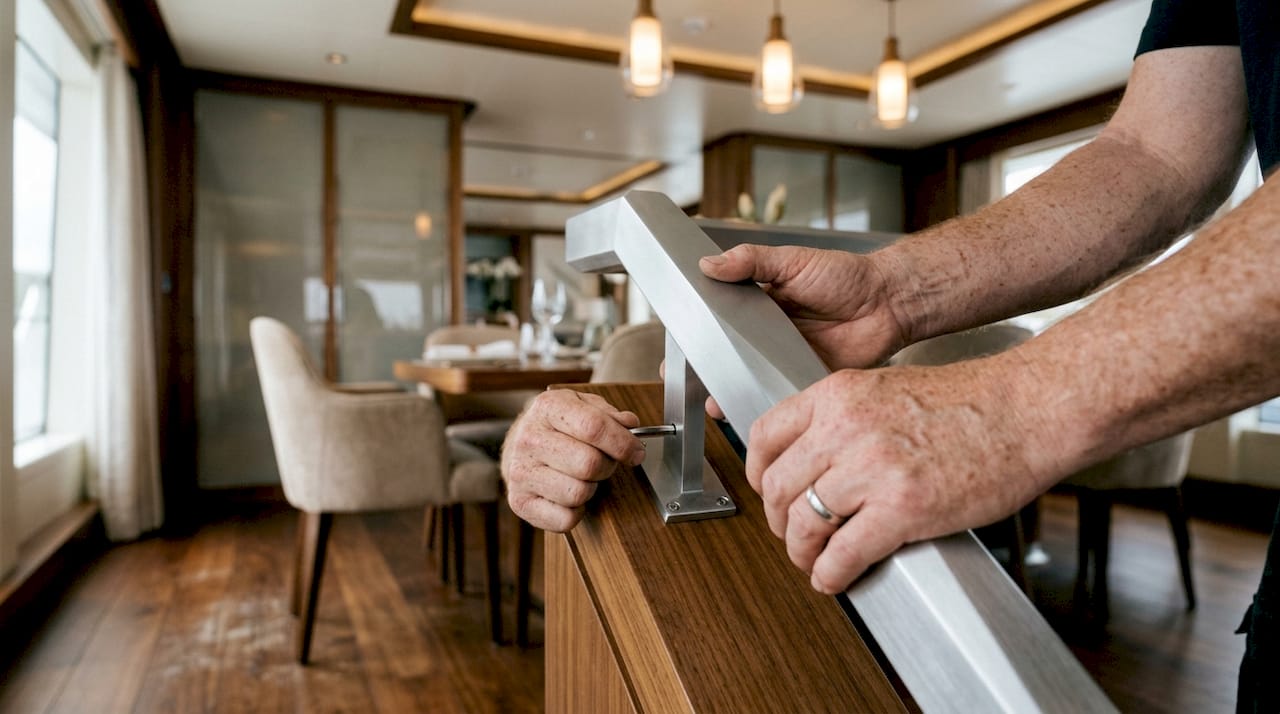
A mirror-polished handrail with a custom cross-section profile feels categorically different from a catalog tube rail. A flush pull ring machined to exact tolerances and finished in brushed satin communicates craftsmanship before a guest has even stepped below deck. These details build trust and deepen the owner’s connection to the vessel in ways that are hard to quantify but impossible to ignore.
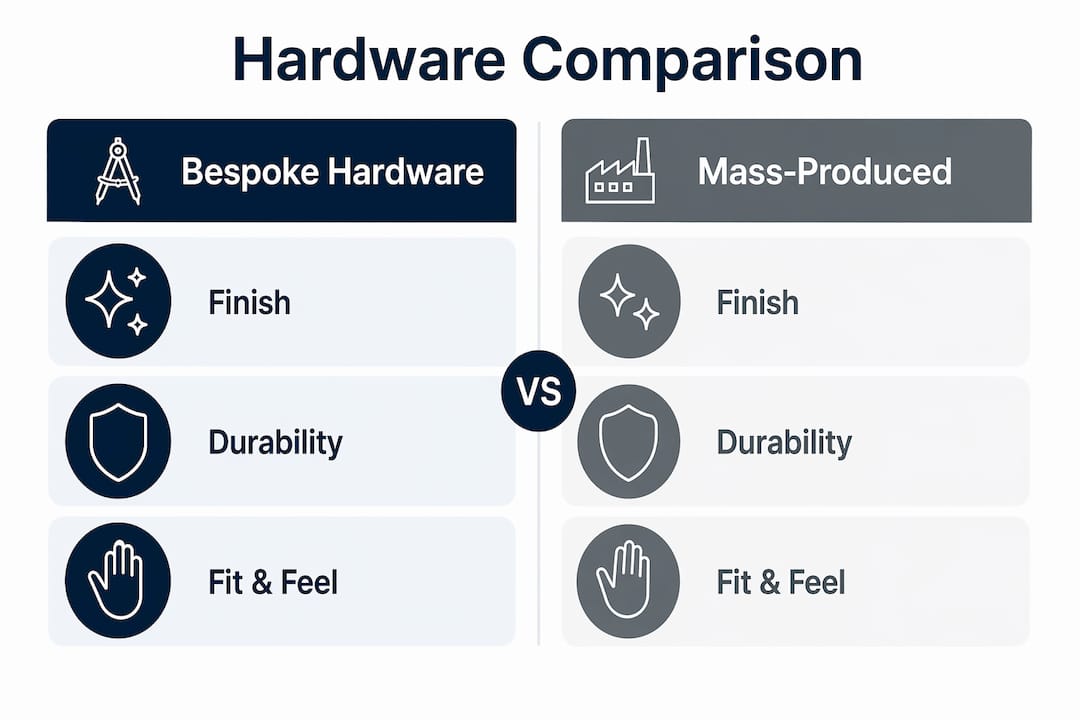
| Feature | Bespoke hardware | Mass-produced fittings |
|---|---|---|
| Surface finish | Mirror-polished or custom brushed to spec | Standard mill finish, variable quality |
| Geometry | Designed to vessel’s exact dimensions | Generic sizing, requires adaptation |
| Material grade | 316/316L stainless, verified by certificate | Mixed grades, often unverified |
| Visual identity | Unique to the build, reinforces brand | Identical to thousands of other vessels |
| Tactile quality | Weighted, precise, intentional feel | Functional but undifferentiated |
Physical hardware differentiation creates user experience value that software cannot replicate in luxury yachts. This is the core argument for investing in bespoke fittings on any build where the owner’s experience matters. And on a luxury yacht, it always matters.
Pro Tip: Specify hardware finishes in a sample library before production begins. A physical sample board showing mirror polish, brushed satin, and powder coat options alongside hull color swatches prevents costly finish mismatches that are expensive to correct after fabrication.
How do modular design and standardization balance cost with uniqueness?
Modular design is not the opposite of customization. It is the tool that makes customization financially viable at scale. The most sophisticated yacht builders today combine standardized core engineering components with bespoke interfaces, achieving the visual and functional uniqueness owners demand without the cost and lead-time penalties of fabricating every part from scratch.
The results of this approach are measurable. Akerboom reduced locking pin variants from 32 to just 2 sizes through systematic standardization. That reduction cuts inventory costs, simplifies maintenance, and reduces the risk of sourcing failures mid-build. The external appearance of the equipment remains fully bespoke. The internal engineering is rationalized.
A practical modular strategy for custom yacht hardware follows this sequence:
- Identify the structural core. Determine which components carry load or perform critical functions. These are candidates for standardized engineering with custom external profiles.
- Define the bespoke interface. Specify the visible surfaces, finishes, and dimensions that must be unique to the build. These are fabricated to order.
- Map the supply chain. Identify which elements can be sourced from verified casting specialists and which require in-house fabrication or dedicated tooling.
- Document the standard. Create a hardware specification document that locks in material grades, tolerances, and finish standards for the entire build. This document protects quality across subcontractors.
- Plan for maintenance access. Modular components should be designed for replacement without structural disassembly. This decision at the design stage saves significant labor costs during the vessel’s operational life.
Working with suppliers who understand both the bespoke and the modular sides of this equation is critical. Bespoke yacht building requires partners who can hold tolerances on custom profiles while also supplying standardized sub-components on predictable lead times. The two capabilities are not always found in the same supplier, which is why early-stage supply chain mapping matters as much as the design itself.
What are the best material and sourcing practices for custom yacht hardware?
Material selection is the foundation of every custom hardware decision. Grade 316 and 316L stainless steel are the industry standard for visible and structural marine fittings. The investment casting process using silica sol technology produces mirror-polished, load-bearing components with the dimensional accuracy and surface quality that high-end yacht fittings demand. This process yields fewer internal voids than sand casting, which translates directly to better fatigue resistance under cyclic loading.
| Material | Key properties | Typical applications |
|---|---|---|
| 316L stainless steel | High chloride resistance, weldable, certifiable | Handrails, cleats, pulpits, radar arches |
| 304 stainless steel | Good general corrosion resistance, lower cost | Interior fittings, low-exposure components |
| Epoxy-saturated fiberglass | Non-conductive, corrosion-free, load-distributing | Backing plates, structural hardware mounts |
| Powder-coated aluminum | Lightweight, good UV resistance | Deck furniture frames, non-structural covers |
Epoxy-saturated fiberglass laminates serve as backing plates for through-deck hardware, preventing galvanic corrosion that occurs when dissimilar metals contact each other through a hull or deck panel. This technique is more cost-effective than stainless backing plates and distributes load more evenly across the laminate. It is a detail that experienced builders specify without hesitation and that inexperienced builders often overlook until a fitting pulls through a deck.
Supply chain management for custom hardware carries its own set of risks. Developing custom marine products requires balancing speed to market, intellectual property protection, and supply chain resilience simultaneously. Partnerships with verified casting and machining specialists reduce these risks and improve component quality. Sharing tooling designs with unverified suppliers creates IP exposure that can compromise a builder’s competitive position on future projects.
Pro Tip: Always retain ownership of tooling and mold designs in your contracts with casting suppliers. Tooling ownership is the single most effective way to protect proprietary hardware profiles and maintain supply chain control if a supplier relationship changes.
During yacht refits, reusing existing wiring infrastructure like Crestron Cresnet avoids costly rewiring labor while allowing hardware upgrades to modernize control systems. The same logic applies to hardware mounting structures. Where existing backing plates and through-hull reinforcements are sound, building new hardware to fit the existing structure saves significant time and cost without compromising quality.
Key Takeaways
Custom hardware is the single most consequential specification decision in a luxury yacht build, determining durability, performance, and owner experience across the vessel’s entire service life.
| Point | Details |
|---|---|
| Material grade determines longevity | Specify 316L stainless steel with mill certificates for all structural and deck hardware. |
| Modular design reduces cost without sacrificing uniqueness | Standardize internal engineering components while keeping external profiles fully bespoke. |
| Tactile quality differentiates luxury builds | Mirror-polished, precisely fitted hardware creates owner trust that no interior styling can replicate. |
| Fiberglass backing plates prevent galvanic failure | Use epoxy-saturated laminates under through-deck fittings to distribute load and block corrosion. |
| Supply chain control protects IP and quality | Retain tooling ownership in all casting supplier contracts to secure proprietary hardware designs. |
What I’ve learned after years of watching hardware decisions make or break builds
The most expensive mistake I see in custom yacht builds is treating hardware as a late-stage decision. Builders finalize hull forms, interior layouts, and propulsion systems with great care, then scramble to specify fittings in the final months before launch. That sequence produces compromises. A pulpit designed after the bow geometry is fixed rarely achieves the visual integration that a pulpit specified alongside the bow does.
The Morrama observation about hardware being “the new moat” resonates with me because I have watched it play out on real projects. Two yachts of similar size and specification sit at a dock. One has catalog hardware. The other has bespoke fittings designed to the vessel. Guests who cannot name a single technical specification will gravitate toward the second yacht and describe it as feeling more substantial, more considered, more worth the price. That perception is not accidental. It is engineered.
The modular approach pioneered by builders like Akerboom is the right direction for the industry. Reducing 32 locking pin variants to 2 is not a compromise. It is discipline. The best custom hardware programs I have seen combine that kind of internal standardization with genuine bespoke craftsmanship at every surface the owner touches. The result is a vessel that is both economical to maintain and genuinely irreplaceable in character.
My advice to any owner or builder entering a new project: bring your hardware specialist into the design conversation at the same time you bring in your naval architect. The knock-on effects of hardware decisions on structural clearances, deck drainage, and system routing are significant. Catching them early costs nothing. Correcting them late costs everything.
— Jason
How Baranofyachts approaches custom hardware in your build
At Baranofyachts, we integrate hardware specification into the earliest stages of every custom build project. We treat fittings, materials, and finishes as design decisions, not procurement afterthoughts.

Our project management approach, built on timing, technique, and trust, coordinates hardware suppliers, casting specialists, and design teams so that every component arrives on spec and on schedule. We work with owners and builders to configure your ideal yacht from the keel up, with hardware choices that reflect both the vessel’s character and the owner’s expectations for long-term performance. If you are planning a new build or a significant refit, our team is ready to guide you through every material and specification decision with the same care we bring to the full project.
FAQ
What is custom yacht hardware?
Custom yacht hardware refers to bespoke marine-grade components, such as pulpits, handrails, cleats, and radar arches, engineered specifically for a single vessel’s structural and aesthetic requirements. These components differ from off-the-shelf fittings in material grade, geometry, finish, and load certification.
Why does marine-grade hardware matter on a yacht?
Marine environments combine high salinity, humidity, and galvanic corrosion risks that destroy standard hardware quickly. ABYC E-11 certified, marine-grade components built from 316L stainless steel resist these conditions and maintain structural integrity over the vessel’s full service life.
How much does custom yacht hardware cost?
Custom-fabricated marine hardware ranges from $450 to $3,500 per piece depending on design complexity, material grade, and finish. That range covers everything from simple cleats to complex structural arches with mirror-polished surfaces.
What is modular design in yacht hardware?
Modular design standardizes internal engineering components, such as locking pins and mounting interfaces, while keeping external profiles fully bespoke. Akerboom reduced locking pin variants from 32 to 2 through this approach, cutting costs and maintenance complexity without changing the vessel’s custom appearance.
How do I protect my custom hardware designs from supply chain risks?
Retain ownership of all tooling and mold designs in your supplier contracts. Partnering with verified casting and machining specialists and maintaining tooling control protects your intellectual property and keeps your supply chain resilient if supplier relationships change.
Recommended
Sold Listings


Design Your Yacht
"*" indicates required fields
Maximus III - PNW
As you step aboard MAXIMUS III, the first impression is her scale.
At 120 feet with an 8-meter beam and 294 GT of interior volume, this 2025 Crescent Custom tri-deck immediately feels open, balanced, and estate-like. A timeless look while still feeling fresh from the shipyard.
Currently Available


Get your yacht value Estimate
"*" indicates required fields