
Imagine standing at the dock, the contract in hand, the vessel of your dreams gleaming under the afternoon sun. You’ve just closed a multi-million-dollar deal. The feeling is extraordinary. But a quiet question surfaces almost immediately: did you pay too much? For buyers entering the luxury yacht market, that question is more than unsettling. It’s a signal that negotiation skill matters as much as financial capacity. This guide walks you through every stage of yacht price negotiation, from reading the market to leveraging inspection findings, so you arrive at closing with confidence and the smartest possible deal.
Table of Contents
- Understanding the yacht market landscape
- Preparing your negotiation: Research and strategy
- Mastering the negotiation process
- Leveraging inspection and sea trial findings
- Bundling non-price terms for a better deal
- Our perspective: The negotiation mindset most buyers underestimate
- Work with a team that knows every layer of the deal
- Frequently asked questions
Key Takeaways
| Point | Details |
|---|---|
| Know the market | Understanding yacht pricing trends and inventory strengthens your negotiation position. |
| Strategic offers work | Anchoring below asking and timing counteroffers can yield significant savings. |
| Leverage inspections | Use survey and sea trial findings as valid reasons to renegotiate terms before closing. |
| Bundle for value | Negotiating non-price benefits like repairs or upgrades adds long-term value beyond the sale price. |
Understanding the yacht market landscape
Before you make a single offer, you need to understand how luxury yacht pricing actually works. The market is not like real estate or fine art, where comps are easy to find and pricing is relatively transparent. Yacht valuations are layered and nuanced, shaped by a combination of factors that interact in ways that aren’t always obvious.
As industry experts note, yacht prices are influenced by brand, condition, size, year, and market demand. A 2018 model from a premier European builder in pristine condition will command a vastly different price than a comparable vessel from a lesser-known yard, even if the specs look identical on paper. Brand heritage, builder reputation, and documented service history all carry significant weight.
Seasonal timing also plays a measurable role. Sellers listing in late fall or winter often face softer demand, which creates natural leverage for buyers. Conversely, spring listings ahead of the boating season attract more competition. Inventory levels in 2025 and 2026 have shifted following post-pandemic demand surges, meaning more pre-owned vessels are now available, which tilts negotiating power slightly toward buyers.
Here is a quick snapshot of the core factors that shape asking prices:
| Factor | Impact on price |
|---|---|
| Builder brand and reputation | High |
| Vessel age and model year | High |
| Condition and maintenance record | High |
| Current inventory levels | Medium |
| Seasonal listing timing | Medium |
| Geographic market (US vs. EU) | Medium |
Key takeaways for buyers entering the market:
- High asking prices are almost never final, especially on listings that have been active for 60 or more days
- Sellers frequently build a negotiation cushion of 8 to 15 percent into their asking price
- A yacht price case study can reveal how real-world transactions differ from listed values
- Engaging experienced project management for yacht buyers early in the process helps you interpret market signals correctly
Understanding these dynamics is the foundation upon which every smart negotiation is built.
Preparing your negotiation: Research and strategy
With an understanding of market forces, the next step is to prepare your own negotiation edge. Preparation is where deals are won or lost, long before any offer is formally presented.
Start by gathering the right intelligence. You want to know recent sale prices for comparable vessels, how long the current listing has been active, and any visible signs of seller motivation such as price reductions, estate sales, or corporate fleet liquidations. This data gives you a realistic anchor for your opening offer.
Speaking of anchors, a 5 to 15 percent below-asking opening offer is widely recognized as an effective starting point. It signals seriousness without insulting the seller, and it creates room for a productive counter-negotiation. Going in too low risks poisoning the relationship; going in at asking price leaves money on the table.

Here is how two common approaches compare:
| Approach | Opening offer | Likely outcome |
|---|---|---|
| Uninformed buyer | At or near asking | Minimal discount, weak position |
| Prepared buyer | 5 to 15% below asking | Opens productive negotiation |
Pro Tip: Before any offer, review pre-purchase research to understand what specifications and features actually justify premium pricing versus what is purely cosmetic.
A structured preparation process looks like this:
- Compile recent comparable sales data from broker databases and auction records
- Document the listing’s days-on-market and any prior price reductions
- Identify the seller’s likely motivation and timeline
- Define your own priorities clearly: is price, delivery timing, or included equipment most important to you?
- Engage a qualified buyer’s representative or broker with direct market experience
Working with a skilled broker is not a luxury here. It is a strategic asset. An experienced advisor brings expert negotiation tips and market relationships that can surface concessions you would never uncover independently. Think of them as the conductor who keeps every instrument in the negotiation playing in harmony.
Mastering the negotiation process
Once your preparation is complete, it is time to engage in the actual negotiation, where tactics and composure matter most. The process follows a recognizable sequence, but knowing how to move through each stage with precision is what separates experienced buyers from those who simply pay what they are asked.
The typical negotiation sequence unfolds as follows:
- Submit your initial offer in writing, with a clear but reasonable rationale
- Receive and evaluate the seller’s counter-offer carefully
- Commission a marine survey and sea trial before any final agreement
- Use survey findings to request price adjustments or repairs
- Finalize all terms, including non-price elements, before signing
Timing matters throughout this process. Introducing non-price requests too early can complicate the initial price discussion. It is often more effective to secure a price agreement in principle first, then layer in equipment, warranty, or dockage requests as the deal firms up.
Pro Tip: Study learning from yacht survey results before your inspection so you know which findings carry real financial weight versus which are cosmetic.
As experienced maritime advisors consistently observe:
“Successful negotiations often include post-inspection adjustments based on survey and sea trial findings, making the inspection phase a critical negotiation tool, not just a technical formality.”
Critical mistakes to avoid during this phase include:
- Revealing your maximum budget or emotional attachment to the vessel
- Making multiple rapid concessions, which signals desperation
- Ignoring the value of walking away as a legitimate tactic
- Overlooking techniques for survey negotiation that experienced buyers use to quantify repair costs precisely
Composure is your most valuable asset at the table. Sellers and their brokers are skilled at reading urgency. Stay measured, stay informed, and let the process work.
Leveraging inspection and sea trial findings
With strong negotiation fundamentals in place, your next key leverage comes from the inspection and trial phase. This is where many buyers leave significant value behind, simply because they do not know how to translate technical findings into financial terms.
Marine surveys and sea trials routinely surface issues across several categories:
| Finding type | Typical cost range | Negotiation approach |
|---|---|---|
| Engine service overdue | $5,000 to $25,000 | Request price reduction or seller-paid service |
| Hull osmosis or blistering | $10,000 to $50,000+ | Deduct estimated repair cost from offer |
| Outdated safety equipment | $2,000 to $10,000 | Request replacement as deal condition |
| Electronics or navigation gaps | $5,000 to $30,000 | Bundle upgrade into purchase terms |
Key principles for using inspection findings effectively:
- Obtain written cost estimates from qualified marine contractors before presenting your requests
- Frame findings as factual cost items, not emotional complaints
- Prioritize your requests: ask for the most significant items first
- Post-inspection renegotiation is a standard and accepted part of the process, not an aggressive tactic
The impact of maintenance history on long-term vessel reliability is something we take seriously in every transaction we guide. A vessel with deferred maintenance is not just a negotiation opportunity. It is a risk profile that must be priced accurately. Presenting your findings with professional contractor estimates gives your requests credibility and makes them difficult for sellers to dismiss.
Timing your post-inspection requests promptly and professionally, within the contractually specified window, ensures you preserve your legal standing while keeping the deal moving forward.
Bundling non-price terms for a better deal
Beyond price alone, sophisticated negotiators maximize value through inventive term bundling. Price is just one dimension of a yacht purchase. The full deal includes a range of terms that can add or subtract tens of thousands of dollars in real value.
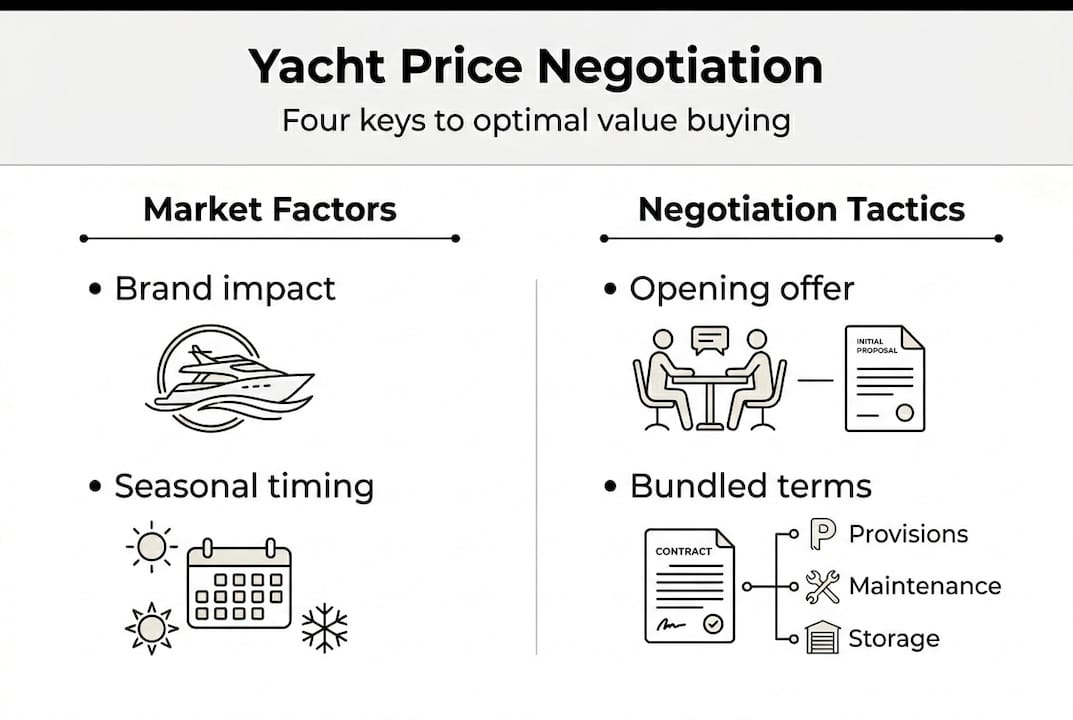
“Terms” in yacht buying refers to everything negotiable outside the headline price. Bundling non-price terms like repairs, warranties, or dockage is often as valuable as lowering the asking price, and it frequently meets less resistance from sellers who are anchored to their listed number.
Common non-price terms worth negotiating:
- Inclusion of new or recently serviced safety equipment (life rafts, EPIRBs, flares)
- Extended warranty coverage on engines and major mechanical systems
- Seller-paid dockage or storage for 3 to 12 months post-closing
- Registration and documentation fee coverage
- Commissioning services or delivery to your home port
- Crew training or familiarization time included in the sale
Pro Tip: Understanding maintenance terms in negotiation can help you identify which seller-offered upgrades genuinely reduce your first-year ownership costs versus which are low-cost gestures.
Bundling works because it reframes the negotiation from a zero-sum price battle into a value-creation exercise. When both parties feel they have gained something meaningful, deals close more smoothly and relationships remain positive. This matters in a small, relationship-driven industry where your reputation as a buyer follows you.
Before signing, run through this final checklist:
- All survey findings addressed in writing
- Non-price terms documented in the purchase agreement
- Clear closing timeline and contingency clauses confirmed
- Escrow and title transfer process verified with your legal advisor
Our perspective: The negotiation mindset most buyers underestimate
We have guided buyers through enough transactions to recognize a pattern that rarely gets discussed openly. Most affluent buyers focus intensely on the price number and almost completely overlook the structural terms of the deal. That is a costly blind spot.
The buyers who consistently achieve the best outcomes are not necessarily the most aggressive negotiators. They are the most prepared ones. They arrive with data, they engage qualified advisors, and they treat the inspection phase not as a formality but as a second negotiation embedded within the first. They also understand that walking away is not a failure. It is often the most powerful move available.
We also believe that the negotiation does not end at closing. How you structure the terms of a deal shapes your first two years of ownership in ways that pure price savings rarely match. A seller who covers 12 months of dockage and pre-pays an engine service has effectively delivered $30,000 to $50,000 in real value, often without moving their asking price at all. That is the kind of outcome that only comes from thinking beyond the headline number.
The luxury yacht market rewards patience, precision, and professional guidance. Rushing to close because you are emotionally attached to a vessel is the single most expensive mistake a buyer can make. We have seen it cost clients far more than any negotiation tactic could recover.
Work with a team that knows every layer of the deal
Navigating a luxury yacht purchase requires more than financial confidence. It requires market intelligence, technical knowledge, and the kind of experience that only comes from years of guiding transactions from first inquiry to final delivery.

At Baranof Yacht Sales, we bring all of that to every client engagement. Whether you are evaluating a pre-owned vessel, considering a custom build, or simply trying to understand what a fair price looks like in today’s market, our team is here to provide clear, expert guidance at every step. We do not just help you buy a yacht. We help you buy the right yacht, at the right price, with the right terms. Reach out to us today to start a conversation about your next acquisition.
Frequently asked questions
What is a reasonable first offer when negotiating a yacht price?
Anchoring your offer 5 to 15 percent below the asking price is widely recognized as a sound opening strategy that signals seriousness while preserving room for productive counter-negotiation.
Can I renegotiate yacht price after an inspection?
Yes, post-inspection renegotiation is a standard and accepted practice. Survey and sea trial findings give you documented, cost-based grounds to request price reductions or seller-paid repairs before closing.
What non-price terms are common in yacht negotiations?
Buyers regularly negotiate for repairs, extended warranties, dockage, upgraded safety equipment, commissioning services, and registration fee coverage, all of which can add substantial real value to the final deal.
Should I use a broker to negotiate a yacht price?
A yacht broker with deep market knowledge can guide the negotiation, protect your interests, and surface concessions and market intelligence that most buyers would never uncover independently.
Recommended
Sold Listings


Design Your Yacht
"*" indicates required fields
Maximus III - PNW
As you step aboard MAXIMUS III, the first impression is her scale.
At 120 feet with an 8-meter beam and 294 GT of interior volume, this 2025 Crescent Custom tri-deck immediately feels open, balanced, and estate-like. A timeless look while still feeling fresh from the shipyard.
Currently Available


Get your yacht value Estimate
"*" indicates required fields