

Ergonomic design in yachts is defined as the deliberate alignment of a vessel’s interior spaces, controls, and furnishings to match the natural mechanics and movement patterns of the human body. Understanding ergonomic design in yachts goes far beyond comfort preferences. It directly shapes safety outcomes, crew performance, and the long-term usability of any vessel. Standards like MLC 2006 and GOST R 72382-2025 set measurable benchmarks for headroom, furniture stability, and habitability that every serious yacht build must meet. When these principles are applied with care, the result is a vessel where movement feels natural, fatigue stays low, and the risk of operator error drops significantly.
What ergonomic principles govern yacht interior design?
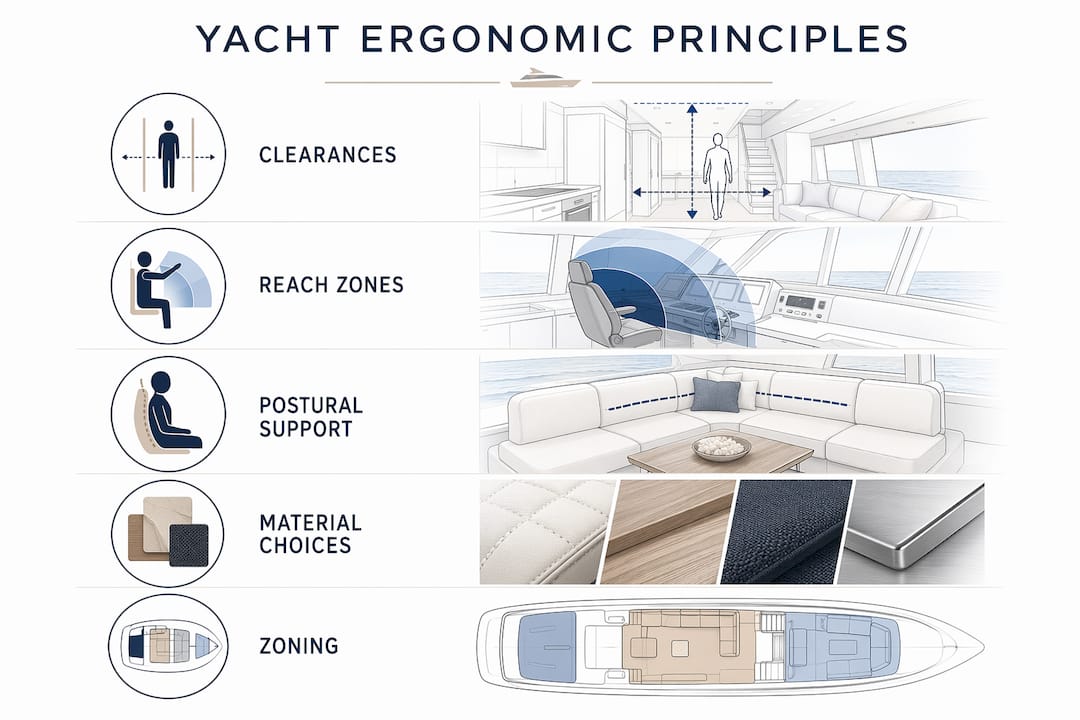
The foundation of yacht ergonomics rests on four measurable principles: clearances, reach zones, postural support, and interface accessibility. Each one addresses a specific way the human body interacts with a confined, moving space.
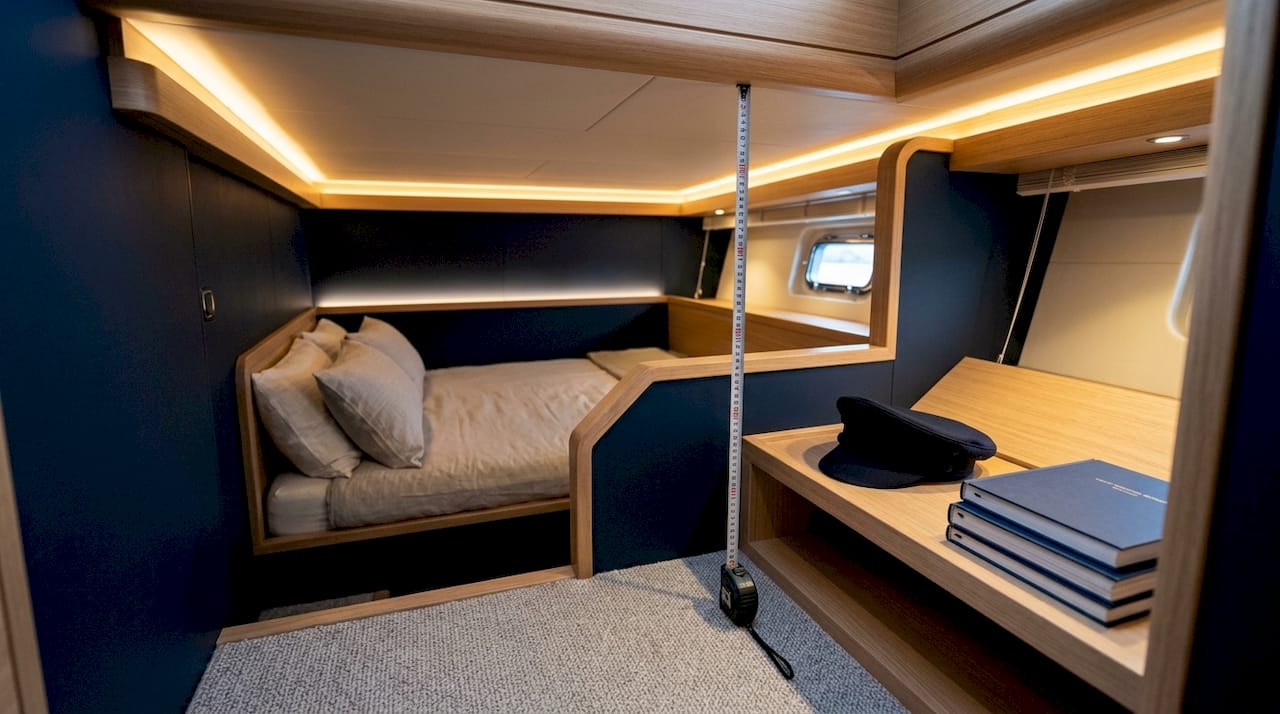
Clearance standards set the baseline. Minimum headroom of 2.03 meters in accommodation spaces is required under MLC 2006 and GOST R 72382-2025, calculated from the 97th percentile male stature with safety gear included. That number is not arbitrary. It reflects the physical reality of tall crew members moving through a pitching vessel without striking overhead structures.
Reach zones define where controls, storage, and equipment must be placed so that a person can access them without twisting, overreaching, or losing balance. On a yacht, this is more demanding than in any fixed building because the floor itself moves. Designers work within a horizontal reach envelope of roughly 600–750 millimeters from a seated or standing position, placing critical controls within that band.
Postural support and seating ergonomics matter most in operational areas like the helm station and navigation desk, where crew spend extended hours. Chairs and seat bases must accommodate lumbar support, thigh clearance, and foot placement simultaneously. Poor seating at the helm is a direct contributor to fatigue-driven errors.
The table below summarizes key space and comfort standards that govern yacht interior ergonomics:
| Design Element | Standard or Benchmark | Practical Implication |
|---|---|---|
| Minimum headroom | 2.03 m (MLC 2006, GOST R 72382-2025) | Prevents injury and allows safe movement with gear |
| Horizontal reach zone | 600–750 mm from operator | Keeps critical controls accessible without overreaching |
| Furniture fastening | Vibration-resistant per GOST R 72382-2025 | Prevents movement and injury during roll and pitch |
| Privacy zoning | Separated crew and guest circulation | Reduces conflict and supports crew habitability |
| Noise and vibration limits | Measurable habitability metrics (ABS) | Directly linked to crew performance and retention |
Ergonomic zoning also shapes how spaces are divided. Separating crew circulation from guest areas is not just a luxury preference. It is a habitability requirement that reduces conflict, supports privacy, and allows service to happen without disrupting the guest experience.
How do yacht designers address the unique physical challenges of a moving vessel?
A yacht is not a building. It flexes, vibrates, heels, and pitches continuously, and every interior element must be engineered to absorb that motion without failing or creating noise. This is the constraint that separates marine ergonomics from residential design entirely.
Hull flex and vibration require expansion joints and vibration-dampening mounts throughout the interior joinery. Without them, panels creak, joints open, and cabinetry degrades within a few seasons. Designers treat the interior as a structure within a structure, one that must move independently of the hull to some degree while remaining visually and functionally stable.
The ergonomic adaptations required by vessel motion include:
- Expansion joints built into all fixed joinery to absorb hull flex without cracking or binding
- Vibration-dampening mounts under mechanical equipment and furniture bases to reduce transmitted noise and fatigue
- Heel angle compensation in galley and workstation layouts, so surfaces remain usable at angles up to 15–20 degrees
- Grab rails and handhold positioning calculated for natural reach during movement through the vessel
- Weight distribution planning that places heavy items low and centered to preserve stability and reduce roll amplitude
Material choices carry significant ergonomic weight. Heavier decorative materials like stone countertops or solid hardwood panels raise the center of gravity and worsen stability on sailing yachts. Lightweight composites and engineered veneers deliver the same visual quality at a fraction of the mass, keeping the vessel responsive and comfortable underway.
Yacht interior designers work within millimeter tolerances, arranging subsystems under constraints of vibration, motion, and regulatory compliance simultaneously. The best practitioners use minimalist built-in joinery and concealed systems to maximize usable space while eliminating the loose elements that rattle and shift at sea.
Pro Tip: When reviewing a yacht’s interior specification, ask specifically about expansion joint placement and vibration-dampening mount specifications. These details rarely appear in marketing materials but are the clearest indicators of whether the build will hold up and stay quiet over years of use.
What impact does ergonomic design have on safety and crew performance?
The safety case for ergonomic design is not theoretical. 75–85% of maritime incidents involve human factors and ergonomic design flaws. That figure covers everything from helm station layout errors to poorly placed emergency equipment that crew cannot reach under stress.
Poor ergonomics increases operator error rates by 40–65% through fatigue, cognitive overload, and interface problems. The mechanism is straightforward. When a crew member must strain to read a display, reach across their body to operate a control, or work in a space with excessive noise and vibration, their decision-making degrades. Over a long watch, those degraded decisions accumulate into incidents.
“Facility design is the most powerful tool to enhance human performance and reduce error.” — Dr. Kevin McSweeney, ABS
Well-designed ergonomics and digitalization improve situational awareness and procedural compliance by 35–50%, strengthening safety management system effectiveness onboard. That improvement comes from placing the right information in the right place at the right time, reducing the cognitive load on crew during high-pressure situations.
The data below summarizes the measurable relationship between ergonomic design and onboard safety:
| Metric | Finding | Source |
|---|---|---|
| Maritime incidents linked to human factors | 75–85% | IJGAM ergonomics and digitalization research |
| Operator error increase from poor ergonomics | 40–65% | IJGAM ergonomics and digitalization research |
| Improvement in SMS compliance from good ergonomics | 35–50% | IJGAM ergonomics and digitalization research |
| Habitability factors affecting crew performance | Noise, vibration, lighting, comfort | ABS human factors research |
Crew accommodation design also affects recruitment and retention. Habitability merges measurable physical qualities with comfort, and crew who work in well-designed spaces perform better and stay longer. For yacht owners, this translates directly into operational reliability and reduced turnover costs.
How do ergonomic yacht interiors enhance guest comfort on board?
The highest compliment an ergonomic yacht interior can receive is that guests never notice it. When layout, lighting, and furniture placement are executed well, the architecture disappears. Guests move through the vessel naturally, find what they need without searching, and rest without discomfort. That invisibility is the goal.
Properly designed yacht layouts achieve this by creating smooth circulation paths, protected privacy zones, and hidden service routes that keep crew movement separate from guest experience. The galley connects to dining areas through concealed passages. Crew quarters sit away from guest cabins. Storage integrates into structural elements so that surfaces stay clear and spaces feel open.
Key design strategies that deliver this level of comfort include:
- Layout flow analysis that maps how guests and crew move through the vessel at anchor and underway
- Privacy zone separation between owner, guest, and crew areas using structural and acoustic barriers
- Integrated furniture design where seating, storage, and surfaces share structural elements to save space and reduce weight
- Lighting layering that uses ambient, task, and accent sources to enhance spatial perception and reduce eye strain
- Material selection that balances visual warmth with low weight, using yacht building materials like engineered composites, marine-grade fabrics, and acoustic panels
Lighting deserves particular attention. Poorly lit spaces feel smaller and create visual fatigue on long passages. Layered lighting systems that shift from bright task lighting in the galley to warm ambient tones in the saloon make the interior feel larger and more comfortable without adding any physical space.
Pro Tip: When evaluating a yacht’s interior for comfort, walk through it at anchor and then again underway. Many ergonomic flaws only appear when the vessel is moving. Doors that swing freely at dock become hazards underway. Surfaces that feel stable at anchor vibrate noticeably at speed.
Why ergonomic design is the detail that changes everything
The most common oversight I see in yacht purchases and custom builds is treating ergonomics as a finishing detail rather than a structural discipline. Owners spend months selecting fabrics and finishes, then accept a helm station layout that was never designed for their height or a galley that becomes unusable in any sea state above flat calm.
Ergonomic design is not decoration. It is the underlying logic that determines whether a yacht works for the people aboard it. A vessel with beautiful materials and poor clearances will frustrate every crew member who works in it. A vessel with thoughtful reach zones, proper headroom, and vibration-managed joinery will feel effortless after years of use.
The long-term usability of a yacht depends on decisions made at the design stage, not the finishing stage. Owners who prioritize human-centered design choices from the first brief get vessels that hold their value, retain crew, and deliver genuine pleasure on the water. Those who treat ergonomics as optional often find themselves retrofitting solutions that should have been built in from the start.
My strongest recommendation is to engage with ergonomic standards like MLC 2006 and GOST R 72382-2025 early in any build or refit conversation. They are not bureaucratic hurdles. They are the accumulated knowledge of what actually works for human beings living and working at sea.
— Jason
How Baranofyachts builds ergonomic principles into every vessel
At Baranofyachts, we treat ergonomic design as a foundational commitment, not an optional upgrade. Every build we manage incorporates MLC 2006 headroom standards, vibration-dampening specifications, and human-centered layout planning from the first design brief through final delivery.

Our bespoke design services address reach zones, postural support, material weight distribution, and privacy zoning as core deliverables, not afterthoughts. We work with clients to translate their lifestyle preferences into spaces that function as well as they look. If you want to understand what next-generation yacht design looks like when ergonomics and aesthetics are treated as one discipline, we are ready to show you. Reach out to our team to begin a conversation about your vessel.
Key takeaways
Ergonomic design is the single most important structural discipline in yacht building, directly determining safety outcomes, crew performance, and long-term owner satisfaction.
| Point | Details |
|---|---|
| Safety is measurable | 75–85% of maritime incidents link to human factors, making ergonomics a safety-critical discipline. |
| Standards set the baseline | MLC 2006 and GOST R 72382-2025 define minimum headroom, furniture fastening, and habitability requirements. |
| Motion changes everything | Hull flex and vibration require expansion joints and dampening mounts that residential design never needs. |
| Invisible design is the goal | Well-executed ergonomics makes the yacht feel natural and effortless, with layout and service paths disappearing from awareness. |
| Material choices carry weight | Lightweight composites preserve stability and comfort; heavy decorative materials compromise sailing performance. |
FAQ
What is ergonomic design in a yacht?
Ergonomic design in a yacht is the alignment of interior spaces, controls, and furnishings to match natural human movement and body mechanics. The goal is to reduce fatigue, prevent injury, and make the vessel intuitive to use for both crew and guests.
What headroom standard applies to yacht crew accommodation?
MLC 2006 and GOST R 72382-2025 both require a minimum clear headroom of 2.03 meters in crew accommodation spaces. This measurement is based on the 97th percentile male stature with safety gear included.
How does poor ergonomic design affect crew safety?
Poor ergonomic design increases operator error rates by 40–65% through fatigue, cognitive overload, and poor interface placement. Research links 75–85% of maritime incidents to human factors and ergonomic flaws.
Why do yacht interiors require different design approaches than residential spaces?
Yacht interiors must absorb continuous hull flex, vibration, and heel angles that no residential building experiences. This requires expansion joints and vibration-dampening mounts throughout the joinery, plus material choices that keep weight low and the vessel stable.
How does ergonomic layout improve the guest experience on a yacht?
A well-planned layout creates smooth circulation, protected privacy zones, and hidden service routes that make the vessel feel natural and uncluttered. When ergonomics is executed correctly, guests move through the space without friction and never notice the design constraints working in the background.
Recommended
Sold Listings


Design Your Yacht
"*" indicates required fields
Maximus III - PNW
As you step aboard MAXIMUS III, the first impression is her scale.
At 120 feet with an 8-meter beam and 294 GT of interior volume, this 2025 Crescent Custom tri-deck immediately feels open, balanced, and estate-like. A timeless look while still feeling fresh from the shipyard.
Currently Available


Get your yacht value Estimate
"*" indicates required fields