
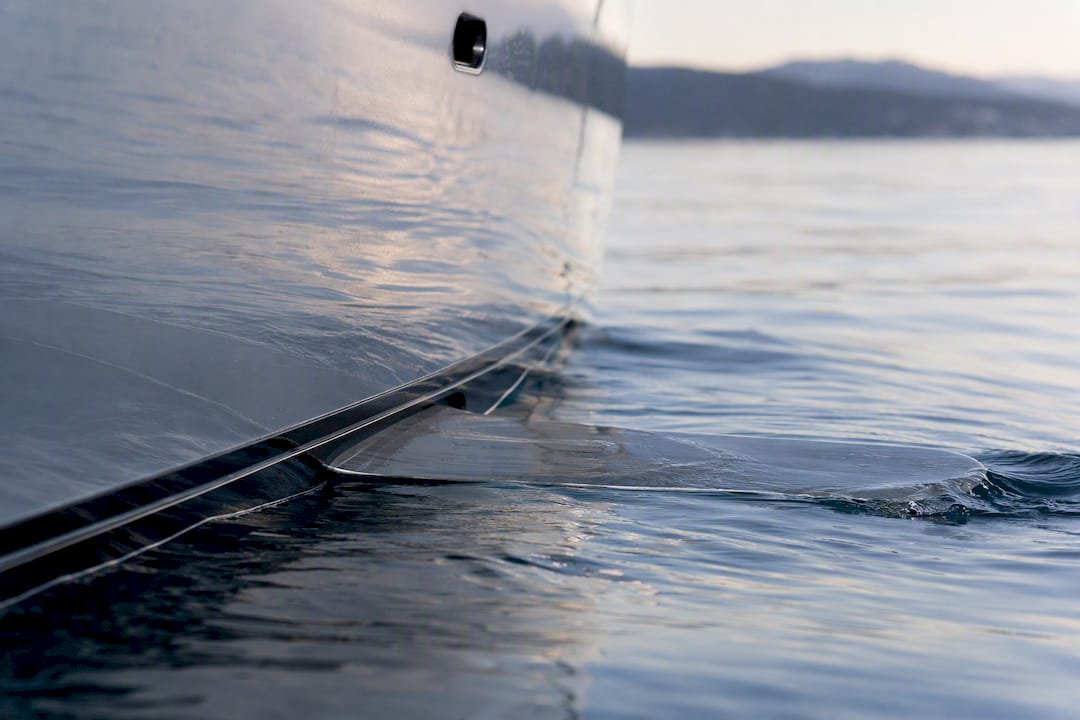
Zero speed stabilizers reduce roll when a yacht is stationary or moving below roughly 4 knots, restoring a level, comfortable anchorage that underway-only systems cannot deliver. The primary benefit is livability: fewer sleepless nights on the hook, fewer seasick guests, and a boat that feels settled rather than pitching in a beam swell. The main technologies are oscillating fins with zero-speed modes, gyroscopic flywheels, Magnus-effect rotors, and stabilizing wings, each with different space, power, and cost demands.
TL;DR:
- Achieving high roll reduction, such as 88.4%, depends heavily on hull-specific engineering and cannot be guaranteed with generic bolt-on kits.
- Retrofitting stabilizers often requires structural reinforcement and careful planning, especially with gyro systems that need dedicated compartments.
- System choice should prioritize vessel size, use pattern, noise tolerance, and available power, rather than brand reputation alone.
- Both fins and gyros draw power continuously, impacting fuel and generator runtime, which should be considered in overall operational planning.
- Proper installation and structural assessment are more critical for performance than manufacturer claims or marketing figures.
Table of Contents
- How Zero Speed Stabilizers Work: Fins, Gyros, Rotors, and Wings
- What Roll Reduction Can You Realistically Expect at Anchor?
- Retrofitting vs New-Build: What Actually Drives Cost and Timeline
- How to Choose the Right Zero Speed Stabilizer for Your Yacht
- Power Draw, Maintenance, and What Ownership Actually Costs Over Time
- Do Zero Speed Stabilizers Work With Your Existing Helm Systems?
- Classification Society Standards and Regulatory Considerations
- Energy Efficiency and Environmental Trade-Offs Worth Knowing
- Real Retrofit Cases That Show What to Expect
- How Baranof Yachts Manages Stabilizer Projects
- Next Steps: Who Should Move on This Now
- The Honest Take on Zero Speed Stabilizer Claims
- Sources
How Zero Speed Stabilizers Work: Fins, Gyros, Rotors, and Wings
Each technology solves the same problem, generating a counteracting force against roll, through fundamentally different mechanics.
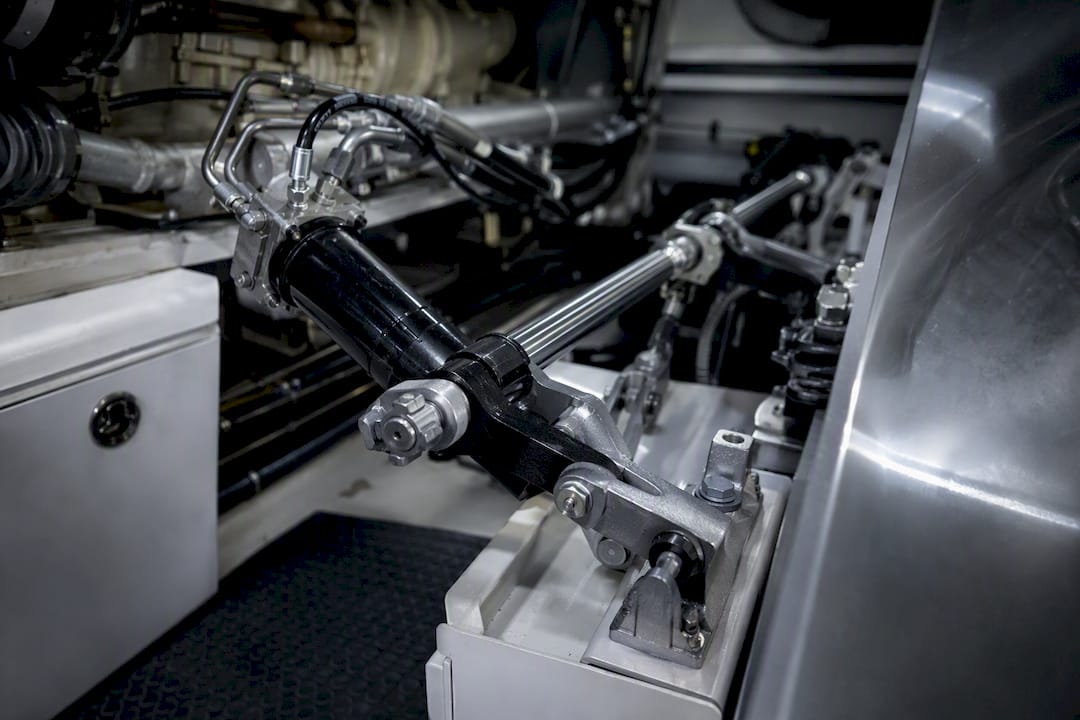
Oscillating fins, the most widely fitted solution, flip rapidly back and forth on their shafts rather than relying on forward motion to create lift. That distinction matters: a fin designed for underway stabilization is a wing shape that needs water flowing across it, while a zero-speed fin actively beats through still water like an oar, pushing volume to generate an opposing moment. Quantum Marine and similar manufacturers have pushed this further with high-aspect “XT” style blades that increase surface area by roughly 30% and lift by up to 100% without enlarging the hull penetration, a meaningful advantage when clearance around shafts or running gear is tight.
Gyroscopic stabilizers work on an entirely different principle. A flywheel spins at high RPM inside a sealed enclosure, and when the boat starts to roll, a control system applies precession torque against that motion. Gyros are effective at anchor but demand a reinforced foundation, dedicated mounting bearers, and reliable continuous power, since the flywheel never fully stops between uses.
Rotary or Magnus-effect devices spin a cylinder to create lift from differential pressure, a less common but proven approach on smaller and mid-size hulls. Wings, sometimes called Dyna-foil hybrids, extend from the hull and can retract when not needed.
A few comparative notes worth knowing upfront:
- Fins generally need less internal volume but more hull penetration and external appendage.
- Gyros need more internal space and structural reinforcement but no hull penetration at all.
- Rotors sit between the two, favoring narrower or shallower-draft hulls.
What Roll Reduction Can You Realistically Expect at Anchor?
Roll reduction of 88.4% was measured in a documented sea trial after Sleipner Group retrofitted a Vector fin system on a Sunseeker Manhattan 60, based on a 20-minute before-and-after comparison. That kind of number tends to grab attention, and rightly so, but it came from an engineered installation tailored to that specific hull, not a generic bolt-on kit.
Several variables shift the outcome in either direction:
- Hull form and beam-to-length ratio change natural roll period and how much force is needed to counter it.
- Vessel displacement affects how large the stabilizer must be sized relative to available power.
- Swell direction relative to the anchorage matters enormously; a beam sea taxes any system harder than a bow-on or quartering sea.
Owner reports collected by Humphree on its zero-speed electric fin systems describe noticeably calmer behavior in challenging anchorages, which lines up with what installers see across brands. When evaluating a sea trial, ask for measured roll angle data logged before and after activation, not a subjective “it felt better” account. On larger yachts that cruise extensively and anchor for extended stays, combining underway fins with an at-anchor gyro is common, since each technology covers a different operating envelope rather than one system trying to do both jobs well.
Retrofitting vs New-Build: What Actually Drives Cost and Timeline
Adding stabilizers to an existing yacht is rarely a weekend job, and the reason comes down to structure. Most hulls were not built with a stabilizer’s loads in mind, so retrofits often require reinforced bearers, additional stringers, or relocated tankage to handle the dynamic forces a spinning gyro or an oscillating fin puts into the hull. A documented Seakeeper 18 retrofit on a Princess Yachts P68 involved a full survey, structural upgrades, and sea-trial validation before the owner saw the benefit.
Gyros and fins have different access footprints. A gyro typically needs a dedicated compartment near the boat’s center of roll, often meaning displaced storage or machinery space. Fins need external hull access below the waterline, which usually means a haul-out, plus interior access to the actuator and control electronics.
For power and cabling, both technologies draw meaningfully from house systems, so genset and battery capacity need review before committing.
A realistic retrofit sequence looks like this:
- Initial survey to confirm structural feasibility and available space.
- Engineering review of hull loads, mounting points, and power budget.
- Haul-out and bespoke fabrication of mounting structures.
- Installation, wiring, and control system integration.
- Sea trials with measured before-and-after roll data.
Pro Tip: Ask your surveyor to check tank and machinery placement before you fall in love with a specific stabilizer brand. The best technology on paper is worthless if there’s no room to mount it without relocating half your engine room.
How to Choose the Right Zero Speed Stabilizer for Your Yacht
The right choice depends less on brand reputation and more on how you actually use the motor yacht boat. Start with these decision points:
- Vessel size: yachts under 30 feet rarely have the volume or power budget for gyros and tend to favor compact fin or rotor systems; 30 to 60 foot yachts are the sweet spot for either fins or a single gyro; yachts over 60 feet often justify combined systems.
- Use pattern: a liveaboard who anchors for weeks at a time benefits more from a dedicated at-anchor solution than a weekend cruiser who is rarely stationary long enough to notice roll.
- Noise tolerance: gyros produce a low hum and some vibration through the hull; fins are quieter but add hydraulic or electric actuator noise.
- Power availability: confirm genset capacity can support continuous draw, not just peak load.
- Service network: a stabilizer is only as good as the technician who can service it in your cruising grounds.
Treat vague answers from an installer as a warning sign. If a shipyard cannot produce a structural analysis or a documented sea trial plan, that is a reason to slow down, not proceed.
Power Draw, Maintenance, and What Ownership Actually Costs Over Time
Zero speed stabilizers are not “install and forget” equipment. Gyros draw continuous power to keep the flywheel spinning, which affects genset sizing on smaller yachts. Fins draw less at idle but spike during active correction in rough anchorages.
- Routine maintenance includes checking hydraulic fluid levels or electric actuator seals, inspecting bearings, and verifying control software updates.
- Expect annual service intervals at minimum, more frequent on yachts that anchor often in challenging conditions.
- Gyros tend to produce more perceptible vibration than fins, though both are far quieter than the roll they prevent.
- Warranty terms and spare-parts availability vary significantly by manufacturer, so ask about service contracts before signing.
Pro Tip: Budget for an annual service call even if nothing seems wrong. Catching a worn bearing before it fails saves far more than the inspection costs.
Do Zero Speed Stabilizers Work With Your Existing Helm Systems?
Modern stabilizer control units are built to sit alongside your existing navigation and helm electronics rather than replace them. Most systems now integrate through NMEA 2000 networks, allowing roll angle, system status, and fault alerts to appear on the same multifunction displays already running your chartplotter and engine data. That matters practically: a captain does not want a separate dedicated screen buried in a side console for one piece of equipment.
Touchscreen control panels have largely replaced older toggle-switch interfaces, letting crew select underway mode, at-anchor mode, or a manual override from a single point. On yachts running combined systems, fins for underway plus a gyro for at-anchor, the control logic needs to hand off smoothly between the two without conflicting commands, which is a detail worth confirming during any retrofit’s engineering phase rather than discovering at sea. Integration complexity rises with older vessels running proprietary or discontinued helm systems, since bridging a modern stabilizer controller to a decade-old network sometimes requires a gateway module or a partial electronics upgrade.
Ask your installer directly whether the system reports diagnostics to your existing displays or requires a standalone panel. The answer tells you a lot about how thoughtfully the retrofit was engineered.
Classification Society Standards and Regulatory Considerations
Stabilizer installations on yachts intended for classification, or those over certain tonnage thresholds, fall under review by classification societies such as ABS, Lloyd’s Register, or DNV, which assess structural mounting, electrical integration, and failure modes as part of broader vessel certification. For private yachts below classification thresholds, there is no single universal mandate requiring a specific stabilizer standard, but installers still need to meet the structural and electrical codes that apply to the vessel’s flag state and any applicable recreational craft directives.
The practical takeaway for owners: a classed yacht undergoing a stabilizer retrofit needs the surveyor and engineering firm to document structural loads and electrical loads in a way the class society can review and approve, which is part of why engineered, hull-specific retrofits outperform generic kits. Unclassed yachts still benefit from the same rigor even without a formal review requirement, since the underlying structural forces do not care whether class society paperwork exists.
Fail-safe design also factors into regulatory thinking. Gyros need a controlled spin-down procedure and precession-lock safeguards in the event of power loss, while fin systems typically fail to a neutral, retracted position. Ask any installer how their proposed system behaves during a power interruption, since that answer often reveals more about engineering quality than a glossy brochure ever will.
Energy Efficiency and Environmental Trade-Offs Worth Knowing
Every zero speed stabilizer draws power that would otherwise go toward house systems or propulsion efficiency, and that draw has real consequences for genset runtime and fuel burn during extended anchorages. Gyros, because the flywheel spins continuously, tend to carry a steadier baseline power draw than fins, which mostly consume energy only during active correction. On a yacht relying on generator power around the clock at anchor, that steady gyro draw can mean running the genset longer than it otherwise would, with the associated fuel consumption and emissions.
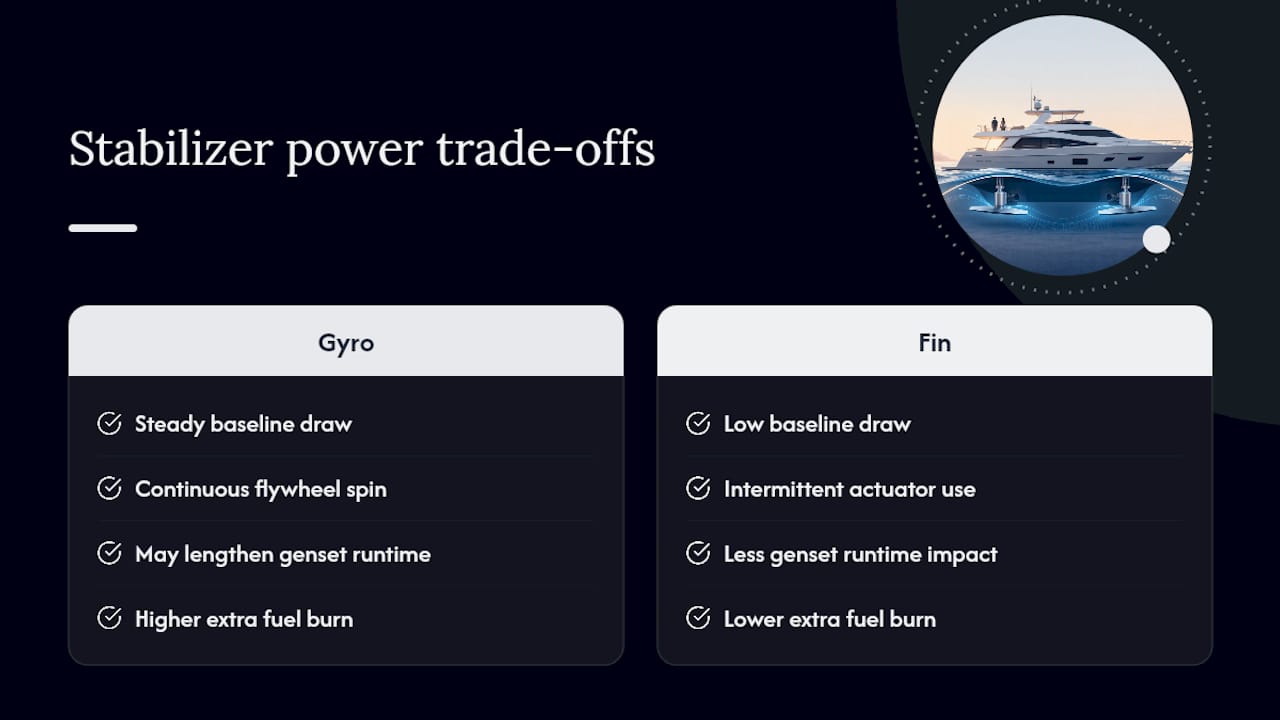
Fins with zero-speed modes, by contrast, tend to be more efficient when roll conditions are intermittent rather than constant, since the actuators only work when correction is actually needed. For owners increasingly focused on quieter, lower-impact systems aboard next-generation builds, this is a real consideration worth raising early with your naval architect rather than after the equipment is already specified.
None of this makes either technology environmentally reckless, and both are minor compared to overall vessel fuel consumption. But on yachts pursuing hybrid propulsion or expanded battery banks, factoring stabilizer draw into the total electrical budget avoids an unpleasant surprise when genset runtime turns out higher than expected. It is a detail worth discussing during the same engineering conversation that covers structural loads and mounting.
Real Retrofit Cases That Show What to Expect
Numbers matter more than marketing copy, and the retrofit record backs that up. The Sleipner Vector fin installation on a Sunseeker Manhattan 60 delivered an 88.4% measured roll reduction, alongside reported improvements in handling and top speed. This is evidence that a well-engineered retrofit can improve more than just comfort at anchor.
The Seakeeper 18 installation on a Princess Yachts P68 tells a different but equally instructive story. That project involved a full survey, structural reinforcement work, and sea-trial validation before the owner saw results, a reminder that gyro retrofits carry their own engineering demands distinct from fin installations. Academic work modeling flapping fin mechanics through CFD and multi-body dynamics simulations backs up why these installations require this level of rigor: the unsteady forces a fin generates while oscillating at anchor are substantial enough that they must be validated against structural and durability limits before certification, not just tested empirically after the fact.
Owners researching a retrofit should treat these two cases as a spectrum rather than a single template. Your hull, your use pattern, and your existing structure will land you somewhere between a straightforward fin conversion and a more involved gyro project, and only a proper survey tells you which.
How Baranof Yachts Manages Stabilizer Projects
We manage stabilizer retrofits and new-build integrations the same way we manage every complex system aboard: survey first, engineer second, install third, validate fourth. That means a structural and power-budget assessment before any equipment is specified, a vetted engineering partner brought in for hull-specific analysis, and defined project milestones so owners know exactly where the work stands. If hull slap at anchor is already a pain point, that same engineering lens applies to stabilizer selection.
Jason has spent years overseeing yacht sales and refit project management, and that experience shapes a straightforward deliverable for owners: a documented survey, an engineering-backed installation plan, and sea-trial data you can actually evaluate, not a sales brochure dressed up as a report.
Next Steps: Who Should Move on This Now
If roll at anchor is costing you sleep or guests, start with a survey, structural assessment, and power audit before requesting installer quotes, and budget with real range in mind rather than a single number from a brochure. Owners planning a new build should specify stabilizers early, since engineering it into the design costs far less than retrofitting later. Retrofit candidates should move now if their current system lacks a true zero-speed mode.
The Honest Take on Zero Speed Stabilizer Claims
The manufacturer numbers are not lying, but they are not the whole picture either. That gap between best-case marketing and realistic outcome is where most owner disappointment originates.
Conventional advice tends to frame this as a simple choice between fins and gyros, as if picking a brand solves the problem. It doesn’t. The harder, more important decision is whether your installer is doing hull-specific engineering or selling a catalog part. A Sunseeker retrofit and a Princess retrofit required different structural work because the hulls demanded it, not because one brand is superior to another.
If you take one thing from this guide, prioritize the survey and structural analysis over the stabilizer brand name. A mediocre fin system engineered correctly for your hull will outperform a premium gyro shoehorned in without proper reinforcement. Get the engineering right first. The equipment choice becomes much easier after that.
— Jason
Sources
- Stabilization systems | Quantum Marine
- Retrofit case: 88% roll reduction on Sunseeker Manhattan 60 – Sleipner Group
- Everything you need to know about yacht stabilisers – BOAT International
Recommended
Sold Listings


Design Your Yacht
"*" indicates required fields
Maximus III - PNW
As you step aboard MAXIMUS III, the first impression is her scale.
At 120 feet with an 8-meter beam and 294 GT of interior volume, this 2025 Crescent Custom tri-deck immediately feels open, balanced, and estate-like. A timeless look while still feeling fresh from the shipyard.
Currently Available


Get your yacht value Estimate
"*" indicates required fields