

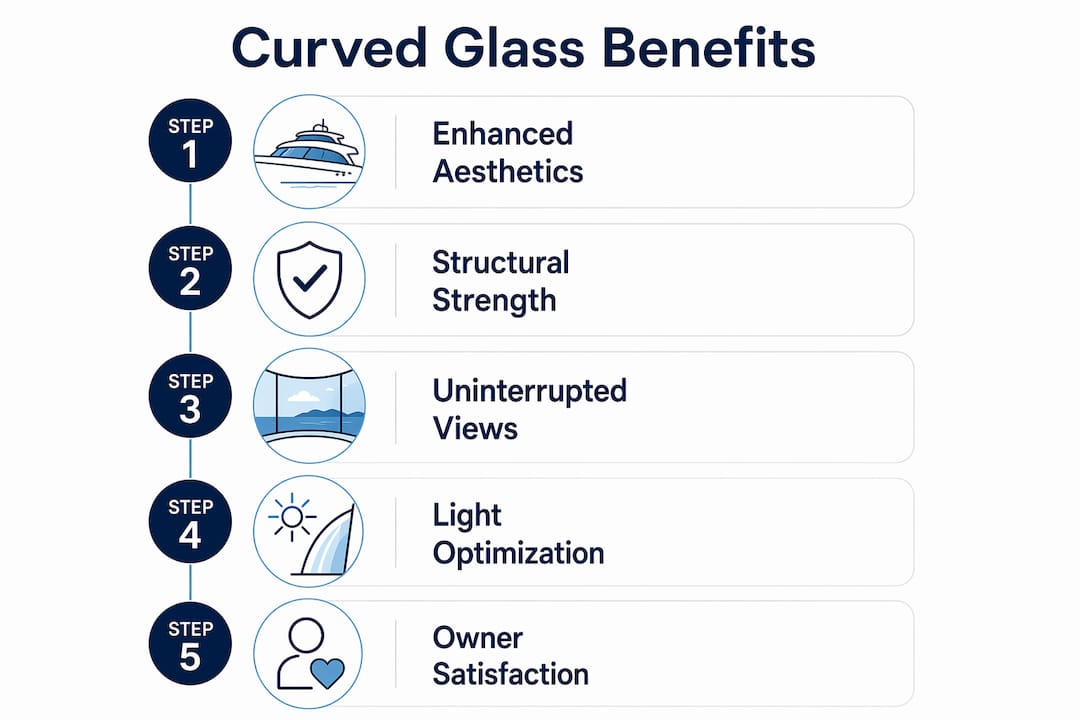
Curved glass enhances yacht design by unifying aesthetics, structural performance, and onboard experience in ways that flat glazing simply cannot match. When engineered from concept, curved glazing becomes a design driver that shapes a vessel’s identity, not just its appearance. The practical payoffs are immediate and measurable:
- Panoramic sightlines with no vertical mullions interrupting the horizon
- Geometry-driven stiffness that can reduce glass thickness requirements compared with flat panels of the same span
- Aerodynamic and spray-shedding profiles that lower wind noise and reduce water ingress risk at speed
- Daylighting and perceived space that transform interior comfort, particularly in salons and wheelhouses
- Post-break integrity through laminated build-ups that satisfy classification society safety requirements
- Resale premium driven by buyer demand for panoramic, glass-intensive superstructures
Classification bodies including Lloyd’s Register and the American Bureau of Shipping (ABS) require structural glazing to be verified through finite element analysis (FEA) and impact testing before acceptance, which means the engineering rigor behind curved glass is as serious as the visual ambition.
Table of Contents
- What are the real design and owner benefits of curved glass?
- Which materials and treatments make curved marine glass perform?
- How is curved marine glass actually manufactured?
- How does curved glass perform structurally, and what standards apply?
- How do you integrate curved glass into the yacht’s systems and structure?
- What are the practical limits, costs, and lead times for custom curved glazing?
- What should you specify and ask suppliers when procuring curved glass?
- Short project examples that show curved glass in action
- Why early collaboration between designers, shipyards, and glazing engineers changes outcomes
- Key Takeaways
- The case for committing to curved glass early, not late
- Baranofyachts brings glazing expertise to your build from day one
- Useful sources for designers and builders
What are the real design and owner benefits of curved glass?
The most immediate benefit owners notice is the uninterrupted sightline. Where framed flat panels create a grid of visual interruptions, precision-fabricated curved glass delivers optical continuity that connects interior and exterior as a single visual field. That effect is not cosmetic. Buyers consistently associate panoramic glazing with a sense of openness and luxury that commands a measurable premium at resale.
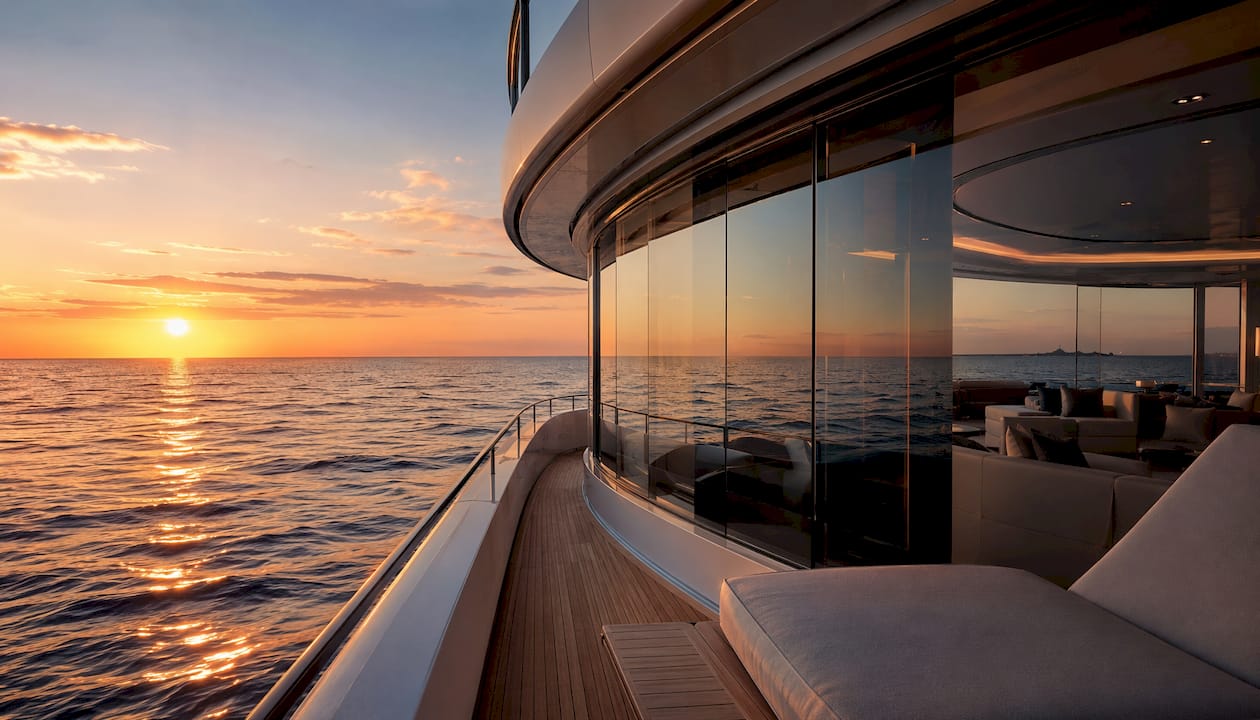
Daylighting is the second major payoff. Larger, curved glazed areas flood salons and staterooms with natural light, reducing the need for artificial lighting during the day and creating a psychological sense of space that even the finest joinery cannot replicate on its own. Combined with acoustic control through laminated interlayers, the onboard environment becomes noticeably quieter and more comfortable at sea.
Operationally, curved profiles shed spray more efficiently than vertical flat panels and reduce aerodynamic drag on the superstructure. At cruising speeds, that translates to lower wind noise in the wheelhouse and, on larger vessels, a modest but real contribution to fuel economy. The exterior styling argument is equally strong: a curved glass superstructure reads as modern and purposeful from the water in a way that flat-paneled alternatives rarely achieve.
- Uninterrupted panoramic views with no vertical framing
- Natural daylighting that reduces energy demand and improves comfort
- Acoustic attenuation through laminated glass build-ups
- Spray shedding and aerodynamic drag reduction at speed
- Resale premium tied to glass-intensive, modern superstructure design
Pro Tip: Balance owner ambition with engineering reality early. Larger frameless expanses often require thicker glass or stronger interlayers to maintain stiffness and safety, which adds weight and can affect optical clarity. Set the maximum panel size and minimum curvature radius before the design is frozen, not after.
Which materials and treatments make curved marine glass perform?
Marine glazing is almost never a single pane of glass. The standard build-up for a curved yacht panel is a laminated assembly: two or more glass plies bonded by a polymer interlayer, with surface coatings applied to the outer face. The choice of glass type, interlayer, and coating determines how the panel performs under load, in fire, and over years of UV and salt exposure.
Glass types and strengthening methods:
- Thermally toughened (tempered) glass is heated and rapidly quenched to induce surface compression. It is the most common marine glazing type and breaks into small, relatively safe fragments.
- Chemically strengthened glass is treated in a potassium salt bath that exchanges sodium ions for larger potassium ions, creating a deep compressive surface layer. Chemically strengthened glass can provide flexural strength up to roughly twice that of thermally tempered glass, enabling larger spans or thinner sections in laminated build-ups. It is the preferred route for deep curves because it does not require furnace heating that can introduce warpage.
- Laminated assemblies combine two or more plies with an interlayer. Post-break, the interlayer holds fragments in place, which is the primary safety mechanism for overhead and structural glazing.
Interlayer options:
- PVB (polyvinyl butyral) is the standard marine interlayer, offering good adhesion and post-break fragment retention.
- Ionoplast interlayers (such as SentryGlas) are significantly stiffer than PVB, contributing meaningfully to the panel’s bending stiffness and enabling thinner overall build-ups for a given span.
Surface treatments and coatings:
- Low-emissivity (low-e) coatings reduce solar heat gain and improve U-values for climate-controlled interiors.
- Hard coatings improve abrasion resistance against salt spray and cleaning.
- Anti-reflective films reduce glare and improve optical clarity, particularly on windshields.
- UV-blocking interlayers or films protect interior fabrics and surfaces.
Advanced coatings combined with high-performance interlayers allow designers to meet thermal and acoustic targets simultaneously without sacrificing transparency. One important constraint: not all coatings adhere well to chemically strengthened curved surfaces, so coating compatibility must be confirmed with the glass fabricator before specification is finalized.
Statistic callout: Chemically strengthened glass can achieve flexural strength approximately twice that of thermally tempered glass, allowing thinner sections and larger spans when paired with ionoplast interlayers.
Pro Tip: Specify interlayer performance by mechanical property (shear modulus, creep resistance at temperature) rather than by brand name alone. A performance specification gives you the flexibility to accept equivalent products and protects you if a preferred brand has supply issues during a long build.
How is curved marine glass actually manufactured?
The forming process determines optical quality, geometry accuracy, and the mechanical properties of the finished panel. Three primary methods are used in marine glazing production, and the choice depends on the curvature depth, panel size, and strengthening method required.
- Sag bending (gravity bending): Glass is placed on a mold and heated in a furnace until it softens and sags into the mold profile under gravity. This is the most common method for moderate curves and large panels. Thermal tempering can be applied in the same furnace cycle.
- Forced bending in a furnace: The glass is actively pressed or rolled into shape during heating, allowing tighter radii than sag bending alone. Articulated tooling and non-contact supports minimize the contact between the mold and the glass surface during heating, reducing optical distortion and surface marking.
- Chemical strengthening after cold forming: For deep or compound curves where furnace bending would introduce warpage, the glass is cold-formed to shape and then chemically strengthened. This approach supports tighter curvature and is increasingly preferred for complex geometries.
Tooling advances now allow larger-format curved panels without bespoke molds in many cases, reducing tooling cost and lead time for projects with standard curvature profiles.
A practical QA and engineering workflow:
- Transfer the 3D hull or superstructure geometry from the CAD model to the glass fabricator in a neutral format (STEP or IGES).
- Run virtual form checks to confirm the target curvature is achievable within the fabricator’s furnace and tooling envelope.
- Produce a trial panel or prototype for optical distortion testing and geometry verification against the CAD model.
- Conduct FEA on the bonded panel assembly to confirm load performance before committing to full production.
- Agree on optical distortion acceptance criteria (zebra-board or laser measurement) and document them in the purchase order.
- Final inspection: geometry, optical quality, edge finish, and coating integrity before shipment.
Pro Tip: Agree on allowable optical distortion limits in writing before the fabricator begins production. Optical distortion is subjective until it is measured, and disputes about “acceptable” quality at delivery are one of the most common sources of delay and cost on glazing packages. A simple zebra-board test protocol, agreed upfront, eliminates most of that ambiguity.
How does curved glass perform structurally, and what standards apply?
Curvature is not just an aesthetic choice. It is an engineering advantage. A curved panel resists bending loads more efficiently than a flat panel of the same thickness and span because the geometry converts some bending stress into in-plane (membrane) stress, which glass handles far better. In practical terms, this means a curved panel can often be thinner than a flat panel covering the same opening, or it can span a larger area at the same thickness.
When glazed panels are used as structural elements, bonded directly into the hull or superstructure without a surrounding frame, the engineering implications are significant:
- The bond line between the glass and the supporting structure carries shear and peel loads that must be calculated under static and dynamic sea conditions.
- Structural glazing requires detailed FEA to demonstrate load sharing and bonding performance to the satisfaction of classification societies.
- Lloyd’s Register, ABS, and DNV each publish guidance on glazing acceptance, and the specific requirements vary by vessel class, operating area, and panel location (windshield, hull side, overhead).
Safety layers and post-break performance:
- Laminated build-ups are mandatory for overhead glazing and strongly recommended for any structural application.
- Post-break integrity means the interlayer holds fragments together, maintaining weather tightness and preventing injury until the panel can be replaced.
- Egress requirements must be considered: some panel locations require the glass to be breakable by crew in an emergency, which affects interlayer selection.
Statistic callout: Curved panels of considerable size are regularly produced for ambitious superyacht projects, with some specialist facilities capable of even larger formats. Panels at this scale require FEA sign-off and classification society review before installation.
Fatigue testing, which cycles a panel through repeated pressure differentials simulating wave loading, is increasingly required for large structural panels. Impact testing to ASTM or equivalent standards is standard for windshields and any glazing in a crew or passenger area.
How do you integrate curved glass into the yacht’s systems and structure?
Curved glass does not exist in isolation. It intersects with HVAC ducting, blind and shading systems, drainage channels, electrical runs for switchable glass, and the structural framing of the superstructure. Resolving these interactions late in the design process is expensive. Resolving them early, with the right people in the room, is straightforward.
The most important integration decisions to lock before detailed design begins:
- Glass geometry and tolerances: The 3D curvature must be defined precisely enough for the fabricator to quote and produce. Vague geometry leads to fabrication errors and costly remakes.
- Edge and bond details: Whether the panel is framed, bonded, or a combination determines the structural interface with the hull and affects waterproofing, thermal performance, and aesthetics.
- HVAC and insulation: Large glazed areas increase solar heat gain. The HVAC system must be sized for the actual glazing specification, not a placeholder. Insulated glazing units (IGUs) with low-e coatings reduce the load but add thickness and weight.
- Shading and blinds: Motorized blind systems require a housing that must be integrated into the surrounding joinery before the glass is installed. Retrofitting blind housings after glazing is installed is rarely clean.
- Drainage: Condensation drainage channels and wash-down drainage must be routed without creating cold bridges or water traps behind the glass.
- Switchable glass: Electrochromic or PDLC (polymer dispersed liquid crystal) glass requires electrical connections at the edge, which must be planned into the bond line and frame detail.
Lighting design interacts directly with glazing choices: daylight harvesting strategies and glare control depend on the glass specification being finalized before the lighting layout is set.
Pro Tip: To maintain optical continuity across adjoining curved panels, specify matching curvature radii and glass tint from the same production batch. Even small variations in tint or radius between adjacent panels create visible color and reflection discontinuities that are impossible to correct after installation.
What are the practical limits, costs, and lead times for custom curved glazing?
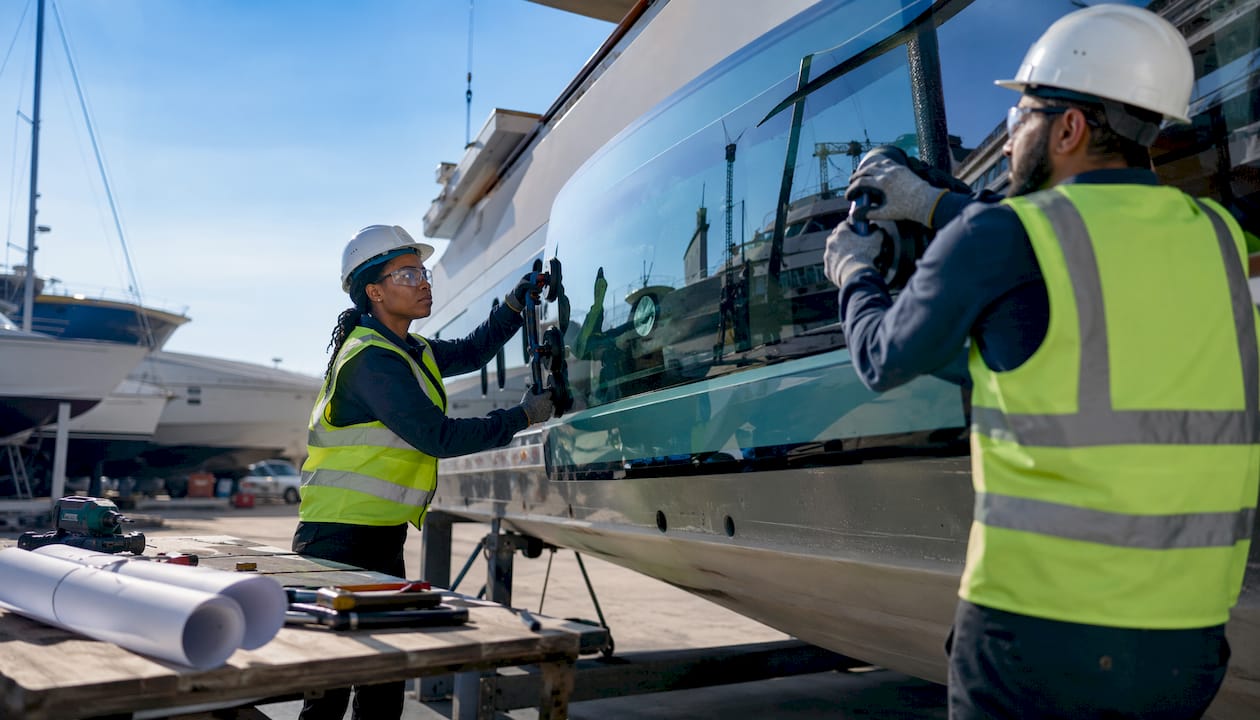
Custom curved marine glazing is one of the longer-lead and higher-cost items in a new build or refit. Understanding what drives cost and schedule allows project teams to make informed trade-offs rather than discovering them at the worst moment.
Fabrication limits to know:
- Maximum panel size: curved panels up to 6×3 meters are regularly produced; some vendors quote even larger maximum formats in special facilities for specific geometries.
- Minimum curvature radius: typically 1,000–1,500 mm for thermally tempered glass; chemical tempering supports tighter radii.
- Weight: a 19 mm laminated curved panel at 6×2 meters weighs approximately 570 kg, which has real implications for superstructure structure and crane capacity during installation.
- Compound curves (curves in two axes simultaneously) are significantly more complex and expensive than single-axis curves.
Cost and lead-time reference:
| Scenario | Relative cost | Typical lead time |
|---|---|---|
| Small curved window, single axis, standard tempering | Baseline | 8 weeks |
| Medium salon panel, single axis, chemically tempered | up to 2× baseline | — |
| Large wraparound salon glazing, single axis, laminated | 2.5–4× baseline | — |
| Compound-curve structural panel, custom tooling | 4× baseline | — |
What drives cost upward:
- Panel area: larger panels require larger furnaces and more complex handling.
- Custom tooling: non-standard curvature profiles require bespoke molds or articulated tooling setups.
- Chemical tempering: more expensive than thermal tempering but necessary for deep curves and some coating systems.
- High-performance interlayers: ionoplast interlayers cost more than standard PVB but deliver meaningfully better stiffness and post-break performance.
- Coatings: low-e, anti-reflective, and hard coatings each add cost and must be compatible with the chosen strengthening method.
- Logistics and installation: large curved panels require specialized transport, lifting equipment, and installation crews with marine glazing experience.
Prototype or trial panels, while adding cost, almost always save money overall by catching geometry or optical issues before full production runs.
What should you specify and ask suppliers when procuring curved glass?
A complete RFQ for curved marine glazing leaves no room for ambiguity. Scope gaps at procurement become change orders at installation.
Specification items to include:
- 3D geometry file (STEP or IGES) with curvature tolerances stated in millimeters
- Optical distortion limits (measurement method and acceptance threshold)
- Glass build-up: ply thicknesses, interlayer type and grade, total assembly thickness
- Strengthening method: thermal tempering, chemical tempering, or combination
- Coating schedule: which coatings, on which surfaces, in which sequence
- Edge finish: ground, polished, or arrised, with dimensional tolerances
- Bond line detail: adhesive type, width, and depth for bonded installations
- Ingress protection rating for the installed assembly
Contractual and testing requirements:
- Sample panels for optical and mechanical approval before full production
- Test reports: impact resistance (ASTM F3057 or equivalent), flexural strength, and interlayer peel
- FEA sign-off documentation for structural panels
- Installation method statement from the glazing contractor
- Warranty terms covering delamination, coating failure, and seal integrity
Questions to ask every supplier:
- What is your maximum panel size for curved production?
- Do you have chemical tempering capability in-house or do you subcontract it?
- What optical distortion measurement method do you use, and what are your standard tolerances?
- Can you provide references for marine projects of similar panel size and curvature?
- What is your warranty coverage for laminated curved panels in a marine environment?
Pro Tip: Embed an approval gateway in the contract: the fabricator must receive written sign-off on a trial-fit panel before proceeding to final tempering and lamination of the full order. This single step catches geometry mismatches before they become a full-order remake.
Short project examples that show curved glass in action
These four project notes illustrate how curved glazing decisions play out in practice, and what lessons each scenario produces for future specifications.
-
New-build panoramic salon: A 55-meter motor yacht specified a continuous curved glazing band running the full length of the main salon. The key technical solution was a chemically tempered laminated build-up with ionoplast interlayers, allowing thinner panels and a lighter superstructure. The primary lesson: the glazing engineer was brought in at concept stage, which allowed the structural frame to be designed around the glass geometry rather than retrofitted to it. The result was a cleaner bond line and no visible framing from inside.
-
Structural bonded windshield: A 40-meter sailing yacht used a bonded curved windshield as a structural element of the coachroof, eliminating the need for a traditional frame. FEA modeled the bond line under dynamic sea loads, and the panel was tested to ABS impact standards before installation. The lesson: classification society engagement must begin before FEA is commissioned, not after, because the society’s specific requirements shape the analysis scope.
-
Curved side windows with compound geometry: A 30-meter explorer yacht required compound-curve side windows to follow the hull flare. Custom articulated tooling was required, adding eight weeks to the lead time and roughly 40% to the unit cost versus a single-axis equivalent. The lesson: compound curves must be identified and budgeted in the concept phase, not discovered during detailed design.
-
Glass balustrade and pool surround: A refit project replaced opaque GRP balustrades with curved laminated glass panels, opening the side decks visually and increasing perceived deck space. The lesson: marine-grade sealant selection and drainage detailing behind the glass are as important as the glass specification itself. Inadequate drainage caused water trapping and seal degradation within 18 months on an earlier project on the same vessel class.
Why early collaboration between designers, shipyards, and glazing engineers changes outcomes
Early collaboration is the single most effective cost and schedule control available on a curved glazing package. When glazing engineers and suppliers are brought in at concept stage, the geometry, curvature, bonding interfaces, and structural requirements are aligned before any detailed design work is done. When they are brought in late, every change to glass geometry triggers knock-on effects in the structural frame, HVAC layout, and joinery, each of which costs time and money to resolve.
The composite materials and glazing disciplines share this dynamic: early interdisciplinary coordination consistently produces better outcomes than sequential handoffs between teams.
A recommended coordination workflow from concept to production:
- Concept stage: Include the glazing engineer and a shortlisted fabricator in the design team. Agree on maximum panel sizes, minimum curvature radii, and structural bonding strategy.
- Preliminary design: Freeze the 3D glass geometry and issue it to the fabricator for feasibility review. Confirm strengthening method and interlayer specification.
- Detailed design: Complete FEA on structural panels. Submit to the classification society for preliminary review. Finalize coating schedule and edge details.
- Pre-production: Fabricate and approve trial panels. Conduct trial fit on the vessel or a full-scale mock-up. Issue written approval before full production begins.
- Production and delivery: Monitor fabrication milestones. Arrange specialized transport and confirm installation crew qualifications before panels leave the factory.
- Installation: Glazing engineer present for bond-line preparation, panel placement, and initial seal inspection.
Pro Tip: At concept stage, freeze three tolerances in writing: maximum allowable optical distortion, maximum panel weight (for structural and crane planning), and minimum curvature radius. These three numbers govern more downstream decisions than any other single specification item, and changing them after detailed design has begun is disproportionately expensive.
The shipyard’s role in this workflow is to act as the integration point, ensuring that the glazing engineer’s requirements are reflected in the structural drawings and that the installation sequence is planned before the hull is closed. Projects where the shipyard treats glazing as a late-stage subcontract consistently encounter more rework than those where it is managed as a primary system from the start.
Key Takeaways
Curved glass enhances yacht design by combining geometry-driven structural efficiency with panoramic aesthetics, but realizing those benefits requires early coordination, precise specification, and realistic budget and schedule planning.
| Point | Details |
|---|---|
| Curvature improves both form and function | Curved panels resist bending loads more efficiently than flat glass, often enabling thinner sections or larger spans. |
| Chemical tempering unlocks deeper curves | Chemically strengthened glass can achieve roughly twice the flexural strength of thermally tempered glass, supporting larger spans and tighter radii. |
| Panel size and cost scale together | Curved panels up to 6×3 meters are regularly produced; some industry-leading facilities are capable of even larger formats in specific cases. Compound curves and custom tooling can push costs to 4× the baseline for a standard curved window. |
| Specify before you procure | Lock geometry tolerances, optical distortion limits, interlayer grade, and coating schedule in the RFQ — scope gaps become change orders at installation. |
| Baranofyachts coordinates glazing from concept | Baranofyachts provides design coordination, supplier selection, FEA oversight, and installation supervision to align glazing ambition with engineering reality. |
The case for committing to curved glass early, not late
Curved glazing is one of those specification decisions where the cost of ambition is almost entirely front-loaded. The glass itself, the tooling, the FEA, the trial panels — these are real expenditures that happen before a single panel is installed. What owners and designers sometimes underestimate is that the cost of not committing early is higher. A glazing package that is redesigned at detailed design stage, because the concept-stage geometry was never validated with a fabricator, routinely adds weeks to the schedule and significant cost in structural rework.
The conventional wisdom in luxury yacht design is that curved glass is a premium finish. That framing gets it slightly wrong. Curved glass is a structural and spatial strategy that happens to look extraordinary. The panoramic views, the light, the acoustic calm — those are the outputs of an engineering decision made correctly, not decorative choices bolted on at the end.
What we find, working through complex glazing packages, is that the projects with the cleanest outcomes are the ones where the owner’s ambition for glass was stated clearly at the very beginning, and where the design team had the discipline to test that ambition against fabrication reality before committing to geometry. The projects that struggle are the ones where the glazing was treated as a vendor selection problem rather than a design problem.
One example that stays with us: a refit project where the owner wanted to replace a traditional framed windshield with a bonded curved unit. The geometry looked straightforward on the rendering. When the glazing engineer reviewed the actual hull lines, the compound curvature required was beyond the thermal tempering envelope of every fabricator the project had contacted. Chemical tempering was the solution, but it added 10 weeks and required the classification society to review a revised FEA. The project absorbed that delay. It would have been invisible if the glazing engineer had been in the room six months earlier.
Baranofyachts brings glazing expertise to your build from day one
Curved glass packages on ambitious new builds and refits are exactly the kind of specification challenge where project oversight makes a measurable difference. Baranofyachts works with designers, shipyards, and owners to coordinate glazing decisions from the concept stage through to installation sign-off, so that the glass your vessel deserves is also the glass your schedule and budget can support.

We bring glazing engineers and vetted fabricators into the design conversation early, manage FEA review and classification society submissions, oversee trial-panel approvals, and supervise installation to confirm bond-line integrity and optical quality. For owners planning a next-generation glass-intensive build, we provide the coordination layer that keeps the glazing package on track without compromising the design vision. If you are at concept stage or approaching detailed design on a project with significant curved glazing, contact Baranofyachts to discuss how we can support your team from specification through delivery.
Useful sources for designers and builders
- Designing with glass — SuperyachtNews: Industry overview of how glazing engineering integrates with superyacht new-build design; covers chemical tempering, interlayer options, and early-stage coordination.
- See-through boats — Yachting World: Explains the shift toward glass-intensive yacht design and the structural and FEA requirements that come with it.
- Curved and flat glass for yachts — Nautech News: Covers current manufacturing capabilities, maximum panel sizes, and tooling advances for curved marine glazing.
- Cracking the glass ceiling — SuperyachtNews: Addresses the trade-offs between owner ambition for frameless glazing and the engineering constraints that govern thickness and framing.
- Challenging Glass conference proceedings: Peer-reviewed technical paper on articulated tooling, non-contact bending, and optical distortion control in curved glass production.
- BCEGlass BestCurve Yacht/Ship: Manufacturer technical notes on chemical tempering for deep curves, coating compatibility, and cold-bending limitations in marine applications.
- Curved Marine Glass for Yachts — Quality Marine Glass: Practical overview of optical continuity, edge bonding, and fabrication tolerances for curved yacht glazing.
Recommended
Sold Listings


Design Your Yacht
"*" indicates required fields
Maximus III - PNW
As you step aboard MAXIMUS III, the first impression is her scale.
At 120 feet with an 8-meter beam and 294 GT of interior volume, this 2025 Crescent Custom tri-deck immediately feels open, balanced, and estate-like. A timeless look while still feeling fresh from the shipyard.
Currently Available


Get your yacht value Estimate
"*" indicates required fields