
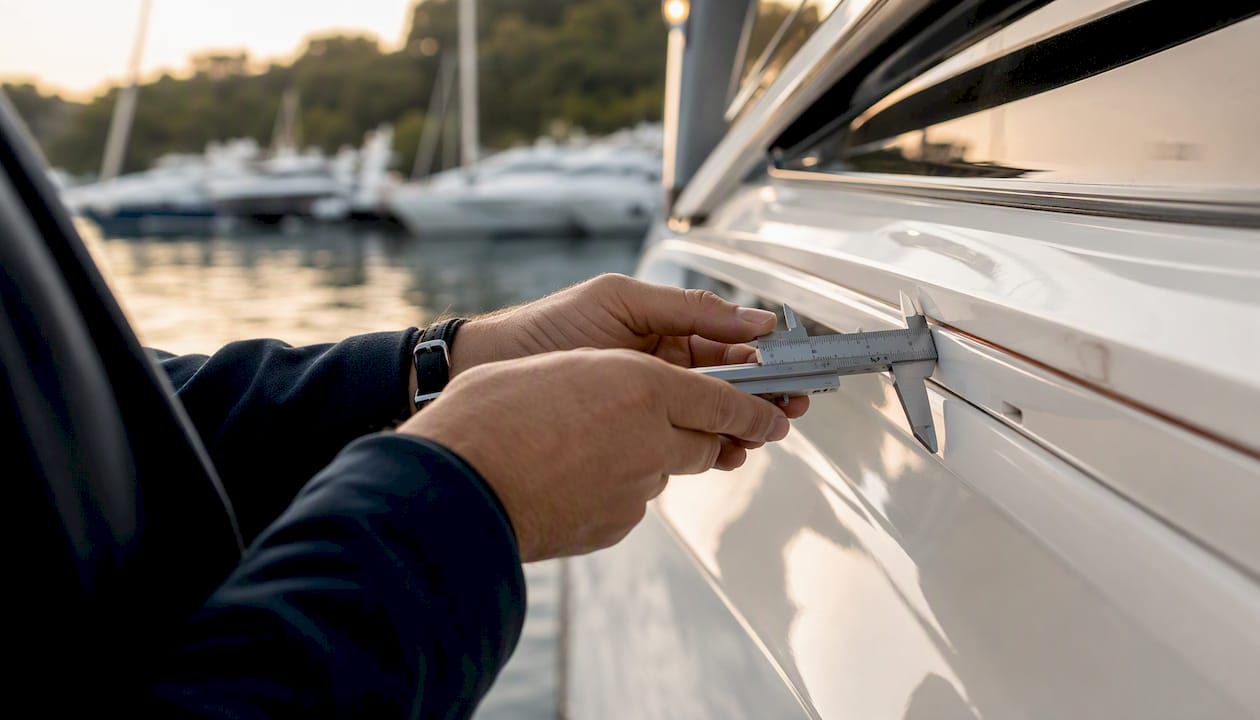
Every credible yacht valuation rests on three approaches: market (sales-comparison), cost (replacement), and income (charter). A properly reconciled valuation weighs the strongest evidence among the three and publishes a range rather than a single figure. If you are buying or selling, start with market comparables; if you are insuring a unique build, lean on cost; if you operate a charter yacht, income evidence carries the argument. Whichever job you’re doing, commission a survey before you treat any number as final.
TL;DR:
- The market approach relies on recent comparable sales and requires matching yachts by category, size, build, and condition for accurate valuation.
- Replacement cost calculations depend on current shipyard prices and adjustment for physical and functional depreciation, useful for unique or insured yachts.
- The income approach needs verified charter data, including actual bookings and expenses, and is only suitable for yachts with proven operating histories.
- Effective valuation requires weighing all three methods and reconciling them into a range, with market data usually dominating unless the yacht is unique or chartered.
- A thorough survey and comprehensive documentation are essential to support an accurate valuation and avoid costly mistakes.
Table of Contents
- What Is the Market Approach to Yacht Valuation?
- How Do You Estimate Replacement Cost for a Yacht?
- When Does the Income Approach Apply to Yacht Value?
- How Appraisers Weight and Reconcile the Three Approaches
- Which Factors Most Affect a Yacht’s Value?
- What Should a Yacht Survey Cover Before You Rely on a Valuation?
- How Do You Commission a Yacht Valuation, Step by Step?
- How Baranof Supports the Valuation Process
- A Broker’s Take on the Valuation Mistakes That Cost Buyers Money
- Get Hands-On Valuation Support From Baranof Yacht Sales
- Sources
What Is the Market Approach to Yacht Valuation?
The market approach, sometimes called the sales-comparison method, is where nearly every credible yacht valuation starts. It asks a simple question: what have genuinely comparable yachts actually sold for, not what are they listed for? Closed-sale data reflects what a buyer was actually willing to pay, while asking prices are opening positions that can sit notably above eventual sale figures in a soft market. Market-intelligence providers that track sales, deliveries, and order books give appraisers a far more defensible starting point than a handful of active listings pulled from a brokerage site.
Matching comparables means aligning category, length band, builder tier, and build year within a tight window, then adjusting for everything that makes two “identical” yachts worth different amounts.
- Specification level (interior finish, tender package, stabilization systems)
- Engine hours and major service intervals
- Refit history and the quality of the yard that performed it
- Flag state, tax status, and titling jurisdiction
- Regional demand and liquidity for that model
Price-per-foot is a useful sanity check, but it flattens real differences in outfitting and condition into a single number, which is why it works best as a screening tool rather than a final calculation.
Pro Tip: Pull multiple closed comparables from recent months before trusting any desktop estimate. If you can’t find three, you’re likely dealing with a thin market and need to lean harder on the cost or income approach.
How Do You Estimate Replacement Cost for a Yacht?
The cost approach starts with a straightforward question: what would it cost to build this yacht again today? Appraisers build that number from current shipyard quotes, itemized parts and systems pricing, and recent build contracts for comparable tonnage and construction type. From there, you deduct value the yacht has already lost.
- Physical deterioration from age, hours, and wear on hull, engines, and systems
- Functional obsolescence, such as outdated electronics or a hull mold the builder no longer supports
- Market-driven discounts when demand for that model or configuration has softened
This approach becomes the primary tool in narrow situations: unique or heavily customized builds with no true market comparables, new-construction projects still mid-build, and insurance work where the policy is written on replacement value rather than resale value. Our depreciation guide for investors walks through how physical and functional depreciation typically compound over a yacht’s first decade.
When Does the Income Approach Apply to Yacht Value?
Income capitalization only works when a yacht has real, documented charter operations behind it. That means actual booking records, realized charter rates (not brochure rates), utilization weeks per year, and audited operating costs.
- Verified bookings and realized rates over at least two full seasons
- Documented utilization, broker commissions, and crew and management costs
- Berth fees, insurance, and maintenance reserves netted out of gross charter revenue
Converting an advertised weekly rate into normalized net income usually reduces the headline number significantly once commissions, crew, and reserves are subtracted. Without a multi-season operating history, the income approach becomes scenario-based, useful for a range but not a standalone number, which is exactly why it rarely stands alone in a final report.
How Appraisers Weight and Reconcile the Three Approaches
A single-approach valuation is a red flag. Sound practice weights each method by the quality of its evidence and reconciles the outputs into one defensible range, stating an effective date, purpose, and assumptions alongside the number itself.
- Liquid market, strong comparables. Market approach dominates; cost and income serve only as cross-checks.
- Thin comparables, unique specification. Cost approach gains weight, adjusted heavily for depreciation and obsolescence.
- Charter-capable yacht with verified operating history. Income approach earns real weight alongside market data, and the two are reconciled rather than averaged.
Pro Tip: Ask any valuer for the low, mid, and high figures separately, along with the reasoning behind each. A single point estimate with no range attached is usually a sign the work wasn’t stress-tested.
Which Factors Most Affect a Yacht’s Value?
Two nearly identical hulls from the same builder and model year can differ in value by a wide margin, and the difference almost always traces back to documentation. A continuous maintenance file with dated invoices, oil analysis reports, and engine ECU data gives a buyer or lender confidence that a clean survey report alone can’t fully replicate.
- Maintenance records, refit invoices, and transferable warranty documentation
- Engine hours, service intervals, and ECU-logged performance data
- Abstract of title, bills of sale, and lien history
- Condition below the waterline, corrosion patterns, and core integrity in the hull and deck
- Builder reputation, parts and service network strength, and model desirability
- Timing relative to boat show season and broader market demand
Survey findings translate directly into price. A soft deck core or corroded shaft log doesn’t just cost the repair estimate. It also erodes buyer confidence in everything else on the vessel, which tends to widen the negotiated discount well beyond the raw repair figure. Specification detail matters here too. Our breakdown of high-end yacht features covers which systems and finishes buyers actually pay a premium for versus which ones simply meet expectations.
What Should a Yacht Survey Cover Before You Rely on a Valuation?
A desktop model can screen a price range, but it cannot inspect a hull. Different survey types answer different questions, and confusing them costs buyers real money.
- Pre-purchase or condition survey. Full hull, systems, and mechanical inspection, typically including a sea trial and haul-out.
- Insurance survey. Narrower scope focused on safety equipment, fire risk, and structural soundness for underwriting purposes.
- Sale/condition survey. Broker-commissioned to support a listing price with documented condition evidence.
Hire a qualified marine surveyor with experience in that builder’s construction method, and ask directly what the report will and won’t cover before the haul-out is scheduled. Every defect the survey finds should translate into one of three outcomes: a repair credit, a price adjustment, or a walk-away threshold you set before the inspection, never after. Our guide to yacht surveys breaks down scope language you should require in the engagement letter.
How Do You Commission a Yacht Valuation, Step by Step?
Getting a usable valuation, rather than a rough guess, comes down to preparation and asking the right questions upfront.
- Gather documents first. Maintenance file, refit invoices, engine logs, title abstract, and prior survey reports.
- Ask providers pointed questions. What’s the effective date? Which comparables are being used? Is a physical survey included, or is this a desktop estimate only?
- Match the scope to the stakes. A desktop screening might run a modest flat fee and take a few days; a full on-site appraisal with survey coordination runs longer and costs considerably more, but it’s the version lenders and insurers will actually accept.
If you’re financing the purchase, confirm your lender’s minimum survey requirement before you pay for any report. Our yacht financing guide outlines what most lenders expect to see in the valuation file.
Pro Tip: Request the surveyor’s credentials and sample report before booking, not after. A vague scope letter is the single most common reason valuations get rejected by lenders.
How Baranof Supports the Valuation Process
We coordinate the survey, assemble the maintenance file, and manage any refit work needed to close deficiencies a survey turns up, so the valuation reflects the yacht’s real condition, not its worst-case one.
- Document pack assembly (title, service records, engine data)
- Survey scheduling and scope negotiation with qualified marine surveyors
- A reconciled valuation range with stated assumptions and effective date
A Broker’s Take on the Valuation Mistakes That Cost Buyers Money
The costliest mistake I see is trusting an asking price or an automated estimate without a survey behind it. Second most costly: waiting until closing week to request the maintenance file. Ask for it on day one.
— Jason
Get Hands-On Valuation Support From Baranof Yacht Sales
Baranof Yacht Sales is built for the reader who needs more than a desktop number. Where an automated model gives you a screening range, our team coordinates the actual survey, assembles the documentation a lender or insurer will demand, and reconciles the findings into a range you can act on with confidence.

A consultation with our team typically starts with a review of your maintenance file and title documents, followed by a scoped survey recommendation and a market comparison pulled from recent closed sales in your yacht’s category. If you’re preparing to sell, buy, or refinance, our brokerage services for luxury yacht buyers and sellers page outlines exactly what a sale mandate and valuation support engagement includes. Reach out to schedule a consultation and get a reconciled valuation range built around your specific yacht, not a generic model estimate.
Sources
- GetBoat intelligence — yacht valuation guide
- Marine inspection — marine vessel valuation survey guide
- Boat International — superyacht market intelligence
- Minted Yachts — what drives yacht value
Recommended
Sold Listings


Design Your Yacht
"*" indicates required fields
Maximus III - PNW
As you step aboard MAXIMUS III, the first impression is her scale.
At 120 feet with an 8-meter beam and 294 GT of interior volume, this 2025 Crescent Custom tri-deck immediately feels open, balanced, and estate-like. A timeless look while still feeling fresh from the shipyard.
Currently Available


Get your yacht value Estimate
"*" indicates required fields