

A yacht toy garage is an enclosed storage and operations space built to hold and deploy a yacht’s water-toy inventory. Unlike a tender garage, which handles heavy launching gear for chase boats and rescue craft, a toy garage prioritizes rapid access, protection, and organization for smaller equipment. Owners who understand this distinction early avoid costly redesigns later, which is exactly what the examples and design guidance below are meant to prevent.
TL;DR:
- Proper planning for a toy garage requires detailed knowledge of the specific water toys’ size and weight to ensure accessibility and safety.
- Use of modular inflatable docks and expansion systems can provide flexible staging solutions and accommodate future increases in electric toy inventory.
- Structural considerations, such as door type, internal clearance, and hoist capacity, directly impact the garage’s usability and should be prioritized early in design.
- Electric-powered toys demand dedicated charging infrastructure with proper ventilation, and safety standards vary depending on classification society and yacht size.
- Regular maintenance of saltwater exposure, battery health, and hardware integrity is essential to keep the garage operational and prevent costly repairs.
Table of Contents
- What Is a Toy Garage and How Does It Differ From a Tender Garage?
- How Do the World’s Best Superyacht Toy Garages Compare?
- What Should You Consider When Designing a Toy Garage?
- Are Inflatable Toy Docks and Modular Systems Worth It?
- How Do You Keep a Toy Garage Running Smoothly Day to Day?
- When Should You Use a Support Vessel Instead of Expanding the Garage?
- How Does Baranof Yacht Sales Advise on Toy Garage Projects?
- What Safety Standards Apply to Yacht Toy Garages?
- How Do You Maintain a Toy Garage and Its Stored Equipment?
- What New Materials and Technologies Are Changing Toy Garage Construction?
- What Environmental Factors Should Toy Garage Owners Consider?
- What Should Owners Prioritize When Planning a Toy Garage?
- How Baranof Yacht Sales Supports Your Toy Garage Project
- Where Can You Learn More About Toy Garage Design and Examples?
- Sources
- FAQ
What Is a Toy Garage and How Does It Differ From a Tender Garage?
A toy garage is a dedicated, enclosed stowage space built to hold a fleet of smaller water toys: Seabobs, e-foils, jet skis, paddleboards, dive gear and, increasingly, mini-submersibles. The emphasis is on quick retrieval and tidy stowage rather than moving heavy machinery.
A tender garage, by contrast, exists to launch and recover the yacht’s chase boats and rescue tenders. It relies on structural elements the toy garage typically doesn’t need at the same scale:
- Heavier-duty hoists rated for multi-ton loads
- Slipways or transom doors engineered for a tender’s hull shape
- Reinforced overhead rails for crane-assisted launching
Toy garages, meanwhile, favor lighter racking systems, wall-mounted brackets, and side or stern access points sized for smaller gear. The tradeoff owners face is space itself. Every cubic meter dedicated to toy storage is a cubic meter unavailable for guest cabins, crew quarters, or engine-room capacity, which is why the decision to prioritize a larger garage is rarely made lightly.
How Do the World’s Best Superyacht Toy Garages Compare?
The most photographed toy garages in the industry share one trait: inventive use of every available inch. Here’s what distinguishes five widely referenced examples.
- Hodor. Built as a 68-meter shadow vessel, Hodor’s toy garage reportedly stores nine jet skis alongside submarines and support craft, making it one of the largest floating toy collections in private yachting.
- Flying Fox. At 136 meters, Flying Fox carries several tenders and a dedicated dive center, illustrating how a garage can double as a working dive-support facility rather than pure storage.
- Ragnar. Known for its expedition-style profile, Ragnar’s garage setup reflects a support-vessel mentality, prioritizing rugged, self-sufficient toy deployment over pure luxury display.
- Savannah. Its garage configuration favors compact, efficient racking, showing how mid-size superyachts can still carry a varied toy fleet without sacrificing guest space.
- Illusion V. This yacht demonstrates how internal layout and door placement can maximize usable garage volume even within a tighter hull footprint.
Across these vessels, Boat International’s survey of top toy garages notes inventories ranging from inflatable water parks to ATVs, proof that garage design scales with imagination as much as budget. When touring a yacht or reviewing renderings, look for garage depth, door type (side hinge versus transom drop), internal clearance height, and whether racks are fixed or reconfigurable. Those four details tell you more about real-world usability than any brochure specification.
What Should You Consider When Designing a Toy Garage?
Good toy garage design starts with racking and hoist selection matched to the actual toy inventory, not a generic template. Overhead rails need to support the heaviest anticipated toy, typically an e-foil or small jet ski, while securing points and drainage prevent saltwater damage during transit.
- Choose racks sized for specific toy dimensions rather than generic shelving
- Confirm hoist capacity exceeds the heaviest single item by a safety margin
- Route drainage away from electrical charging zones
- Plan internal service routes so crew can move gear without disturbing guest areas
Access matters just as much as storage. Stern or transom doors work well for straight-line launching, while fold-down platforms suit yachts with side-access garages. Josh Richardson of Superyacht Tenders and Toys has argued that stern-access configurations improve boarding efficiency, particularly for private guest use and operations while underway.
Structural planning has to happen early. Crane capacity, deck load distribution, and garage placement all affect naval architecture decisions that are difficult to reverse once steel is cut or hull molds are set.
Pro Tip: Bring your toy list, with exact weights and dimensions, to the design table before finalizing garage dimensions. A garage sized for “toys in general” almost always ends up too shallow, too narrow, or missing a critical charging outlet.
Are Inflatable Toy Docks and Modular Systems Worth It?
Inflatable toy docks and toy islands let crews stage equipment off the swim platform entirely, which reduces pressure on built-in garage volume and gives guests a centralized spot for briefings and gear changes.
Modular systems extend this idea further. FunAir’s FunFlex system is designed to expand as a yacht’s toy collection grows, packing down for storage when not in use. The Yachtbeach Toy Dock 6.16, at 616 by 205 centimeters with a 20 centimeter drop-stitch construction, illustrates the category well: an artificial teak surface, 316L D-rings for secure mooring of jet skis and Seabobs, and dimensions large enough to handle several toys at once.
- Inflatable docks work best when guest programs need flexible, movable staging
- Modular systems suit owners planning to add electric toys over time
- Built-in garage expansion makes sense when space allows a permanent refit
The right call depends on whether you’re solving a temporary capacity problem or a structural one.
How Do You Keep a Toy Garage Running Smoothly Day to Day?
Operational success starts before the toys ever leave the rack. Inventory choices should be filtered through one question: does this toy actually fit the garage’s racking and launch geometry? Buying an oversized e-foil or an odd-shaped submersible because it looked impressive at a boat show is how garages end up with unusable dead space.
- Match purchases to the garage. Confirm dimensions and weight against existing racks before any toy is ordered.
- Plan charging infrastructure properly. Electrical and ventilation systems for e-toys need dedicated circuits and cable routing designed into the build, not added afterward.
- Build a repeatable crew workflow. Staging routines, guest safety briefings, and pre-launch checks should follow a set sequence every time.
Deployment speed drives usage. Toys that take twenty minutes to untangle and launch get used far less than ones ready in under five. Strong crew training workflows reinforce this by keeping staging routines consistent across shifts.
Pro Tip: Schedule a monthly “dry run” where crew launches and recovers every toy in the garage, even ones guests haven’t requested recently. Idle equipment develops mechanical issues that only show up under real use.
When Should You Use a Support Vessel Instead of Expanding the Garage?
Support vessels carry overflow toy inventory, dive equipment, and even helicopters, letting the main yacht preserve guest and machinery space. They integrate with mothership operations through scheduled rendezvous, shared crew logistics, and radio coordination for toy handoffs.
- In-tender lockers can absorb smaller items like paddleboards and dive gear
- A support vessel suits owners with large or growing toy collections
- Refitting existing garage space works best when volume is limited but structurally recoverable
Choosing between these options often comes down to how yacht operating costs factor into the decision, since a support vessel adds crew and running expenses a refit does not.
How Does Baranof Yacht Sales Advise on Toy Garage Projects?
Baranofyachts works with owners at the concept stage, where toy garage decisions carry the least cost to change and the most long-term impact. Our project management team coordinates directly with shipyards, tender specialists, and toy suppliers so that weight, dimension, and clearance calculations happen before steel is cut, not after.
Early coordination between the owner’s toy list and the naval architect’s drawings prevents the single most common and expensive mistake in toy garage design: specifying a space that looks right on paper but can’t actually fit or launch the equipment the owner wants.
What we provide includes detailed drawings, weight and dimension coordination with shipyards, and ongoing project oversight through delivery. Every build has its own constraints, and the earlier those constraints meet real toy specifications, the fewer compromises an owner has to accept later.
What Safety Standards Apply to Yacht Toy Garages?
Toy garages fall under the same general safety oversight that governs other yacht storage and machinery spaces, though specific requirements vary by classification society and flag state. Structural fire integrity, ventilation for stored fuel or batteries, and secure stowage to prevent shifting in rough seas are standard concerns any naval architect will address during design review.
Electric toys introduce additional considerations. Lithium battery storage requires ventilation and fire suppression planning that differs from traditional fuel-powered jet skis, and class societies increasingly expect dedicated charging zones separated from crew work areas. Crane and hoist systems used to launch heavier toys also fall under lifting-equipment inspection regimes, similar to those governing tender davits.
Practical safety planning includes:
- Non-slip flooring in garage walkways, especially where saltwater tracks in from wet gear
- Secured racking that prevents toys from shifting during transit in heavy weather
- Clear emergency egress routes, since garages are often below deck and near crew traffic patterns
- Fire suppression appropriate to the fuel or battery types stored
Owners working with a shipyard should confirm which classification rules apply to their specific hull size and flag registration, since requirements differ meaningfully between a 40-meter yacht and a 90-meter one. This is an area where early conversations with the shipyard and class surveyor save significant redesign cost later, particularly if the toy inventory includes newer electric equipment that older class guidelines didn’t originally anticipate.
How Do You Maintain a Toy Garage and Its Stored Equipment?
Saltwater is the primary enemy of both the garage structure and everything stored inside it. Drainage systems need regular inspection to confirm they’re actually channeling water away from electrical components and not just pooling near charging stations.
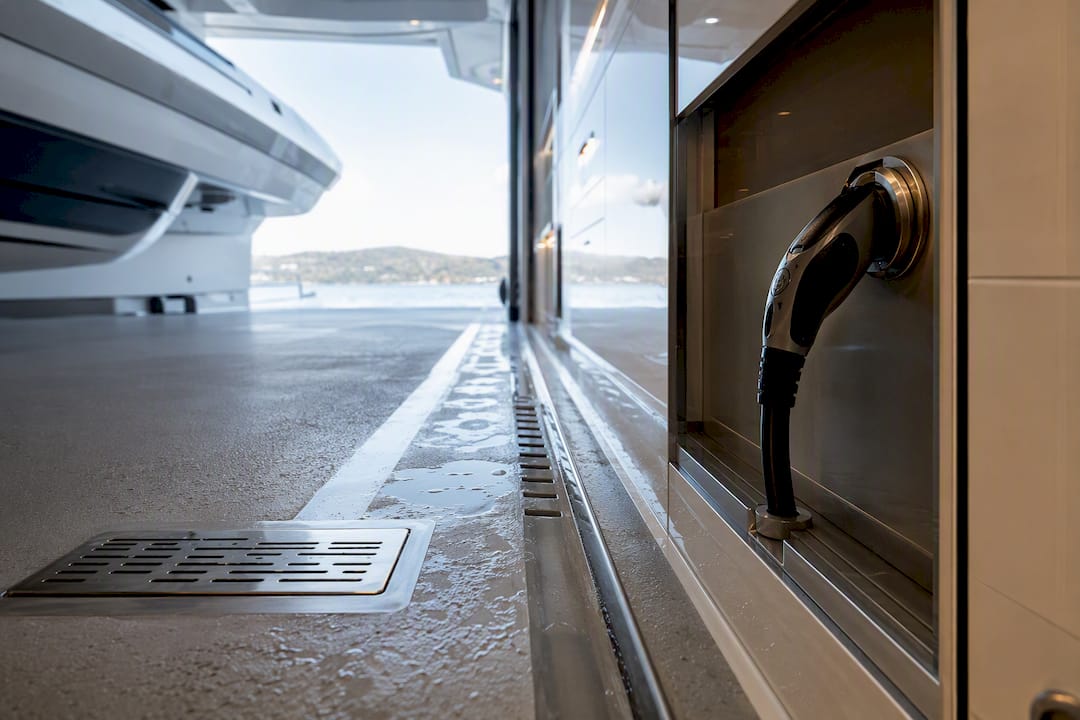
Toy maintenance follows its own rhythm. Seabobs and e-foils need battery health checks even when not in active use, since lithium cells degrade faster when left fully charged or fully depleted for extended periods. Jet skis and other engine-powered toys require the same seasonal maintenance they’d get on land: fuel system checks, impeller inspections, and corrosion prevention on any exposed metal fittings.
Racking and hoist hardware deserve their own maintenance schedule. Saltwater exposure accelerates wear on moving parts, and a hoist that fails during deployment isn’t just inconvenient, it’s a safety incident waiting to happen. Crews should inspect cable integrity, hoist motor function, and rack mounting points on a set interval rather than waiting for visible problems.
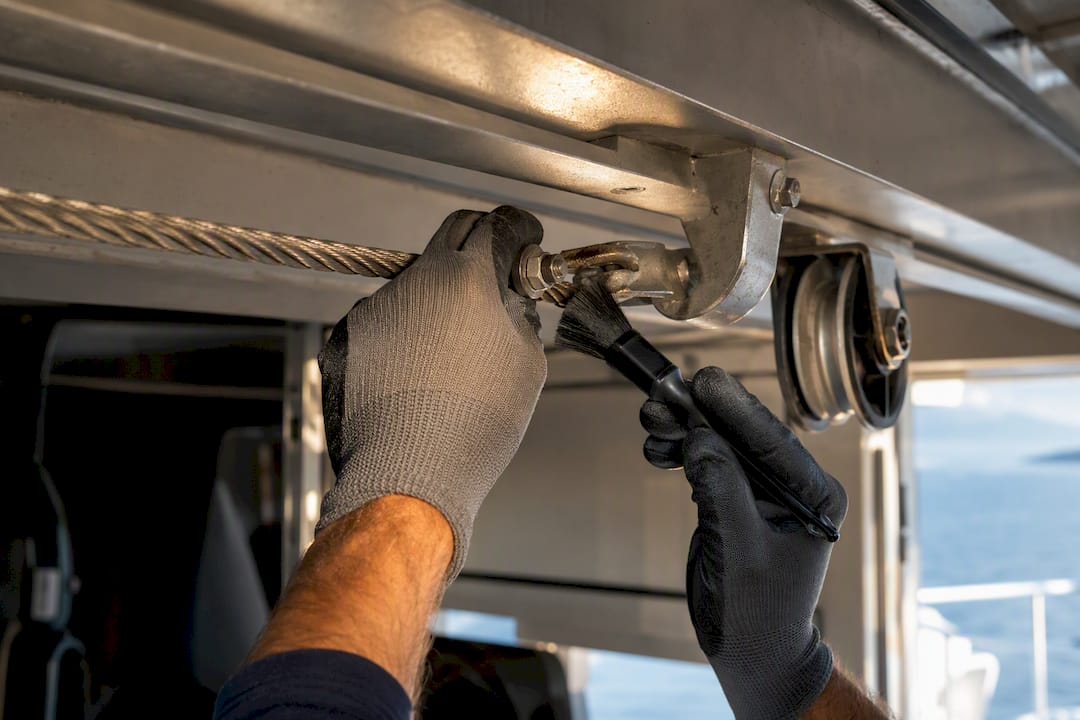
Inflatable toy docks and modular systems carry their own upkeep requirements. Drop-stitch construction and artificial teak surfaces hold up well to sun and saltwater, but connection hardware like D-rings needs periodic inspection for corrosion, particularly on vessels that deploy inflatables frequently in tropical climates.
A practical maintenance calendar treats the garage as its own subsystem, with the same scheduled attention given to engines or HVAC, rather than an afterthought handled only when something breaks.
What New Materials and Technologies Are Changing Toy Garage Construction?
Composite materials are reshaping how garages get built, favoring lightweight, corrosion-resistant panels over traditional steel or aluminum in areas where structural load allows it. This matters directly for weight budgets, since every kilogram saved in garage construction is a kilogram available elsewhere in the design.
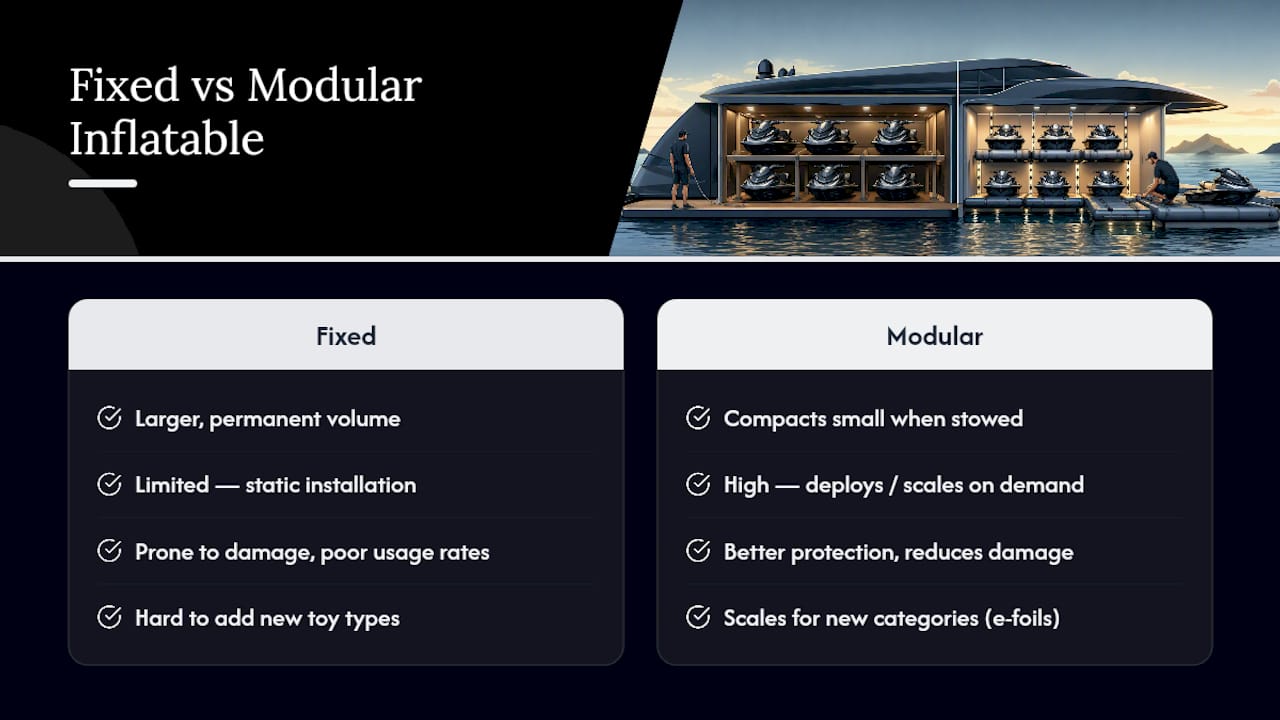
Drop-stitch technology, the same construction method behind Yachtbeach’s inflatable toy docks, has moved well beyond paddleboards into serious load-bearing marine equipment. These inflatable structures pack down to a fraction of their deployed size while still supporting multiple jet skis or Seabobs, which is changing how designers think about garage volume versus staging flexibility.

Charging infrastructure has advanced alongside the growing popularity of electric toys. Modern e-toy racks increasingly integrate charging directly into the mounting system, eliminating the tangle of extension cords that plagued early electric-toy adoption. Ventilation systems designed specifically for lithium battery storage are becoming standard in new builds rather than a retrofit afterthought.
Modular inflatable systems represent perhaps the most significant shift. As John Courtney of FunAir has noted, static, fixed solutions often lead to damaged equipment and poor usage rates, while systems built to scale with a growing toy inventory keep both the equipment and the guest experience in better condition over time. This flexibility matters more as owners add new toy categories, like e-foils, that didn’t exist in most fleets a decade ago.
What Environmental Factors Should Toy Garage Owners Consider?
Battery-powered toys have shifted the environmental conversation around toy garages considerably. Electric Seabobs, e-foils, and jet skis produce no direct exhaust emissions during use, a meaningful improvement over gas-powered predecessors, though the electricity to charge them still typically comes from the yacht’s generators.
Charging infrastructure planning has environmental implications beyond safety. Dedicated circuits sized appropriately for the actual toy fleet, rather than oversized generic wiring, reduce wasted generator runtime spent charging equipment inefficiently. Some owners are exploring solar-assisted charging for smaller toys, though this remains a supplementary rather than primary power source for most fleets.
Material choices in garage construction carry their own environmental footprint. Composite panels and modern coatings generally require different disposal and recycling considerations than traditional aluminum or steel, and owners working through a refit should ask shipyards directly about end-of-life material handling.
Inflatable toy docks and staging systems reduce the need for hard launching equipment, which can lower the overall energy demand of toy deployment compared to crane-assisted launches for heavier gear. That said, drop-stitch and PVC-based inflatables have their own manufacturing footprint worth weighing against their operational benefits.
None of this makes a toy garage inherently sustainable or unsustainable. It’s a set of choices, toy selection, charging design, and material sourcing, that owners and their design teams can shape deliberately rather than defaulting to whatever was standard a decade ago.
What Should Owners Prioritize When Planning a Toy Garage?
Deployment speed, toy compatibility, and crew efficiency matter more than sheer garage size. A smaller, well-organized space beats a cavernous one that takes twenty minutes to stage a jet ski. Future-proof for electric toys and modular inflatables now, since retrofitting charging infrastructure later costs far more than building it in from the start. Bring your design and project management team in early, before the naval architect finalizes hull volume.
— Jason
How Baranof Yacht Sales Supports Your Toy Garage Project
Our project management team coordinates design drawings, weight and dimension planning, and shipyard communication so toy storage decisions happen alongside naval architecture, not after it’s already locked in.

For owners weighing a new build against a refit, our guidance on space optimization strategies walks through how garage volume trades off against accommodation and machinery space. If you’re still early in the process, our pre-build planning resource covers the questions worth answering before you ever meet with a shipyard.
Ready to start? Review our guide on design moves shaping next-generation yachts and request a consultation to discuss your toy inventory, timeline, and garage priorities with our project management team.
Where Can You Learn More About Toy Garage Design and Examples?
For deeper specifics, the SuperyachtTenders glossary defines core terminology, while Boat International’s toy garage feature offers photo tours of Ragnar, Hodor, and Flying Fox. OB Magazine’s tender garage design guide covers planning fundamentals, and FunAir’s FunFlex page details modular inflatable specifications.
Sources
FAQ
What Is the Garage on a Yacht Called?
It’s typically called a tender garage if it houses launch craft, or a toy garage when it’s dedicated to smaller water toys like Seabobs and jet skis. Larger yachts often have both, sometimes combined into one flexible space.
Who Is Building the Somnio Yacht?
Somnio is a large sailing yacht project built by Vitters Shipyard, known for its focus on residential-style layouts and extensive owner customization, though specific toy garage details for the vessel aren’t publicly listed.
What Is the 12 Person Rule on a Yacht?
This typically refers to commercial vessel classification thresholds tied to passenger limits and crew certification requirements, which vary by flag state and vessel use. Owners should confirm the exact rule with their flag administration, since it affects staffing and safety compliance rather than toy garage design specifically.
Who Owns the Toy-A Yacht?
Ownership details for specific named vessels like Toy-A aren’t publicly listed in most cases, as many superyacht owners maintain privacy through holding companies.
How Big Should a Yacht Toy Garage Be?
Garage size depends entirely on the intended toy inventory rather than a fixed standard, but designers recommend calculating exact weights and dimensions for every planned toy before finalizing garage volume. A garage sized around a vague toy list almost always ends up too shallow or missing critical clearance for larger items like e-foils.
Recommended
Sold Listings
Design Your Yacht
"*" indicates required fields
Maximus III - PNW
As you step aboard MAXIMUS III, the first impression is her scale.
At 120 feet with an 8-meter beam and 294 GT of interior volume, this 2025 Crescent Custom tri-deck immediately feels open, balanced, and estate-like. A timeless look while still feeling fresh from the shipyard.
Currently Available


Get your yacht value Estimate
"*" indicates required fields