

Yacht market liquidity is defined as the ease and speed with which a vessel can be sold at or near its fair market value without significant price concessions. Understanding yacht market liquidity is not optional for serious investors and brokers. It is the single most important variable separating a profitable transaction from a prolonged, value-eroding listing. The 2026 brokerage market tells a clear story: median time on market reached 392 days in Q1 2026, with over 70% of sales involving price reductions. That single data point reframes how we think about yacht ownership as an asset class.
What factors determine yacht market liquidity?
Yacht market liquidity is shaped by four core variables: vessel size, documentation quality, pricing realism, and prevailing market conditions. Each factor compounds the others. A well-maintained 45m yacht with complete records and a realistic asking price will sell in months. The same vessel, overpriced and poorly documented, can stagnate for years.
Vessel size and buyer pool depth are the most immediate liquidity drivers. The 40–55m segment attracts the broadest buyer pool globally, which translates directly into faster sales and fewer price concessions. As vessels grow beyond 90m, the buyer pool shrinks to a handful of qualified individuals worldwide, making liquidity by size segment one of the most predictable patterns in the market.

Documentation and maintenance history carry more weight than most sellers expect. Documentation quality often outweighs physical condition in determining how quickly a vessel sells. Buyers and their technical teams scrutinize classification records, refit histories, and survey reports. Poor or incomplete records extend listings significantly, regardless of the vessel’s actual condition.
Pricing strategy determines transaction velocity. Key pricing considerations include:
- Asking prices set more than 10% above comparable recent sales trigger immediate buyer skepticism.
- Vessels priced within market range attract offers within the first 90 days of listing.
- Overpriced inventory accumulates “days on market,” which itself becomes a negotiating liability.
- Price reduction history signals desperation to informed buyers, compressing final sale prices further.
Market conditions have shifted materially since the pandemic-era spike of 2021–2022. Buyer leverage has returned. Inventory has risen. The sellers’ market that defined 2021 no longer exists in 2026, and pricing strategies that worked then now produce stale listings.
Pro Tip: Before listing any vessel, commission an independent broker’s opinion of value from a party with no financial interest in the sale. This removes the most common source of pricing error.
How does yacht size influence liquidity and buyer dynamics?
Yacht size is the single most reliable predictor of market liquidity. The relationship is direct: smaller vessels within the luxury segment attract more buyers, sell faster, and require smaller price concessions to close. Larger vessels invert every one of those dynamics.
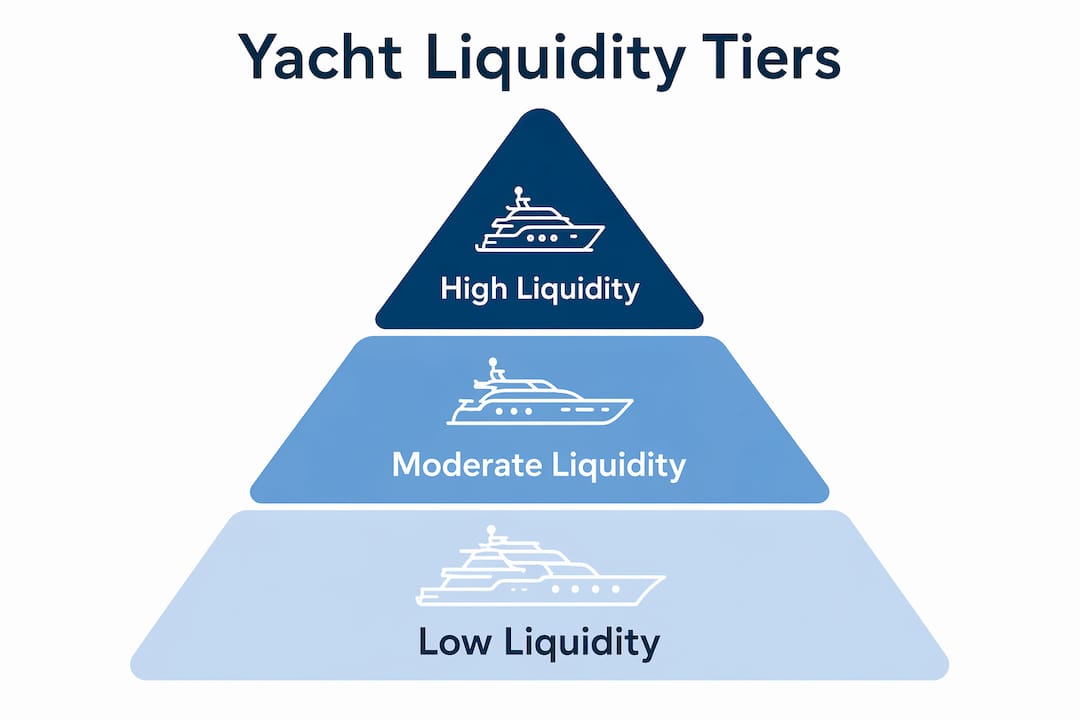
The 30–55m range represents the highest liquidity tier in the superyacht market. Buyers in this segment include first-time superyacht owners, experienced operators trading up, and charter investors. The 50–70m segment combines strong value retention with reasonable liquidity, making it the most attractive range for investors who prioritize both resale potential and holding value. This is the segment where Baranofyachts focuses much of its advisory work, precisely because the risk-adjusted returns are most predictable.
The 55–90m range introduces meaningful liquidity friction. Buyer pools thin considerably, and transactions in this segment often require six to twelve months of active marketing before a qualified offer emerges. Pricing discipline becomes critical here. A vessel that sits unsold for eighteen months in this range will almost certainly require a price reduction to reset buyer perception.
Vessels above 90m operate in a category where liquidity, in the traditional financial sense, barely exists. The buyer pool is global but tiny. Transactions are bespoke negotiations that can span years. Price discovery is opaque, and comparable sales data is sparse.
| Size segment | Liquidity level | Buyer pool | Typical time on market |
|---|---|---|---|
| 30–55m | High | Large, global | 6–12 months |
| 55–70m | Medium-high | Moderate | 9–18 months |
| 70–90m | Medium-low | Limited | 12–24 months |
| 90m+ | Low | Very small, global | 24+ months |
The table above reflects current brokerage market conditions in 2026. These ranges shift with macroeconomic conditions, but the relative hierarchy between segments is consistent across market cycles.
What does recent market data reveal about liquidity trends in 2026?
The 2026 brokerage market has split into two distinct categories. Well-priced, well-documented vessels sell within months. Overpriced or “tired” inventory stagnates, accumulates days on market, and eventually sells at deep discounts. This bifurcation is the defining characteristic of the current market.
Median time on market reached 392 days in Q1 2026. That figure represents the midpoint of all brokerage transactions, meaning half of all sales took longer than thirteen months to close. The implication for investors is direct: plan for a minimum twelve-month exit timeline in any scenario analysis.
“The market is functioning but ruthless. Buyers today expect clarity, transparency, and realistic pricing. Vessels that deliver on all three sell. Those that do not simply wait.”
Peter Hürzeler, reflecting on 2026 superyacht brokerage conditions
Price concessions have widened from the pandemic era. In a strong market, superyachts typically sell within 5–15% below asking price. Current discounts on older or less-maintained vessels now commonly reach 15–25% below the original asking price. Vessels that remain unsold beyond two years face median price reductions exceeding 30%. That is not a negotiating concession. That is a structural destruction of asset value.
Shipyard inventory data adds another layer to the liquidity picture. Turkey’s unsold new-build projects stood at 41.8% in early 2026. Elevated unsold inventory in key shipyards increases buyer leverage across the entire market, because buyers can credibly threaten to commission a new build rather than accept an unfavorable brokerage price. Brokers who understand this dynamic use it as a negotiating reference point in every transaction.
How to analyze yacht market liquidity for investment and brokerage decisions
Superyacht market liquidity assessment requires a structured approach. Experienced investors treat liquidity analysis as a pre-purchase discipline, not an afterthought. The following framework applies to both buy-side and sell-side decisions.
-
Track time on market and price adjustment history. Every listing carries a timestamp. Experienced investors monitor days on market and the number of price reductions as primary liquidity proxies. A vessel listed for over 500 days with two price reductions is telling you something the asking price does not.
-
Audit documentation before any offer. Request the full classification history, refit records, crew logs, and survey reports. Gaps in documentation are not administrative inconveniences. They are liquidity risks that will surface during the buyer’s due diligence and compress your negotiating position.
-
Map inventory saturation in relevant shipyards. Inventory saturation in key shipyards creates pricing pressure across the brokerage market. Understanding which yards carry high unsold inventory tells you how much leverage a buyer realistically holds and where pricing floors are likely to settle.
-
Price to the current market, not the last transaction. The 2021–2022 sale prices are not comparable to 2026 conditions. Use only transactions from the past twelve months as pricing benchmarks. Anything older reflects a different market entirely.
-
Invest in professional marketing and representation. Yacht video marketing and high-quality visual presentation materially reduce time on market for correctly priced vessels. Buyers in the luxury segment make emotional decisions first and rational ones second. Presentation quality signals vessel quality before a single survey is commissioned.
Pro Tip: When evaluating a vessel as an investment, calculate your break-even exit price assuming a 20% discount from today’s asking price and a 15-month sale timeline. If the numbers still work, the investment is genuinely liquid enough to hold.
Key Takeaways
Yacht market liquidity determines how quickly and at what price a vessel sells, making it the central variable in every investment and brokerage decision.
| Point | Details |
|---|---|
| Liquidity varies sharply by size | The 30–55m segment sells fastest; 90m+ vessels can take years to transact. |
| 392 days is the 2026 median | Half of all brokerage sales in Q1 2026 took longer than thirteen months to close. |
| Documentation drives speed | Complete maintenance and classification records reduce time on market more than cosmetic condition. |
| Overexposure destroys value | Vessels listed beyond two years face median price reductions exceeding 30%. |
| Pricing realism is non-negotiable | Current market discounts on older vessels commonly reach 15–25% below original asking price. |
What I’ve learned about liquidity that most sellers ignore
The most consistent mistake I see in this market is sellers treating their vessel’s asking price as a negotiating starting point rather than a market signal. Buyers in 2026 are informed. They have access to days-on-market data, price adjustment histories, and comparable sales. When a vessel is overpriced, buyers do not negotiate. They wait, or they walk.
The second pattern I observe is the underestimation of documentation as a liquidity tool. Sellers invest in cosmetic refits and deck refinishing while neglecting to organize their classification records and refit invoices. A buyer’s technical team will spend two hours reviewing paperwork for every one hour they spend on the vessel. Incomplete records create doubt, and doubt kills deals.
My honest advice to any investor evaluating a yacht purchase is to treat yacht brokerage expertise as a non-negotiable line item, not an optional service. The brokers who understand current market liquidity conditions will save you more money in negotiation than their commission costs. The ones who do not will cost you far more in time and value erosion.
The market right now rewards preparation and punishes optimism. That is not a pessimistic view. It is the most useful framing for anyone who wants to transact successfully in 2026.
— Jason
Baranofyachts and the liquidity challenge
Navigating yacht market liquidity requires more than market awareness. It requires the right representation, pricing discipline, and documentation management from day one.

Baranofyachts works with investors and brokers who need more than a listing service. We bring structured market analysis, documentation review, and yacht marketing strategies that position vessels for the fastest possible sale at the strongest defensible price. Our team also tracks the 2026 yachting market conditions in real time, so every pricing and timing recommendation reflects current buyer behavior, not last year’s data. If you are evaluating a purchase or preparing a vessel for sale, contact Baranofyachts to discuss how we approach liquidity from both sides of the transaction.
FAQ
What is yacht market liquidity?
Yacht market liquidity is the measure of how quickly a vessel can be sold at or near its fair market value. High liquidity means fast sales with minimal price concessions; low liquidity means extended listings and significant discounts.
How long does it take to sell a superyacht in 2026?
The median time on market for brokerage yachts in Q1 2026 reached 392 days, with over 70% of sales involving price reductions. Well-priced, well-documented vessels in the 30–55m segment can sell in six to twelve months.
Which yacht size segment has the best liquidity?
The 30–55m segment carries the highest liquidity due to its large global buyer pool. The 50–70m range offers the strongest combination of value retention and reasonable liquidity for investment purposes.
How do price reductions affect a yacht’s market position?
Each price reduction signals to buyers that the original asking price was unrealistic, which invites lower offers. Vessels listed beyond two years face median price reductions exceeding 30%, compounding the value loss.
What makes a yacht easier to sell quickly?
Realistic pricing relative to current comparable sales, complete documentation and maintenance records, and professional marketing representation are the three factors that most consistently reduce time on market.
Recommended
Sold Listings


Design Your Yacht
"*" indicates required fields
Maximus III - PNW
As you step aboard MAXIMUS III, the first impression is her scale.
At 120 feet with an 8-meter beam and 294 GT of interior volume, this 2025 Crescent Custom tri-deck immediately feels open, balanced, and estate-like. A timeless look while still feeling fresh from the shipyard.
Currently Available


Get your yacht value Estimate
"*" indicates required fields