
Yes, many yachts entering the United States are dutiable. The base rate under HTS 8903 typically runs around 1.5% of declared value, but overlay tariffs under Section 301 or Section 232 can push effective duty considerably higher. Whether you owe anything at all, and how much, hinges on country of origin, USMCA eligibility, how the vessel is owned, and whether it’s ever offered for sale to a U.S. resident.
TL;DR:
- Customs classification and proper documentation are critical, as misclassification or missing origin proof can lead to significantly higher duties including overlay tariffs.
- Ownership structure and vessel use directly influence dutiability; offering the yacht for sale or using it commercially while in U.S. waters automatically triggers import duties.
- Proper pre-import steps include requesting a Certificate of Origin, engaging a licensed customs broker, and preparing all required forms before vessel arrival.
- USMCA eligibility often allows duty-free entry for North American-built yachts, but only if a valid certificate of origin is provided; otherwise, duties apply.
- Delay in planning or failure to comply with documentation requirements can cause costs and timelines to balloon, emphasizing early coordination with customs professionals.
Table of Contents
- Yacht Import Duty Calculation: HTS Rates and Overlay Tariffs
- Legal Strategies to Reduce Yacht Import Duty Exposure
- Forms and Steps for a Lawful U.S. Yacht Import
- Yacht Import Costs and Timeline: What to Budget
- What Customs Rulings Reveal About Yacht Dutiability
- Pre-Purchase Checklist for Managing Yacht Import Duty
- A Broker’s View on Minimizing Yacht Import Risk
- Import Coordination Through Baranof Yacht Sales
- Sources
Yacht Import Duty Calculation: HTS Rates and Overlay Tariffs
Every dutiability question starts with classification. HTS 8903 covers yachts and other pleasure vessels, and Chapter 89 breaks that heading into subheadings based on hull material, propulsion, and length. Get the subheading wrong and you’ll either overpay or invite a CBP correction down the road. Value matters too. Onboard equipment, electronics packages, and whether a trailer travels with the vessel can all shift the classification and the number CBP uses to calculate duty.
We tell every client to verify the current rate directly through the HTS search tool rather than trust a broker’s memory or a five-year-old blog post.
Origin changes everything from there. A vessel built in a country with Most Favored Nation status pays the standard rate. One built in North America may qualify for duty-free treatment under USMCA, provided the rules of origin are met and documented. But origin can also work against you:
- Section 301 tariffs apply additional duty to Chinese-built vessels and components, often stacking well above the base rate.
- Section 232 aluminum derivative duties target aluminum-hulled boats and can apply regardless of where final assembly occurred.
- IEEPA-related tariff actions occasionally layer on top of both, depending on the political and trade climate at the time of entry.
A tariff calculator built on the HTS 8903 dataset shows how quickly these overlays compound by country of origin. Run your numbers before you sign anything, not after the vessel is already at a U.S. port.
Legal Strategies to Reduce Yacht Import Duty Exposure
Duty isn’t automatic just because a yacht crosses into U.S. waters. Cruising licenses and foreign-flag registration let nonresident owners bring foreign-built vessels in for personal use without triggering a formal consumption entry. CBP’s own guidance confirms pleasure boats brought by nonresidents for their own use can be admitted without paying duty upfront, though the required paperwork still needs to be in order at the port.
Ownership structure matters just as much as flag state. A foreign corporation owning a foreign-flag yacht can preserve that duty-free temporary status, but the moment the vessel is offered for sale or lease to a U.S. resident, the exemption disappears. Customs Ruling HQ 111495 lays this out clearly: intent and use, not just paperwork, decide the outcome.
Three triggers commonly convert a duty-free temporary entry into a taxable consumption entry:
- Listing the vessel for sale while it sits in U.S. waters under a temporary permit.
- Re-documenting the yacht under U.S. flag without properly exporting and re-importing it.
- Using the vessel commercially, such as chartering it to U.S. clients, while it’s still classified as a personal-use import.
USMCA offers the cleanest path to zero base duty, and often sidesteps Section 232 exposure too, when a vessel genuinely qualifies as North American in origin. That requires a proper certificate of origin, not just a builder’s assurance.
Pro Tip: Get customs counsel involved before you finalize a purchase agreement, not after the vessel arrives. Rulings like HQ 111495 exist precisely because owners assumed a strategy was safe without confirming it against current CBP interpretation.
Forms and Steps for a Lawful U.S. Yacht Import
Every import boils down to a documentation trail. CBP, the EPA, and NHTSA each want their own proof before a yacht clears entry.
- Bill of sale and title or ownership documents establishing chain of custody.
- Certificate of Origin, including a USMCA Certificate if you’re claiming duty-free treatment.
- EPA Form 3520-1, the engine declaration confirming emissions compliance for the vessel’s power plant.
- NHTSA Form HS-7, required only if a trailer accompanying the yacht qualifies as a motor vehicle.
- CBP entry paperwork and Form 7501, the formal entry summary used to calculate and post duty.
If you’re relying on a cruising license rather than a full consumption entry, CBP will expect evidence rebutting any presumption of permanent import, things like ownership records, foreign-flag documentation, and proof the vessel hasn’t been offered for sale. A licensed customs broker handles most of this filing, and for high-value vessels, a continuous customs bond is standard practice rather than optional. Getting a broker involved before the yacht leaves its country of origin, not after arrival, is what separates a smooth entry from a stalled one at port.
Yacht Import Costs and Timeline: What to Budget
Duty is only part of the bill. The Merchandise Processing Fee (MPF) and Harbor Maintenance Fee (HMF) both apply to formal entries, calculated as a percentage of declared value with statutory minimums and caps. Broker fees and bond costs vary with vessel value and complexity, and valuation itself deserves scrutiny. CBP can rely on the invoice price, but a written appraisal carries more weight if origin or value is contested later.
A common industry benchmark puts the full process at two to six weeks from signed contract to cleared entry, assuming documentation is complete on day one. Overlay tariffs are where budgets get blown. A yacht that looks like a straightforward 1.5% duty case can jump considerably higher once Section 301 or Section 232 exposure applies, so run the math on landed cost before you commit to a purchase price.
What Customs Rulings Reveal About Yacht Dutiability
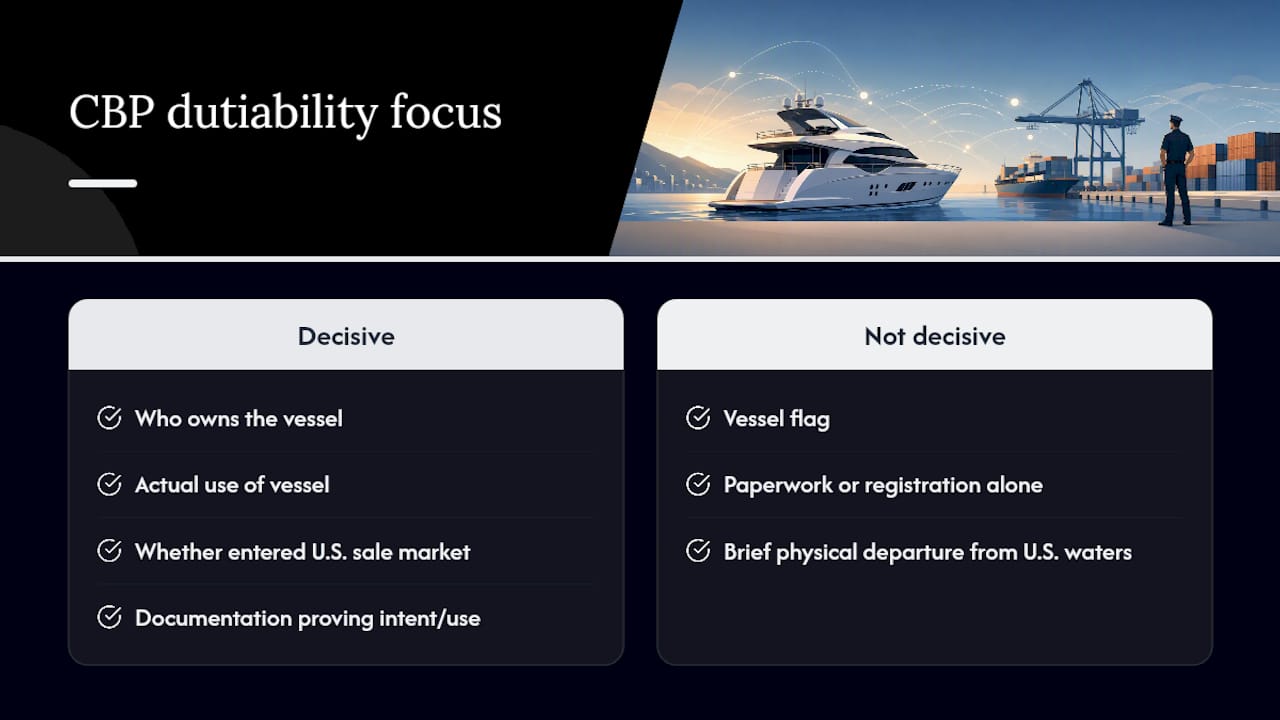
Two rulings do more to explain real-world dutiability than any general guide. In HQ 111495, CBP found a foreign-flag yacht owned by a foreign corporation could enter temporarily without duty, but only because it stayed out of the U.S. sale market. The moment that changes, so does the duty status.
HQ 114301 tackles a trickier question: does a previously duty-paid vessel stay duty-free on resale? CBP’s answer turns on whether a regulatory “exportation” actually occurred, not just whether the vessel physically left U.S. waters at some point.
The lesson from both rulings is the same. CBP looks past the flag and the paperwork on file to the facts on the ground, who owns the vessel, what it’s being used for, and whether it’s ever crossed into the sale market. Documentation that proves intent and use consistently outweighs a technically correct registration.
Pre-Purchase Checklist for Managing Yacht Import Duty
Before you sign anything, work through this sequence:
- Confirm the correct HTS classification and country of origin.
- Request a Certificate of Origin, including USMCA documentation if the vessel qualifies.
- Line up EPA Form 3520-1 and NHTSA HS-7 (if a trailer applies) before arrival, not after.
- Engage a licensed customs broker and confirm bond requirements early.
- Get a written valuation or appraisal rather than relying solely on the invoice price.
- Avoid listing the vessel for sale until dutiability is fully resolved.
Watch for the same red flags that appear in every contested ruling: re-documenting under U.S. flag without proper exportation, selling to a U.S. resident while under temporary entry, or leaving the vessel permanently moored in U.S. waters with no exportation trail.
Pro Tip: Treat the offshore delivery process as part of your compliance plan, not just logistics. How and where a yacht is delivered can itself become evidence in a dutiability dispute.
A Broker’s View on Minimizing Yacht Import Risk
Compliance beats cleverness every time. The buyers who avoid duty surprises are the ones who nail down ownership records, classification, and broker selection before the purchase agreement is signed, not after the yacht is sitting at a U.S. dock with a CBP question mark over it. We coordinate customs planning alongside logistics for exactly this reason: duty exposure is a build-and-buy decision, not an afterthought. If you’re weighing an import, talk to us before you commit to terms.
— Jason
Import Coordination Through Baranof Yacht Sales
We offer an alternative to piecing together your import from separate brokers, customs agents, and logistics firms. We coordinate brokerage, customs documentation, valuation, and project management under one roof, so classification questions, USMCA eligibility, and CBP paperwork get resolved before they become costly delays.

Our team works directly with clients on boat brokerage services that extend beyond the sale itself, covering documentation assistance and coordination with licensed customs brokers for U.S. entries. Whether you’re evaluating a foreign-built yacht or planning a custom build with import considerations from the start, support is available to help you see the full landed cost before you commit. Consider scheduling a consultation to discuss your specific import scenario and obtain a clear understanding of duty exposure before signing a purchase agreement.
Sources
CBP personal-use boat guidance, HTS lookup, EPA Form 3520-21, NHTSA HS-7, HQ 111495, HQ 114301.
- Importing a Boat for Personal Use into the United States
- HTS search — U.S. Harmonized Tariff Schedule
- Customs Ruling HQ 111495 – Foreign-flag Yacht; Foreign Corporate Ownership; Importation; Cruising license; HTSUSA; 46 U.S.C. App. 104
Recommended
Sold Listings


Design Your Yacht
"*" indicates required fields
Maximus III - PNW
As you step aboard MAXIMUS III, the first impression is her scale.
At 120 feet with an 8-meter beam and 294 GT of interior volume, this 2025 Crescent Custom tri-deck immediately feels open, balanced, and estate-like. A timeless look while still feeling fresh from the shipyard.
Currently Available


Get your yacht value Estimate
"*" indicates required fields