

Most multi-cabin yachts are best served by a modular chilled-water system rather than a self-contained or split unit, because it scales cleanly with vessel size and runs far quieter than direct-expansion alternatives. The three families worth knowing are self-contained units, split systems with remote condensers, and chilled-water chillers. Whichever route you take, the decisions that matter most are correct capacity, low noise and vibration, and electrical sufficiency, and every one of those decisions gets easier when serviceability is designed in from the start rather than bolted on later.
TL;DR:
- Modular chilled-water systems offer scalable, quiet, and redundancy-capable climate control for vessels with four or more cabins, making them ideal for new builds or major refits.
- Proper system sizing requires detailed load calculations that account for vessel-specific factors like hull, glazing, and cruising environment, rather than simple rules of thumb.
- Acoustic insulation, vibration isolation, and low-speed fans are essential to achieving cabin noise levels below 40 decibels at cruising load.
- Redundancy can be built with multiple chiller modules and electrical backup schemes, which prevent total climate control loss during failures or maintenance.
- Correct installation and ongoing maintenance, including regular cleaning, leak checks, and monitoring pump amperage, are vital to system longevity and performance.
Table of Contents
- Which Yacht HVAC System Type Fits Your Vessel?
- What Are the Core Components of a Yacht HVAC System?
- How Do You Size a Yacht HVAC System Correctly?
- How Quiet Should a Yacht HVAC System Be?
- What Controls Should a Yacht HVAC System Include?
- What Should You Know Before Installing or Retrofitting Yacht HVAC?
- How Do You Maintain a Yacht HVAC System?
- What Belongs in a Yacht HVAC Specification Checklist?
- What Environmental Rules Apply to Yacht HVAC Systems?
- How Does HVAC Affect Yacht Fuel Consumption and Emissions?
- What Air Filtration Do Yacht HVAC Systems Need?
- What Backup and Redundancy Should Critical HVAC Have?
- Sequencing HVAC Decisions From Concept to Commissioning
- How Baranofyachts Supports Your HVAC Decisions
- Sources
- FAQ
Which Yacht HVAC System Type Fits Your Vessel?
The vessel size and cabin count decide most of this question before you ever compare brands. Self-contained units house the compressor, condenser, and evaporator in one box, usually tucked under a bunk or settee, with seawater plumbed directly to that box. They’re compact, inexpensive per ton, and simple to service, which is why they still dominate smaller motor yachts and sailboats under roughly 50 feet. The tradeoff is noise: the compressor sits close to living space, and there’s no practical way to isolate it fully from the hull.
Split systems move the condenser and compressor to a remote location, often a lazarette or engine room, leaving only a quieter air handler in the cabin. That single change cuts perceived noise dramatically, but it adds refrigerant line runs, more failure points, and a harder retrofit if the original layout wasn’t designed for it.
Chilled-water systems change the architecture entirely. A central chiller (or a modular bank of chillers) cools a water loop that circulates to fan coil units throughout the yacht, so no refrigerant lines run through living spaces at all. This is the approach that dominates crewed yachts above roughly 80 feet, and increasingly on smaller vessels where owners specifically ask for near-silent cabins.
- Self-contained: lowest cost, easiest to install on smaller boats, but compressor noise lives where you sleep.
- Split/remote condenser: quieter cabins, moderate retrofit complexity, still refrigerant-dependent.
- Chilled-water/central chiller: best noise performance, true modular capacity growth, and redundancy through multiple chiller modules, at a higher installation and equipment cost.
For a new build or a major refit involving four or more cabins, the modular chilled-water route is the one we recommend clients specify from day one. It’s the only architecture that lets a shipyard add zones later without re-plumbing refrigerant through finished joinery.
What Are the Core Components of a Yacht HVAC System?
Every yacht climate system, regardless of family, moves heat out of the cabin and dumps it into seawater using a closed refrigerant loop and a seawater heat exchanger. Chilled-water systems add a second loop between the chiller and the fan coils, which is what allows the quiet, distributed layout owners now expect. Here’s what each component actually does, and where it tends to fail.
- Chillers: the refrigeration unit that cools the water loop. Titanium condensers are increasingly standard here because they resist the pitting and scaling that plague copper-nickel units in seawater service, extending service life well beyond a typical refit cycle.
- Condensers: reject heat from the refrigerant to seawater. This is the single most corrosion-exposed component in the whole system, which is why material choice matters more here than almost anywhere else on the boat.
- Air handlers and fan coils: distribute cooled or heated air to cabins. These units need adequate filtration and condensate drainage, since a clogged drain pan is one of the most common causes of unexplained cabin odors.
- Seawater heat exchangers: transfer heat from the chilled-water loop (or refrigerant, in DX systems) to raw seawater before it’s discharged overboard.
- Sea strainers: the first line of defense against marine growth and debris; an undersized or neglected strainer starves the whole system of flow.
- Seawater and chilled-water pumps: circulate raw water and the internal loop, respectively. Pump amp draw is one of the earliest warning signs of impending failure.
- Expansion vessels and valves: maintain loop pressure and regulate flow to each fan coil, keeping zones balanced even as demand shifts across the yacht.
Ventilation and filtration deserve a mention here too, since fresh-air intake and cabin air turnover directly affect how “close” a stateroom feels, regardless of how well the cooling itself performs. If you’re weighing fresh-air strategy alongside cooling capacity, our crew comfort guidance covers the ventilation side in more depth.
How Do You Size a Yacht HVAC System Correctly?
Heat-load calculation for a yacht isn’t the same math used for a house, and treating it that way is the single most common sizing mistake we see in refit proposals. Cabin count, glazing area, hull material, generator heat, and the number of people aboard all shift the load, and marine environments add humidity and solar gain that residential formulas underestimate. A rough starting point is 12,000 to 18,000 BTU/h per average stateroom, but that figure moves substantially with large windows, dark hull colors, and tropical cruising grounds, so it should always be verified against a proper load calculation rather than a rule of thumb alone.
Modular chilled-water systems solve the capacity question differently than a single large chiller would. Instead of one unit sized for peak load, you combine multiple modules. Webasto’s BlueCool V-PRO series, for example, is offered in 60 to 180 kBTU/h units that combine up to six modules for a combined output near 1,080,000 BTU/h, which covers everything from a large motor yacht to a full superyacht refit.
- Redundancy planning: with modular systems, losing one chiller module drops capacity rather than killing climate control entirely. A three-module installation sized at 120% of calculated load still delivers roughly 80% of demand if one module fails.
- Electrical planning: compressors draw far more current on startup than while running, so generator and shore power sizing must account for peak starting amps, not steady-state draw. Three-phase power is common on larger installations because it reduces per-line current and balances load more evenly across a generator.
- Efficiency metrics to require: ask for EER figures in writing, not just tonnage. Variable-speed compressor models, like Webasto’s BlueCool VX-series, post EER values up to about 5.6 on certain models, which is a meaningful improvement over fixed-speed units running at part load most of the time in port.
Pro Tip: Ask your integrator to model electrical load at anchor with the generator running at its typical cruising RPM, not full rated output. Chiller compressors often start when voltage is already sagging under galley and hydraulic loads, and that’s where undersized wiring shows up first.
If shore or generator capacity is already tight, it’s worth reviewing your onboard power budget before finalizing HVAC specs, since solar and battery buffering can shave peak generator runtime meaningfully.
How Quiet Should a Yacht HVAC System Be?
Owners judge HVAC success by what they don’t notice, not by tonnage. Trade reporting on marine HVAC design consistently frames the ideal system as one that’s essentially invisible: no audible compressor cycling, no vibration through the hull, no lingering odor in staterooms. That standard is achievable, but it requires deliberate engineering rather than a default installation.
- Isolate the source: mount chillers and pumps on silent blocks or spring isolators, never bolted directly to structural bulkheads that transmit vibration into cabin walls.
- Decouple the plumbing: flexible couplings between the chiller and rigid piping prevent vibration from traveling down the seawater and chilled-water loops.
- Slow the air: low-speed, larger-diameter fans move the same air volume with less turbulence noise than small, high-speed fans.
- Rack it separately: mounting multiple chiller modules on a decoupled rack, rather than individually bolted to the hull, cuts cumulative vibration transfer significantly.
- Manage air quality actively: fresh-air units with proper filtration prevent the musty, closed-cabin smell that owners often mistake for an HVAC fault rather than a ventilation gap.
A reasonable acceptance target is cabin noise under 40 dB(A) at cruising load, though luxury builds increasingly ask for figures closer to 35 dB(A) in master suites. Whatever number you settle on, get it written into the contract as a measurable target, not a marketing adjective.
What Controls Should a Yacht HVAC System Include?
Local touchscreen control at each zone is table stakes now, but the more important question is what happens when nobody’s standing at that screen. Networked systems that report flow rate, seawater inlet temperature, and fault codes back to a central gateway let an engineer catch a failing pump before it becomes a 2 a.m. cabin without air conditioning at anchor. Modular chiller platforms increasingly build this in, with autonomous per-module control and centralized displays that simplify both commissioning and day-to-day monitoring.
- Local panels: give crew and guests direct temperature and fan control per cabin without needing a technician.
- Networked gateways (CAN or Wi‑Fi): allow remote diagnostics, so a shore-based technician can review fault history before a service call rather than guessing at the dock.
- Performance telemetry that matters: flow rate, seawater temperature, compressor run hours, and fault logs are the four data points that catch problems early.
- Automation integration: HVAC increasingly ties into the same networked platforms that manage vessel security and automation, which is efficient but raises the stakes on basic cybersecurity hygiene, like changing default credentials on any networked panel before commissioning.
What Should You Know Before Installing or Retrofitting Yacht HVAC?
Retrofits fail more often on plumbing geometry than on the equipment itself. A chiller with a perfect spec sheet still needs proper seawater intake placement, adequate strainer sizing, and enough service clearance to pull a pump without cutting into joinery.
- Confirm access before ordering equipment. Measure the actual clearance around the proposed chiller location, including room to slide out a fan coil for filter changes, not just the footprint of the unit itself.
- Size seawater pickups and strainers to worst-case demand, not average draw, since undersized strainers are the leading cause of reduced flow and premature pump wear.
- Route through-hull plumbing to minimize fittings and elbows, each of which adds friction loss and a potential leak point below the waterline.
- Verify electrical compatibility before demolition begins, especially voltage, phase, and breaker sizing against the new unit’s startup draw.
- Check for drop-in retrofit compatibility. Platforms like the Ti22 ProX are built around identical seawater and chilled-water connection points to older units, which can cut refit labor substantially when replacing an aging chiller.
Pro Tip: Photograph and label every existing seawater and chilled-water connection before disconnecting anything during a retrofit. It sounds obvious until you’re three weeks into a refit trying to remember which valve fed which loop.
How Do You Maintain a Yacht HVAC System?
Most HVAC failures at sea trace back to a maintenance step that got skipped weeks earlier, not a sudden component failure. A simple cadence catches the majority of problems before they become an at-anchor emergency.
- Daily: check for visible leaks around fittings and confirm normal fan and pump sound.
- Weekly: inspect the sea strainer for debris and confirm pump amp draw is within the manufacturer’s normal range.
- Annually: clean or acid-flush condensers to remove scale and biofouling, check refrigerant charge and pressures, and service or replace worn valves.
- Watch for pump cavitation, usually caused by a clogged strainer or air in the seawater line, which shows up as unusual pump noise before it shows up as reduced cooling.
- Watch for fouled condensers, which reduce heat transfer and show up as longer compressor run times for the same cooling result.
A basic onboard spares kit should include a spare strainer basket, pump seal kit, contactor, and a set of the specific fuses or breakers the system uses, since a $20 part failure shouldn’t strand a $30 million yacht at anchor for a week waiting on a courier.
Pro Tip: Log pump amp draw monthly in a simple spreadsheet or your maintenance software. A slow upward creep over several months is often the earliest, cheapest-to-fix warning sign of impending pump failure. Service software platforms built for marine operations, like Modern DMS, can automate that tracking across a fleet rather than relying on a paper logbook.
What Belongs in a Yacht HVAC Specification Checklist?
A tender or RFP that doesn’t nail down these specifics invites vague bids that are impossible to compare fairly.
- Minimum capacity with redundancy margin: specify total BTU/h at worst-case load, plus a stated percentage of capacity retained if one module fails.
- Acoustic acceptance criteria: a measurable dB(A) target per cabin type, verified at sea trial, not just at the dock.
- Control and monitoring requirements: networked diagnostics, fault logging, and remote access specified by name, not left to the installer’s default configuration.
- Warranty and service terms: parts and labor coverage length, and confirmed access to authorized service in your cruising region.
| Checklist item | What to specify | Why it matters |
|---|---|---|
| Capacity margin | Percent above calculated peak load | Prevents undersized systems in tropical cruising |
| Redundancy | Capacity retained with one module offline | Avoids total loss of climate control |
| Acoustic target | dB(A) at cruising load, by cabin | Turns “quiet” into a testable requirement |
| Controls | Named gateway/telemetry features | Reduces service response time |
Before finalizing any of this, it’s worth reviewing broader pre-build planning steps so HVAC specs align with the rest of the build schedule rather than getting locked in isolation.
What Environmental Rules Apply to Yacht HVAC Systems?
Refrigerant choice is the main regulatory lever here. Older R22-based systems have been phased down under international agreements, and most new marine chillers now ship with R410A or the lower-global-warming-potential R32, which yards increasingly prefer for new builds and major refits. Refrigerant handling itself falls under rules similar to those governing other equipment aboard: leak prevention, proper recovery during service, and record-keeping on refrigerant charges added or removed.
MARPOL’s broader framework governs discharge and emissions from vessels generally, and while HVAC seawater discharge is minimal compared to other onboard systems, yards still need to confirm that any additives or biocides used in strainer or condenser maintenance meet discharge requirements in the waters where the yacht operates. EPA refrigerant handling rules apply to technicians servicing systems in American waters, which means choosing a service provider certified to handle modern refrigerants correctly is not optional if you want to stay compliant during ownership.
The practical takeaway for owners: specify refrigerant type in writing during procurement, confirm the installing yard’s technicians hold current certification for that refrigerant, and keep documentation of any refrigerant service performed. It’s a small paperwork habit that avoids real headaches at resale or survey time.
How Does HVAC Affect Yacht Fuel Consumption and Emissions?
Climate control is one of the largest continuous electrical loads on a crewed yacht at anchor, which means it’s also one of the largest drivers of generator runtime, fuel burn, and associated emissions in that mode. A generator idling most of the night largely to satisfy air conditioning demand is a common and often underestimated cost of ownership, particularly in warm-weather cruising grounds where compressors run near continuously.
Efficiency metrics matter here beyond comfort. A variable-speed compressor system that maintains EER near 5.6 at part load draws meaningfully less power overnight than a fixed-speed unit cycling on and off at full draw, and that difference compounds across a season of tropical cruising. Multiply that by every cabin’s fan coil and the aggregate savings on generator fuel become significant over a full year of use.
Owners increasingly ask how HVAC sizing interacts with onboard power generation strategy, and that’s a fair question to bring into the design phase rather than treating electrical load as an afterthought once equipment is already selected. Pairing efficient HVAC specification with a broader look at solar and battery buffering can reduce the hours a generator needs to run purely to keep cabins comfortable, which lowers both fuel cost and the vessel’s carbon footprint over a cruising season.
What Air Filtration Do Yacht HVAC Systems Need?
Marine air handling faces a filtration challenge residential systems rarely see: salt-laden air, high humidity, and enclosed spaces that concentrate odors quickly if fresh-air turnover is inadequate. Standard pleated filters at the fan coil catch dust and larger particulates, but they don’t address humidity control or the musty smell that develops in poorly ventilated staterooms during long periods of closed-up storage.
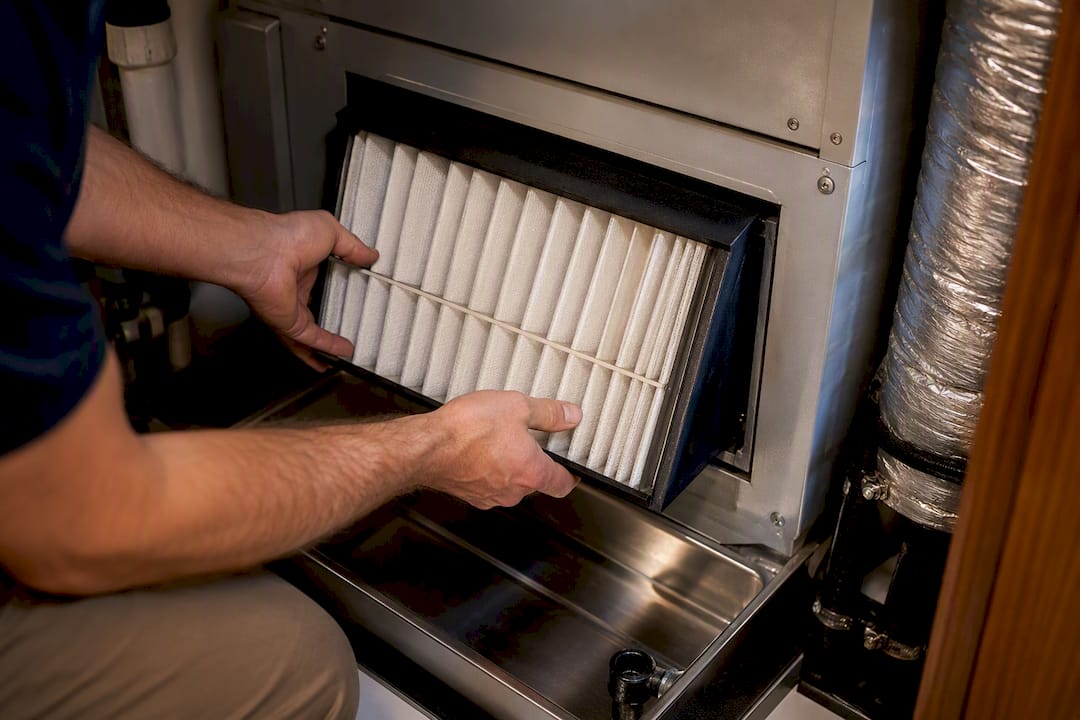
Fresh-air intake units, separate from the recirculating fan coils, actively exchange stale cabin air for filtered outside air, which is the real fix for persistent odor complaints rather than simply running the AC harder. Higher-grade filtration, including activated carbon stages, helps with diesel exhaust infiltration near engine spaces and general air freshness in guest areas, a detail owners notice immediately even if they can’t articulate why a cabin feels “stale” versus “fresh.”
Humidity control deserves separate attention from temperature control on a yacht. A system that hits its temperature setpoint but leaves relative humidity above 60% will still feel damp and will accelerate mildew growth in fabric and joinery, particularly in enclosed lockers and lower decks. Specifying dehumidification capacity alongside cooling capacity, rather than assuming cooling alone will handle it, is one of the more overlooked details in yacht climate design. For a broader look at how ventilation strategy ties into overall crew and guest comfort, our crew comfort resource covers the fresh-air side in more detail.
What Backup and Redundancy Should Critical HVAC Have?
Losing climate control entirely at anchor in a tropical harbor isn’t a comfort inconvenience, it’s a real problem for guests, crew, and in some cases sensitive equipment or wine storage aboard. That’s the practical argument for redundancy beyond what regulation requires.
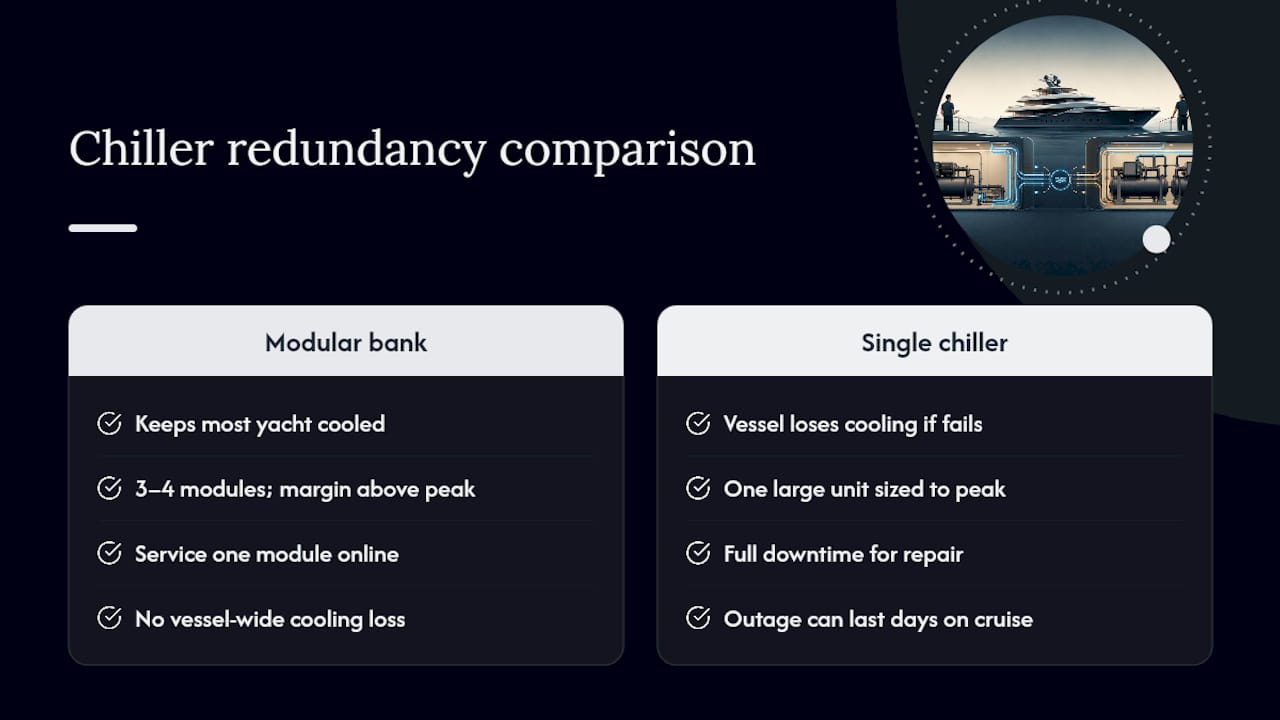
Modular chiller architecture is the most direct redundancy strategy available, since a bank of three or four modules sized with margin above calculated peak load keeps most of the yacht comfortable even if one module drops offline for service or failure. A single large chiller offers no such fallback: if it fails, the entire vessel loses cooling until it’s repaired or replaced, which on a remote cruise can mean days, not hours.
Electrical redundancy matters just as much as mechanical redundancy. HVAC circuits should be wired so a generator failure doesn’t take down climate control entirely if shore power or a second generator is available, and critical zones, like guest master suites or any space with sensitive equipment, deserve priority load-shedding logic that protects them first if total power draw needs to be reduced.
For crewed yachts running charter operations, contractual guest expectations often make backup cooling capacity a business requirement, not just a comfort preference. Building that redundancy into the original specification, rather than retrofitting it after a failure ruins a charter week, is meaningfully cheaper and far less disruptive.
Sequencing HVAC Decisions From Concept to Commissioning
We finalize HVAC architecture earlier in the build sequence than most owners expect, because retrofitting chilled-water plumbing after joinery is installed is one of the costliest mistakes a project can make. Capacity, zoning, and equipment location get locked during concept and general arrangement review, well before interior fit-out begins.
The tradeoff we see most often is owners wanting near-silent cabins without accepting the equipment footprint that quiet engineering requires. Isolated racks, larger fan coils, and decoupled mounting all take space, and resolving that tension early, rather than during sea trials, is where a project manager earns their fee. We push for acoustic sign-off criteria in the contract and a documented commissioning test at sea trial, not just at the dock, since dockside readings routinely understate real cruising noise. Getting that sequence right the first time is far less expensive than fixing it after delivery.
— Jason
How Baranofyachts Supports Your HVAC Decisions
Specifying HVAC correctly on paper is one thing. Making sure the shipyard actually delivers what was specified, on schedule, is a different job entirely, and it’s the job. This job is done for owners every day. Where a shipyard’s own team is naturally focused on getting the build finished, our role is liaison and oversight on your behalf, reviewing chiller and fan coil specifications against your actual load calculations, catching acoustic shortcuts before they get built into the hull, and holding the yard to the commissioning tests written into the contract.

That oversight starts well before equipment gets ordered. If you’re still in the planning stage of a new build or major refit, our pre-build specification guidance walks through exactly where HVAC decisions need to sit in your project timeline. If you’re already deep into a build or refit and want a second set of eyes on the mechanical spec before it’s locked in, reach out and discuss your project’s specific requirements with an experienced team.
Sources
For datasheets and deeper technical detail, review Webasto’s BlueCool V-PRO and Breeze product pages for modular and engine-driven specifications, and Coastal Air Systems’ explainer on marine A/C operation for a plain-language rundown of how the refrigeration cycle works aboard a boat.
- Webasto BlueCool VX-Series – Variable-Speed Marine Chiller for Yachts
- How Marine Air Conditioning Systems Work for Boats
FAQ
What is the $5,000 rule for HVAC?
There’s no universally recognized rule specific to yacht HVAC about repair-versus-replace costs; such decisions depend on factors like age, refrigerant type, and remaining warranty, and must be evaluated on a case-by-case basis.
What are the best marine air conditioners for boats?
The right choice depends on vessel size and layout: self-contained units suit smaller boats needing simple, affordable cooling, while modular chilled-water platforms like Webasto’s BlueCool V-PRO and VX-series suit larger, multi-cabin yachts that need scalable capacity and quiet operation.
What are the three main types of marine air conditioning systems?
The three main types are self-contained units, split systems with a remote condenser, and chilled-water systems built around a central chiller, each differing mainly in where the condenser sits and whether a secondary water loop distributes cooling.
How much does a yacht HVAC installation typically cost?
Costs vary widely by vessel size, cabin count, and whether it’s new construction or retrofit, since retrofit labor and access complexity often exceed equipment cost; get a firm quote based on your specific layout rather than relying on a generic per-foot estimate.
What EER should I look for in a yacht chiller?
Look for variable-speed compressor models with published EER figures, since some marine chillers on the market now reach EER values up to about 5.6, meaningfully better than fixed-speed units running at partial load most of the time in port.
Recommended
Sold Listings
Design Your Yacht
"*" indicates required fields
Maximus III - PNW
As you step aboard MAXIMUS III, the first impression is her scale.
At 120 feet with an 8-meter beam and 294 GT of interior volume, this 2025 Crescent Custom tri-deck immediately feels open, balanced, and estate-like. A timeless look while still feeling fresh from the shipyard.
Currently Available


Get your yacht value Estimate
"*" indicates required fields