

A successful yacht galley design delivers a braced, chef-led workflow, secure equipment, and systems sized to your actual voyage profile, not the dockside showroom. Getting there means consulting the chef during general arrangement, specifying a gimbaled stove with 20 to 30 degrees of heel coverage, and budgeting refrigeration insulation before anyone talks appliance brands. Everything below builds on that foundation, from layout geometry to the checklist we hand owners before they sign off on a shipyard proposal.
TL;DR:
- Choosing a braced, chef-designed layout with proper clearance and secure storage is crucial for safety and efficiency underway, especially for dual-cook scenarios.
- A gimbaled stove with a 20 to 30 degree heel coverage and secure hardware around counters prevents spills and burns during rolls at sea.
- Power system choices should prioritize propane for long passages, while insulation quality in refrigeration greatly reduces energy consumption and costs.
- Sea trials with the chef are essential to validate layout, storage, and equipment performance under actual cruising conditions before final approval.
- Early engagement of the chef during design ensures the galley supports realistic workflows, preventing costly retrofits and functional failures at sea.
Table of Contents
- Yacht Kitchen Layout: Which Configurations Actually Work Underway
- Safety and Securement: What Keeps a Cook Upright in a Beam Sea
- Stove, Refrigeration, and Ventilation: The Trade-Offs That Matter
- Yacht Galley Storage Solutions for Long Cruises
- Materials and Hygiene: Building a Galley That Ages Well
- How to Design a Yacht Galley: Timing, Phases, and Cost Drivers
- The Owner’s Checklist: Questions to Ask Before You Approve a Galley Design
- Water and Waste Systems: The Plumbing Behind a Working Galley
- Power Supply Planning: Keeping the Galley Running When It Matters
- Reducing Noise and Vibration in the Galley
- Sustainability Considerations in Galley Equipment and Materials
- Why Chef Consultation Changes Everything About Galley Design
- Work With Baranof Yacht Sales on Your Galley Design
- Sources
Yacht Kitchen Layout: Which Configurations Actually Work Underway
Land-based kitchen design leans on the classic work triangle connecting sink, stove, and refrigerator. At sea, that triangle needs handholds. A galley that looks efficient in a rendering can become dangerous the moment the vessel takes a beam sea, which is why ergonomic marine galley design adapts the triangle around bracing points, narrow bracing corridors, and shorter reach distances rather than pure efficiency.
U-shaped and L-shaped galleys consistently outperform linear runs once the boat is moving. A U-shape lets the cook wedge into a corner with a hip or thigh against a counter edge on both sides, which does more for stability than any grab rail. Linear galleys, common on sailing yachts where hull width is tight, force the cook to brace against a single counter edge and often a strategically placed handhold instead.
Clearance numbers matter more than they get credit for in early design conversations. We recommend a minimum of 30 inches between opposing counters in a galley meant for one working cook, and closer to 36 inches where two crew members might work simultaneously during charter service. Counter depth should be sufficient to provide a stable preparation zone without causing awkward reach to sink or stove to give the cook a stable prep zone without forcing an awkward reach to the sink or stove.
Layout priorities shift by platform:
- Trawlers and long-range cruisers favor galley-up configurations near the helm, so a solo cook or spouse can stand watch and prep a meal simultaneously.
- Catamarans often run galley-down or split arrangements between hulls, which changes provisioning logistics since crew must transit a companionway with hot dishes.
- Superyachts with professional crew typically separate prep, cooking, and plating zones entirely, supporting a chef and one or two assistants without collision during service.
- Sailing yachts under 60 feet usually default to a linear or U-shape tucked against the hull, prioritizing bracing over counter square footage.
Crew count drives every one of these decisions. A galley designed for a solo owner-operator fails immediately once a professional chef and second cook are added to a charter itinerary, which is exactly the kind of mismatch that shows up in space-constrained yacht layouts when owners retrofit crew capacity after the fact instead of planning for it at the outset.
Safety and Securement: What Keeps a Cook Upright in a Beam Sea
Nothing in a yacht galley matters if the cook can’t stay on their feet while the boat rolls. Every fitting decision here has to answer one question: what happens at 20 degrees of heel with a pot of boiling water on the stove?
Gimbaled stoves solve the leveling half of that problem. Marine stove specialists recommend units with roughly 20 to 30 degrees of heel coverage, which keeps the cooking surface level through the range of motion most cruising and passage-making yachts encounter. A stove gimbaled for less range will slam against its stops in a genuine sea, spilling contents and risking burns.
Securement hardware around the stove and counters does the rest:
- Fiddles at least 1 inch tall on every counter edge, taller around the stove and sink.
- Positive-locking latches on every drawer and cabinet, not friction catches that pop open on a hard roll.
- Non-slip flooring rated for wet conditions, with a texture aggressive enough to grip a wet deck shoe.
- Fire extinguishers mounted within arm’s reach of the stove, not buried in a locker three steps away.
- Separate traffic routes for dirty dishes and prep work so a crew member carrying a hot pan never crosses a path where someone else is reaching into a cabinet.
Ventilation and fire suppression deserve equal weight. Propane installations need dedicated overboard-vented lockers and gas-sniffer alarms wired into the helm annunciator panel. Powered exhaust hoods above the stove reduce grease buildup and heat load, both of which compound fire risk in an enclosed galley.
Pro Tip: Before signing off on a galley design, ask the shipyard to schedule a cook-underway sea trial. Have the chef prepare an actual three-course meal while the boat is moving through representative conditions. Practical experience from working charter crews shows that deep counters, proper fiddles, and secure storage reveal themselves fastest when someone is actually cooking, not just standing in the space at the dock.
Stove, Refrigeration, and Ventilation: The Trade-Offs That Matter
Every galley equipment decision comes down to one constraint: how much power do you actually have, and how long do you need it to last?
Propane stoves remain the default on cruising yachts because they run independent of the electrical system entirely. A full tank cooks for weeks regardless of battery state, which matters enormously on a boat without shore power or a generator running constantly. Induction cooktops draw serious current, often a high electrical load per burner that generally requires shore power or robust onboard power systems, which means they only make sense paired with a generator or a substantial inverter and battery bank. Diesel stoves split the difference, offering fuel commonality with the main engines at the cost of slower response and more installed weight.
Refrigeration decisions follow a similar logic, and this is where owners consistently overspend on the wrong fix. Insulation quality in the refrigeration cabinet reduces compressor runtime more effectively than upgrading the compressor itself. A well-insulated box with a mediocre compressor will often outperform a poorly insulated box with a premium one, at a fraction of the retrofit cost.
Planning your equipment budget means working through these steps in order:
- Estimate refrigeration draw first, typically 4 to 8 amp-hours per hour for a marine fridge with good insulation will run compressor less and draw less current.
- Size the inverter and battery bank around that baseline plus stove and ventilation loads, not the other way around.
- Choose a stove fuel type based on generator runtime and voyage length, not just cooking preference.
- Specify ventilation last, since dorade vents and powered exhaust hoods draw modest but constant power that competes with refrigeration for battery capacity.
Reference ABYC standards for any electrical or fuel-system installation, since compliance here isn’t optional on a vessel that will eventually change hands or need insurance underwriting.
Yacht Galley Storage Solutions for Long Cruises
Storage failures rarely announce themselves at the dock. They show up three weeks into a passage when the fresh produce is gone, the dry goods are damp, and someone is digging through four lockers to find the olive oil.
Vertical space solves more problems than horizontal footprint ever will in a galley this size. Adjustable shelving lets you reconfigure storage for a two-week provisioning run versus a weekend trip, and tall narrow lockers keep bottles and cans from becoming a puzzle every time you need something from the back.
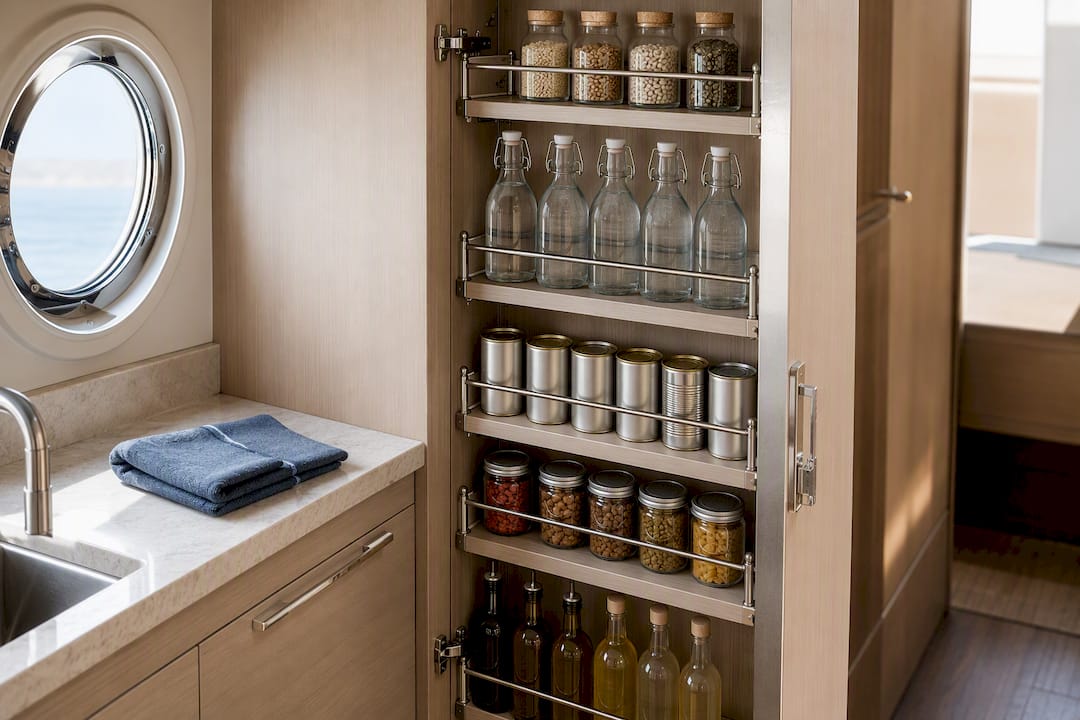
Top-load refrigeration retains cold air better than front-load units since cold air sinks rather than spilling out every time the door opens, which matters on a boat where the compressor is fighting engine room heat and limited insulation space. Front-load fridges offer easier organization and visibility, a fair trade for boats with reliable shore power access and shorter passage legs.
A few provisioning rules keep food safe and usable longer:
- Root vegetables and citrus keep two to three weeks unrefrigerated in a ventilated, dark locker.
- Leafy greens and soft produce need refrigeration and rarely last past five to seven days regardless of storage quality.
- Desiccant packs in dry storage lockers cut moisture damage to packaging and reduce mildew risk in humid climates.
- Heavy provisions belong low and near centerline, never in upper lockers where they raise the boat’s center of gravity.
Pro Tip: Practical experience from working cruising boats shows that small upgrades like gasket replacement, added insulation, and slide-out pantries deliver outsized returns compared to full appliance replacement, often for a fraction of the cost and downtime.
Materials and Hygiene: Building a Galley That Ages Well
Marine environments punish cheap materials fast, and a galley sees more moisture, salt, and thermal cycling than almost any other space aboard.
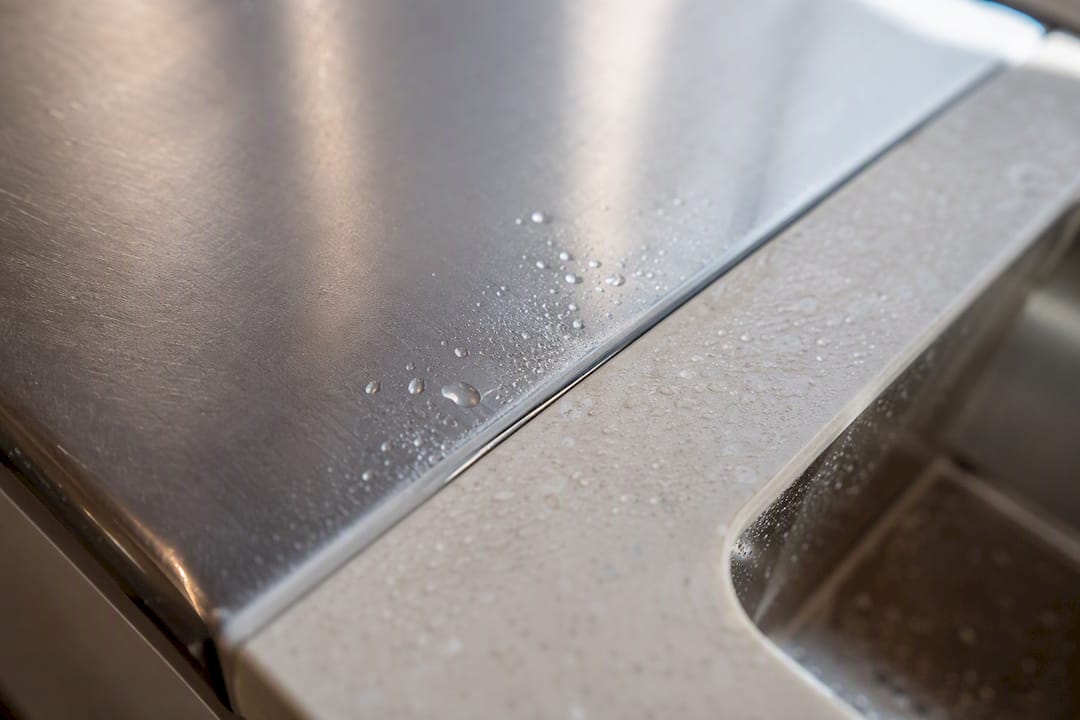
316 stainless steel is worth specifying wherever budget allows, particularly on countertops, sinks, and hardware exposed to salt air or wash-down. It resists pitting corrosion far better than the 304 grade commonly used in less critical applications. Closed-cell insulation behind refrigeration and freezer boxes prevents moisture intrusion that would otherwise degrade insulating performance over a few seasons.
Construction details separate a galley that lasts twenty years from one that needs a refit in five:
- Welded joints instead of caulked seams wherever structurally possible, since caulk fails and traps moisture underneath.
- Rounded internal radii on all cabinetry and counter edges, eliminating the sharp corners where grime and bacteria accumulate.
- LED task lighting in the 4,000 to 5,000K range, which renders food color accurately during prep, unlike warmer bulbs that flatter ambiance but distort what’s actually on the cutting board.
- Sealed hull and deck penetrations for every water and gas line running through the galley structure.
Avoid porous laminates in primary wet zones near the sink and stove. Solid surface or stainless inserts cost more upfront but resist staining and can be replaced individually rather than forcing a full counter tear-out. For a deeper look at material selection across the whole vessel, our guide on choosing yacht building materials covers the trade-offs in more depth.
How to Design a Yacht Galley: Timing, Phases, and Cost Drivers
The single biggest mistake we see in new builds and major refits is treating the galley as a decision that can wait. It can’t. Once bulkheads are set and service runs for plumbing, ventilation, and electrical are fixed, moving the galley footprint becomes cost-prohibitive or physically impossible. The galley has to be locked during general arrangement, alongside engine room and accommodation planning, not after.
A disciplined design process runs through six phases:
- Discovery — consult the chef or primary cook about workflow preferences, typical menu complexity, and crew count before any layout sketches begin.
- Schematic layout — block out the U, L, or linear footprint against clearance rules and adjacent spaces like crew mess or dining.
- Equipment selection — specify stove fuel type, refrigeration capacity, and ventilation based on the power budget established earlier.
- Systems integration — coordinate plumbing, electrical, and fire suppression routing with the naval architect so nothing conflicts with structural members.
- Installation — install cabinetry, appliances, and hardware with access panels for future service work built in from the start.
- Sea trial and commissioning — run the cook-underway test, adjust fiddles or latches that underperform, and sign off only after real conditions confirm the design.
Refits carry their own constraints. Existing hull penetrations, structural bulkheads, and legacy wiring often limit how far you can push a redesign, and coordinating a yacht renovation around those limits takes realistic timeline expectations. A galley refit on a mid-size yacht typically runs 8 to 16 weeks depending on scope, with custom cabinetry, systems integration, and fire suppression upgrades as the primary cost drivers. Our breakdown of refit costs covers what U.S. owners actually pay across these categories.
The Owner’s Checklist: Questions to Ask Before You Approve a Galley Design
A good galley proposal survives being questioned in detail. A weak one falls apart the moment you ask about specifications instead of renderings.
Confirm these dimension and system targets before sign-off:
- Minimum 30 inches between opposing counters, 36 inches for dual-cook operation.
- Gimbal range of 20 to 30 degrees on the stove.
- Positive-locking latches specified on every cabinet and drawer, not friction catches.
- Documented insulation thickness and material for the refrigeration cabinet.
- A stated ventilation flow target for the galley exhaust system.
- A power budget that accounts for refrigeration, stove, and ventilation loads together, not each in isolation.
Ask the designer or shipyard directly: “Can the chef cook a three-course lunch underway with this layout?” and “What is the installed insulation thickness and material for the fridge?” Vague answers to either question are a warning sign.
Watch for these red flags in any proposal: domestic-grade appliances dropped into a commercial-style galley without marine certification, no sea-trial cooking plan mentioned anywhere in the schedule, and insufficient rear or side access for servicing equipment once cabinetry is installed around it.
Water and Waste Systems: The Plumbing Behind a Working Galley
A galley’s plumbing rarely gets discussed until it fails, usually at the worst possible moment mid-passage.
Freshwater supply to the galley sink needs to be sized against realistic daily consumption, not theoretical tank capacity. Low-flow faucets cut freshwater draw significantly compared to standard fixtures, which matters on longer passages where tank capacity limits how far you can cruise before a refill. Foot pumps or manual backup taps give crew a way to conserve water during heavy galley use, particularly useful during provisioning-heavy charter weeks.
Gray water from the galley sink needs its own dedicated line separate from head waste, routed to a holding tank or through a properly sized macerator pump if discharging overboard where regulations allow. Grease and food particles clog gray water lines faster than any other system aboard, which makes an accessible cleanout point near the galley sink connection a design detail worth insisting on rather than discovering you need after the first blockage.
Waste disposal for solid galley trash deserves its own storage plan separate from general cabin waste, ideally with a sealed, ventilated locker that doesn’t share air space with food storage. On longer cruises, that separation prevents odor transfer and pest issues that compromise provisioning quality. Coordinating these systems early, during the same GA phase where layout gets fixed, avoids the common problem of running plumbing after cabinetry is already installed.
Power Supply Planning: Keeping the Galley Running When It Matters
Galley equipment draws more continuous power than almost any other system aboard except climate control, and losing that power mid-passage means spoiled provisions and an unusable stove.
The refrigeration and freezer load runs continuously regardless of whether anyone is actively cooking, which makes it the baseline your entire electrical budget needs to accommodate. Stove and ventilation loads are intermittent but can spike hard, particularly with induction cooktops or powered exhaust hoods running simultaneously during meal service.
Backup power planning separates a galley that survives a generator failure from one that doesn’t. A properly sized battery bank paired with a quality inverter should carry refrigeration loads for at least 24 to 48 hours without generator support, giving crew a buffer to troubleshoot or reach port before food safety becomes a concern. A dedicated shore power connection with automatic transfer switching keeps the galley running seamlessly at the dock without cycling the generator unnecessarily.
Redundancy matters more here than in most onboard systems. A secondary charging source, whether solar, a second generator, or a wind generator on sailing yachts, adds insurance against the single point of failure that a generator-only setup represents. Owners planning a new build should discuss backup power specifically during equipment selection, not as an afterthought once the main electrical plan is finished.
Reducing Noise and Vibration in the Galley
A galley that rattles, hums, and vibrates every time the generator kicks on isn’t just an annoyance. It’s a signal that isolation was skipped somewhere in the build.
Compressor noise from refrigeration units is the most persistent source of galley noise, since these units run around the clock. Mounting compressors on vibration-isolating pads and locating them away from shared bulkheads with guest or crew accommodation cuts down on structure-borne noise transmission significantly. Ventilation fans and exhaust hoods contribute their own noise profile, and specifying variable-speed fans over single-speed units gives crew the option to run quieter during off-peak hours.
Cabinetry and drawer hardware matter more than owners expect. Soft-close hinges and drawer slides eliminate the sharp bang of a cabinet door slamming shut in a rolling sea, a small detail that compounds into real fatigue over a multi-day passage. Loose stowage items rattling inside lockers create a surprising amount of ambient noise, which is one more reason positive-locking latches and well-fitted dividers matter beyond pure safety.
Structural isolation between the galley deck and the hull, using resilient mounts under major appliances, reduces vibration transfer from engines and generators into the galley workspace. This matters most on motor yachts where the engine room often sits close to or beneath the galley. A quieter galley isn’t a luxury add-on. It directly affects whether crew can hear alarms, communicate during meal service, and work without the fatigue that comes from constant low-level noise exposure over a long charter season.
Sustainability Considerations in Galley Equipment and Materials
Energy-efficient equipment choices in the galley compound across an entire voyage, not just a single meal.
Refrigeration units built around variable-speed compressors draw meaningfully less power than fixed-speed models during normal cycling, translating directly into reduced generator runtime and fuel consumption over a season of cruising. LED task lighting, already recommended for its color accuracy during food prep, also draws a fraction of the power that halogen or incandescent fixtures require, a secondary benefit that adds up across a galley lit for hours daily.
Material selection carries its own sustainability weight. Sourcing 316 stainless steel and solid surface materials from suppliers with documented recycling or responsible sourcing practices reduces the environmental footprint of a build without compromising the durability marine environments demand. Closed-cell insulation, beyond its energy-saving performance, tends to have a longer service life than open-cell alternatives, meaning less material waste over the vessel’s lifespan.
Water conservation fixtures reduce freshwater consumption, which matters both for onboard tank capacity and for the environmental impact of frequent shore-based water refills in areas where freshwater resources are already strained. Owners increasingly ask about these considerations not purely for cost savings but because a lower-impact build reflects values that matter to them and, increasingly, to charter guests evaluating a vessel’s overall design philosophy.
Why Chef Consultation Changes Everything About Galley Design
The galleys that fail aren’t usually missing expensive equipment. They’re missing a conversation that should have happened months before the first cabinet was built.
Every recurring galley design mistake traces back to the same root cause: the person who will actually cook in the space wasn’t in the room during general arrangement. Designers optimize for visual flow and square footage. Chefs optimize for whether they can plate four courses during a beam sea without burning themselves or losing a dish to the deck. Both perspectives matter, but only one of them has actually stood at that stove during a real passage.
We build chef consultation into the discovery phase of every galley project, not as a courtesy but as a design input with the same weight as structural constraints. That means walking through a typical charter menu with the chef, understanding how many crew work the galley simultaneously during service, and confirming reach distances against how that specific person actually moves through a kitchen under stress. Shipyard coordination follows the same logic. Our project management work exists specifically to keep the naval architect, the yard’s systems engineers, and the chef aligned so a ventilation duct doesn’t end up routed through the exact spot where a prep counter needs to go.
New builds benefit most from this process starting at GA, before anything is fixed. Complex refits benefit just as much, arguably more, since existing constraints demand creative problem-solving that only works when everyone involved understands the chef’s actual workflow rather than a generic assumption about how galleys should function.
— Jason
Work With Baranof Yacht Sales on Your Galley Design
We provide coordination between the owner, the naval architect, and the chef to help ensure galley decisions get made once, correctly, reducing the need for multiple revisions during construction.

Our project management work covers galley layout coordination alongside the broader build, from confirming clearance and bracing specs during general arrangement to validating equipment choices against your actual power budget. For owners planning a new build, our guide on customizing a yacht interior walks through how galley decisions fit into the wider design timeline. For those managing a complex refit, our construction management services keep shipyard coordination on track so a galley redesign doesn’t stall the rest of the schedule. If you’re weighing the cost implications of a refit against a fresh build, our breakdown of current yachting market trends offers useful context for that decision. Owners coordinating cosmetic and registration details during a refit often work with partners like Registrationdecals for custom vessel identification.
When planning a new build or evaluating a refit, consider scheduling a consultation to design a galley suited to the chef’s cooking style.
Sources
- Marine stoves — Fisheries Supply
- Designing a superyacht galley — Superyacht News
- Yacht galley design: ergonomics and safety — UNOKS
- Galley designs that actually work while cruising — Power & Motor Yacht Central
Recommended
Sold Listings
Design Your Yacht
"*" indicates required fields
Maximus III - PNW
As you step aboard MAXIMUS III, the first impression is her scale.
At 120 feet with an 8-meter beam and 294 GT of interior volume, this 2025 Crescent Custom tri-deck immediately feels open, balanced, and estate-like. A timeless look while still feeling fresh from the shipyard.
Currently Available


Get your yacht value Estimate
"*" indicates required fields