

The yacht design process moves through five owner-facing stages: the Book of Requirements, conceptual design, preliminary and detailed engineering, construction, and sea trials. Each stage narrows decisions and locks in cost. Owners who control scope, systems, and materials early keep both budget and schedule intact, and a resource like Baranof Yacht Sales exists precisely to guide that sequence from brief to delivery.
TL;DR:
- Owners should establish a detailed Book of Requirements early to accurately specify mission profile, capacities, budget, and timeline, preventing costly mid-build changes.
- Selecting a hull form and layout based on the mission profile during conceptual design helps avoid expensive adjustments once construction begins.
- Rigorous communication and formal change-control processes throughout the design and construction phases are vital to prevent scope creep, delays, and budget overruns.
- Integrating systems such as propulsion, HVAC, and connectivity in the early design stages avoids costly retrofits and ensures seamless operation.
- Thorough sea trials, scheduled inspections, and proper project management are critical to identify and resolve issues early, ensuring the yacht meets design expectations.
Table of Contents
- What Are the Stages of the Yacht Design Process?
- How Do You Write a Book of Requirements?
- How Do Designers Choose Hull Form and Layout?
- Exterior Styling and Naval Architecture
- How Does Interior Design Shape the Systems Brief?
- What Engineering Work Happens Before Construction Begins?
- From Drawings to Vessel: Construction and Yard Collaboration
- What Happens During Sea Trials and Commissioning?
- How Long Does a Custom Yacht Build Take, and What Drives Cost?
- Sustainability Considerations and Eco-Friendly Design Options
- Common Challenges and Risk Management During the Design Process
- Technological Integration in Yacht Design
- The Owner’s Perspective on Project Oversight
- Ready to Start Your Yacht Design Project?
- Sources
- FAQ
What Are the Stages of the Yacht Design Process?
Naval architects call this progression the design spiral: a cycle of concept, preliminary, and detailed phases that circles back on itself, tightening with each pass rather than moving in a straight line. The design spiral resolves major trade-offs early, because a hull shape, a weight estimate, and a systems layout all pull on each other, and changing one after the yard has cut steel or laid up composite costs far more than changing it on paper.
Each turn of the spiral produces a specific deliverable:
- Concept report: the first hull form, principal dimensions, and rough performance targets
- Estimating plans: enough detail for a yard to quote a price with confidence
- Building plans: structural framing, systems routing, and equipment lists
- Construction drawings: the exact instructions a yard follows to cut, weld, or laminate
Resolving trade-offs during the concept report, rather than waiting for construction drawings, is what separates a build that stays on budget from one that does not.
How Do You Write a Book of Requirements?
The Book of Requirements is the single document that turns an owner’s idea into a buildable brief, and it comes before any hull sketch or naval architecture calculation. Skipping it, or leaving it vague, is the most common cause of costly changes mid-build, according to committee findings on yacht design communication, which identify unclear specifications and weak owner-yard dialogue as leading causes of overruns.
A working Book of Requirements should cover:
- Mission profile — where the yacht will cruise, how often, and in what conditions
- Capacities — guest count, crew count, fuel and water range targets
- Guest flow — how owners and guests move between decks, cabins, and social spaces
- Systems priorities — propulsion type, climate control, connectivity, and redundancy expectations
- Budget bands — a realistic range per category, not a single fixed number
- Timeline milestones — target dates for concept approval, keel laying, and delivery
Rank these requirements before the yard sees them. Decide which items are fixed and which can flex, then set a sign-off cadence with version control so every change is dated and approved rather than argued about later.
Pro Tip: Ask your designer for a one-page “measures of merit” summary before concept work begins. It forces you to state what actually matters most, whether that is range, guest capacity, or resale value, before dollars get spent chasing details.
Owners who want a template for this process can review our complete guide to the yacht design brief before their first meeting with a designer.
How Do Designers Choose Hull Form and Layout?
Conceptual design is where the Book of Requirements becomes a hull. Designers select hull type, principal dimensions, and powering strategy based directly on the mission profile: a yacht built for long-range Pacific crossings gets a different hull form than one built for coastal entertaining in the Mediterranean.
Concept-stage deliverables typically include:
- Early 3D sketches showing hull form and general arrangement
- Preliminary hydrostatics: displacement, stability curves, and draft estimates
- A concept report summarizing dimensions, speed targets, and rough weight budget
The most valuable thing an owner can request at this point is a small proof of concept. That means a validated set of hydrostatics, a preliminary weight budget, and a 3D walkthrough of the primary owner spaces, because these three items surface trade-offs that become expensive to change once the design moves forward. Owners who want a fuller breakdown of what to check at this stage can read our concept phase checklist.
Exterior Styling and Naval Architecture
Every styling decision on a custom yacht, whether it is a lower sheer line or a wraparound window, has to survive contact with hydrodynamics and structure. A stunning exterior sketch that ignores displacement or stability limits gets sent back to the drawing board, so designers now work in 3D CAD platforms like Rhinoceros, Solidworks, and Alias to test form and function together rather than sequentially, a shift documented in current yacht design curricula.
This stage produces the deliverables a yard actually builds from:
- Faired lines and offsets, defining the exact hull shape at every station
- Scantlings, specifying plate and frame thickness for structural loads
- Structural framing plans showing how the hull, deck, and superstructure tie together
Material choice enters here too. Aluminum offers a strong weight-to-strength ratio and is common in displacement hulls above 100 feet. Steel remains the choice for larger, heavier-displacement vessels prioritizing longevity over top speed. Composite construction saves weight and allows more complex curves, but it carries different lifecycle maintenance demands than metal hulls, a distinction worth discussing with your designer before committing.
How Does Interior Design Shape the Systems Brief?
Interior programming has become as technical as hull design, particularly with 2026 owner priorities pulling toward work-from-yacht suites, dedicated wellness spaces, and even medical-grade features like hyperbaric chambers. Reporting on luxury yacht trends confirms these lifestyle requests are now standard conversation points at the brief stage, not late-stage add-ons.
Translating that lifestyle vision into a buildable interior means specifying:
- Layout zones that separate owner privacy from guest and crew flow
- HVAC, AV, and climate control systems that integrate rather than compete for space
- Redundancy for critical systems, so one failure does not disable an entire deck
- Updateable technical infrastructure, since electronics age faster than joinery
Designers increasingly borrow from residential design, favoring a coherent visual language over scattered “statement” pieces, an approach that holds up better over a decade of ownership. That means sourcing finishes that withstand humidity and UV exposure, planning conservation care for any commissioned art, and building a maintenance schedule into the design itself rather than treating it as an afterthought.
Pro Tip: Write updateability clauses into your systems brief for anything electronic, from entertainment to navigation. A five-year-old control panel is far harder to replace than a five-year-old sofa.
For owners planning connectivity into WFY suites specifically, our guide to onboard connectivity systems covers what to specify before the systems brief is finalized.
What Engineering Work Happens Before Construction Begins?
Preliminary and detailed design is where naval architecture stops being conceptual and becomes calculation. Stability analysis, hydrostatics, structural load analysis, and power and range modeling all get formally verified, because a classification society will not approve a design that has not passed these checks.
The complete drawings package handed to a yard includes:
- Piping and electrical diagrams for every system aboard
- Full equipment lists with model numbers and specifications
- Construction details covering welding schedules, laminate schedules, and joinery specs
This is also where stage deliverables like estimating plans and building plans get finalized into true construction drawings, the documents a yard actually builds from rather than references. Classification society review runs in parallel with this phase, and regulatory approval timelines vary by flag state and vessel size, so owners should ask their project manager for a realistic approval window rather than assuming it happens overnight.
From Drawings to Vessel: Construction and Yard Collaboration
Construction turns paper into steel, aluminum, or composite. Yard workflows typically follow a set sequence: computer-controlled cutting of plate or panels, jigging to hold structure in alignment, systems installation, then interior joinery layered in once the shell is sound.
Owners protect their investment during this phase by following three practices:
- Commission a full-scale mockup of key spaces, since a mockup or VR walkthrough catches layout problems that a drawing cannot, and budgeting for one during the interior design phase materially lowers the cost of late change orders.
- Set a formal change-control process before construction starts, so every requested change gets priced and scheduled rather than argued about on the yard floor.
- Schedule regular site visits tied to milestones, not just whenever convenient, to catch issues while they are still cheap to fix.
Our guide to construction management covers how this oversight works in practice for owners who want a project manager handling these details on their behalf.
What Happens During Sea Trials and Commissioning?
Sea trials verify that the yacht built matches the yacht designed. A thorough trial checklist covers top speed and cruising speed, vibration levels at various RPMs, cabin noise readings, redundancy of critical systems, and actual fuel consumption against the design estimate.
Commissioning happens in stages, not all at once:
- Dock trials confirm systems power up and function at rest
- Harbor trials test low-speed handling and maneuvering
- Offshore trials push the vessel to design speed and load conditions
- Punch-list resolution catches remaining defects before final handover
Warranty documentation, systems manuals, and a clear first-year support plan should all be part of handover, not something owners have to request separately.
How Long Does a Custom Yacht Build Take, and What Drives Cost?
A semi-custom build typically runs from about one and a half to two years from signed brief to delivery, while a fully custom build often takes significantly longer depending on size and systems complexity.
Cost tends to grow in three places: bespoke joinery and finishes, complex integrated systems like advanced climate control or hybrid propulsion, and late-stage changes that ripple backward through drawings already approved. Owners keep budgets under control by locking a firm brief before construction starts, approving each design stage formally rather than informally, and holding a contingency reserve, typically a percentage of total build cost, for the unexpected.
Sustainability Considerations and Eco-Friendly Design Options
Sustainability has moved from a marketing checkbox to a design input that shapes hull form, propulsion, and systems specification. Owner-driven ESG priorities are pushing hybrid and all-electric propulsion further into mainstream custom builds rather than treating them as experimental options reserved for smaller vessels.
Hybrid propulsion systems let a yacht run on batteries at anchor or in harbor, cutting generator noise and emissions during the hours owners and guests are actually aboard and awake. Full electric propulsion remains limited by battery weight and range on larger vessels, but it is increasingly viable for tenders, auxiliary systems, and shorter-range coastal cruisers.
Hull efficiency matters as much as propulsion choice. A hull form optimized for lower resistance at cruising speed burns meaningfully less fuel over a season than one optimized purely for top-end speed, and this trade-off gets decided during conceptual design, not bolted on afterward.
Beyond propulsion, sustainable material sourcing is entering the systems brief: FSC-certified wood for joinery, low-VOC finishes for interior air quality, and waste heat recovery systems that repurpose engine heat for water heating or climate control. None of these additions require sacrificing the luxury feel owners expect. They require specifying them early, before the systems architecture is locked.

Owners weighing propulsion and energy systems in detail can review our eco-friendly design and RFP guide, which walks through the fuel and emissions trade-offs at the brief stage where they are cheapest to resolve.
Common Challenges and Risk Management During the Design Process
The single biggest risk in a custom build is not engineering failure. It is communication failure between owner, designer, and yard. Reports on yacht design practice consistently point to unclear specifications and inconsistent owner-yard dialogue as the leading cause of both schedule slippage and cost overruns, more than any single technical miscalculation.
A second recurring challenge is scope creep. An owner sees a feature on another yacht midway through construction and wants it added. Each addition seems small in isolation, but stacked together they can push a delivery date back by months and a budget well past its original band. The fix is not refusing all changes. It is running every change through a formal change-control process that prices and schedules it before approval, rather than absorbing it informally.
A third risk sits with supply chains. Bespoke systems, specialty finishes, and custom equipment often have long lead times, and a single delayed component can stall an entire construction phase. Owners who ask their project manager for a procurement timeline early, rather than assuming everything arrives on schedule, avoid the worst of this exposure.
Finally, regulatory risk deserves attention. Classification society requirements and flag-state rules can shift mid-project, particularly on emissions and safety systems. Building in a compliance review checkpoint at each major design stage, rather than only at final approval, catches these shifts while they are still cheap to address.
Technological Integration in Yacht Design
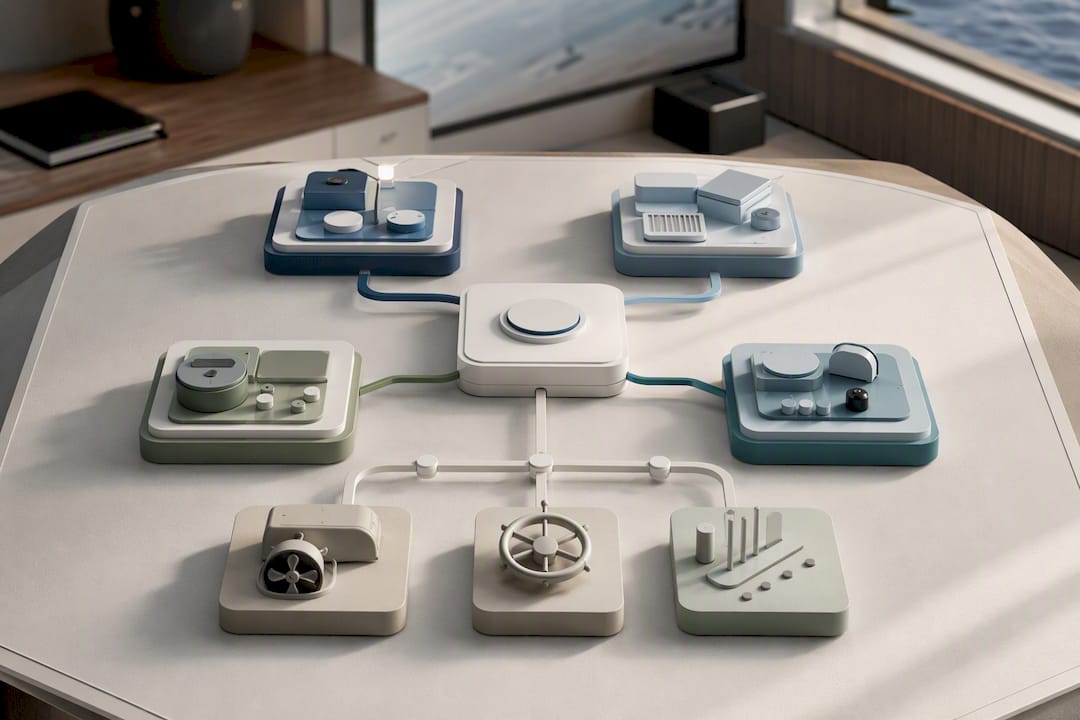
Smart systems architecture has replaced the scattered collection of standalone apps and panels that characterized yacht interiors a decade ago. Trade coverage on integration trends favors unified control architecture, similar in principle to residential systems like Crestron or Lutron, where lighting, climate, entertainment, and security all run through one interface rather than five competing ones.
The advantage is not just convenience. A unified architecture is easier to update as components age, and it reduces the redundancy failures that plague yachts running on a patchwork of disconnected systems installed at different points during the build.
Automation now extends into propulsion and navigation as well. Dynamic positioning systems, automated trim and stabilization, and predictive maintenance sensors that flag mechanical wear before it becomes a failure are increasingly standard specifications in the systems brief, not optional upgrades requested after delivery.
Connectivity deserves its own line item in the brief. WFY suites depend on reliable, high-bandwidth connections at sea, and specifying that infrastructure during preliminary design, rather than retrofitting it after construction, avoids running new cable runs through finished joinery. Our guide to onboard connectivity covers what to ask for at the systems brief stage.
The practical owner takeaway is straightforward: request an integration architecture diagram from your designer before systems get specified individually. It costs little to ask for upfront and it prevents a yacht full of smart features that do not actually talk to each other.
The Owner’s Perspective on Project Oversight
Construction management with frequent, scheduled inspections catches defects while they are still cheap to fix, not after joinery has closed them in. This oversight is applied through every build phase, and owners typically bring in project management either for full construction oversight on a new build or as advisory support layered onto a designer relationship already in place.
— Jason
Ready to Start Your Yacht Design Project?
This service is ideal for owners who want one accountable partner managing design coordination, yard selection, and construction oversight, rather than juggling a designer, a yard, and a project manager who rarely speak to each other directly. Such integration helps keep a build on schedule and on budget once construction starts, because problems get caught during a scheduled inspection instead of discovered after the fact.
A useful first step for a serious owner is an owner briefing meeting paired with a Book of Requirements workshop, to help rank priorities, set realistic budget bands, and identify the trade-offs worth resolving before a single line gets drawn. If you are still narrowing down what belongs in that brief, our guide on what to settle before building your yacht is a solid starting point, alongside our breakdown of how to choose a yacht designer who will protect your budget and schedule from the first sketch onward. From there, reach out through Baranofyachts to schedule a consultation and talk through whether full construction management or advisory support fits your project best.
Sources
- The design spiral and the Book of Requirements (NewBoatBuilders)
- Superyacht trends: gyms, offices, eco-friendly comfort (Business Insider)
- ISSC committee report on yacht design (Leigh Sutherland / ISSC)
- Yacht design program curriculum (Landing School)
FAQ
What Are the Main Stages in a Yacht Design Process?
Most custom builds move through the Book of Requirements, conceptual design, preliminary and detailed engineering, construction, and sea trials with commissioning. Each stage produces specific deliverables, from a concept report to full construction drawings, and each one narrows the design further before the next begins.
What Is the Book of Requirements and Why Does It Matter?
The Book of Requirements is the owner’s brief that defines mission, capacities, budget bands, and timeline before any hull work begins. It is the essential first document in the design spiral, and skipping it is a leading cause of expensive mid-build changes.
How Long Does the Full Yacht Design and Build Process Take?
A semi-custom build typically runs from about one and a half to two years from signed brief to delivery, while a fully custom build often takes significantly longer. Complexity of systems, bespoke joinery, and the number of design changes requested during construction all affect the final timeline.
What Happens During Sea Trials?
Sea trials test speed, vibration, cabin noise, fuel consumption, and system redundancy across dock, harbor, and offshore stages. Any issues found get logged on a punch list and resolved before final handover and warranty documentation are delivered to the owner.
Should I Hire a Project Manager for My Custom Yacht Build?
A dedicated project manager conducting frequent inspections catches defects and schedule slippage early, before they become expensive to fix. Baranof Yacht Sales offers both full construction management for new builds and advisory support for owners who already have a designer in place.
Recommended
Sold Listings
Design Your Yacht
"*" indicates required fields
Maximus III - PNW
As you step aboard MAXIMUS III, the first impression is her scale.
At 120 feet with an 8-meter beam and 294 GT of interior volume, this 2025 Crescent Custom tri-deck immediately feels open, balanced, and estate-like. A timeless look while still feeling fresh from the shipyard.
Currently Available


Get your yacht value Estimate
"*" indicates required fields