
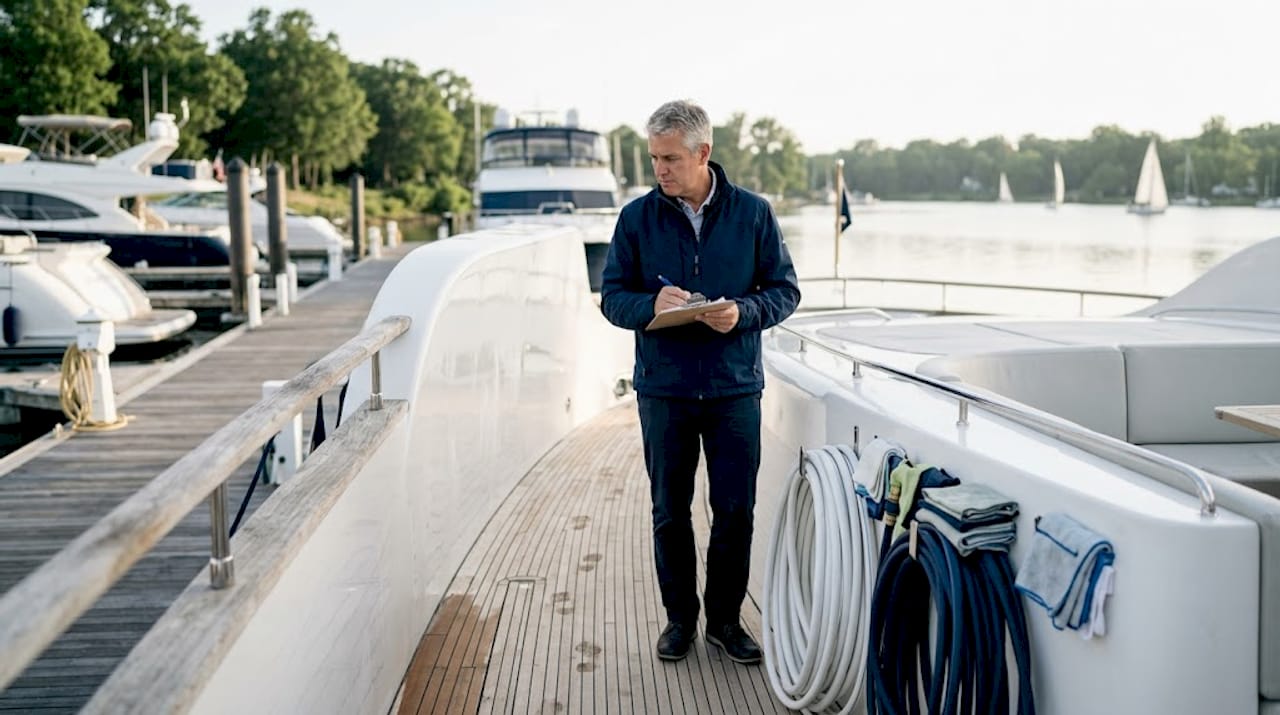
Many yacht owners believe that aftercare begins and ends with a repair call or a seasonal wash-down. That assumption is one of the most costly misconceptions in luxury maritime ownership. True aftercare is an orchestrated, ongoing commitment spanning warranty management, structured service schedules, meticulous logging, sea trials, and strategic customization planning. Every element plays a role in preserving both the performance and the exclusivity that define a vessel worth protecting. This guide walks you through the complete aftercare landscape so you can approach ownership with the confidence and foresight your investment demands.
Table of Contents
- Defining yacht aftercare: More than maintenance
- The aftercare framework: Warranty, service intervals, and logging
- Commissioning, verification, and sea trials: Beyond static checks
- Aftercare and customization: Enhancing luxury and legacy
- The uncomfortable truth: Aftercare is what separates discerning owners from the rest
- Next steps: Custom expertise and personalized yacht solutions
- Frequently asked questions
Key Takeaways
| Point | Details |
|---|---|
| Aftercare is ongoing | Yacht aftercare involves planned maintenance, not just reactive repairs. |
| Warranty depends on routines | Aligning service and logging with authorized providers keeps your warranty valid. |
| Sea trials confirm performance | Verifying upgrades underway reveals issues not visible during dockside checks. |
| Custom upgrades rely on care | Aftercare routines pave the way for safe luxury enhancements. |
| Resale value is proven | Aftercare records and structured service boost buyer confidence and vessel value. |
Defining yacht aftercare: More than maintenance
Building on why aftercare matters, let’s clarify its true scope. Most discussions reduce aftercare to oil changes and antifouling coats, but that framing misses the full picture. Aftercare covers both warranty coverage and longer-term planned maintenance systems, not just isolated one-off repairs. When you understand that distinction, the entire approach to ownership shifts from reactive to proactive.
Structured aftercare typically integrates three layers:
- Warranty and after-sales coverage: Factory-backed protection for hull, mechanical, and electronic systems, valid only when properly maintained through authorized channels.
- Planned maintenance routines: Scheduled service intervals derived from manufacturer matrices, covering engine hours, calendar milestones, and seasonal cycles.
- Technical support access: Relationships with qualified engineers and service networks that provide rapid, expert-level response when systems need attention beyond routine servicing.
Properly structured aftercare has a direct effect on optimizing yacht resale value. A vessel with documented, systematic care consistently commands a premium in the brokerage market compared to one with spotty or undocumented history. Buyers read service records the way investors read balance sheets: inconsistency signals risk.
| Aftercare element | Primary benefit | Frequency |
|---|---|---|
| Engine service | Performance and longevity | Every 100-250 hours or annually |
| Hull inspection | Structural integrity | Biannually or post-passage |
| Electrical system audit | Safety and reliability | Annually |
| Antifouling application | Speed and fuel efficiency | Annually |
| Full warranty review | Coverage compliance | At each service milestone |
“A vessel maintained through a structured aftercare program retains both mechanical reliability and market prestige in ways that ad-hoc repairs simply cannot replicate.”
Pro Tip: Align with your manufacturer’s authorized service providers on day one, not after your first breakdown. Early alignment protects warranty validity and establishes the service relationship that will serve you for years.
The connection between maintenance’s impact on reliability and long-term ownership satisfaction is not theoretical. We see it consistently across our client portfolio: the owners who build structured aftercare into their ownership plans from the outset spend less over the vessel’s lifetime and experience fewer disruptive failures at the worst possible moments.
The aftercare framework: Warranty, service intervals, and logging
Now that the scope is clear, let’s explore the nuts and bolts of aftercare management. The framework that actually holds aftercare together has three pillars: warranty compliance, service interval adherence, and rigorous logging. Each one reinforces the others, and failure in any pillar creates real vulnerability.
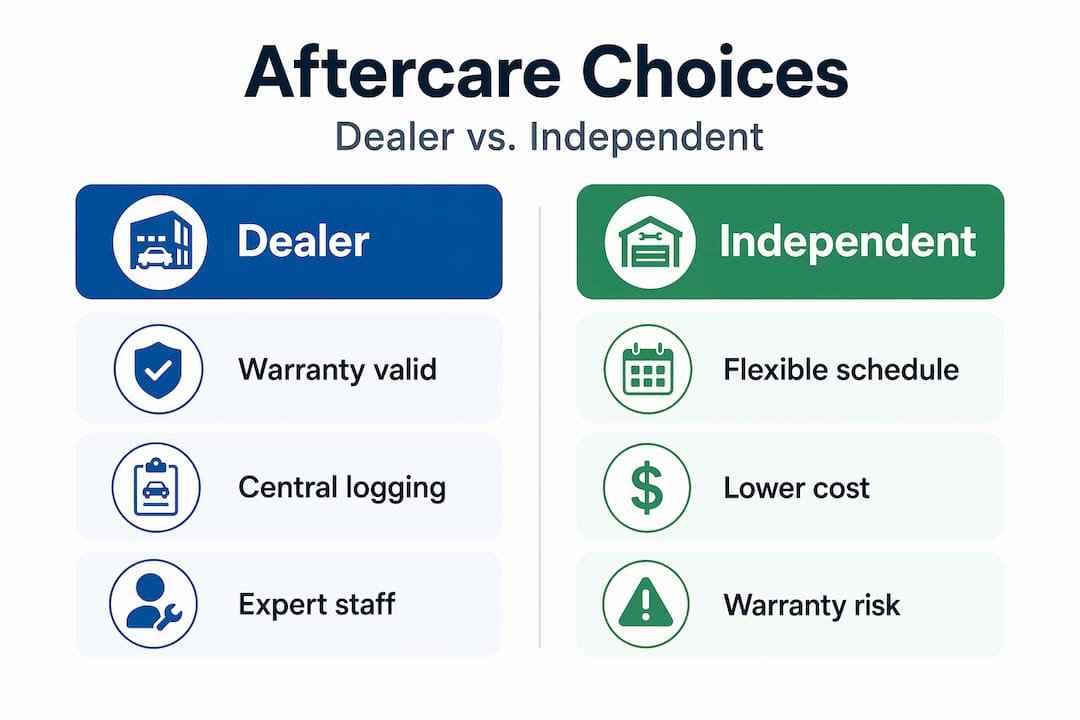
Warranty compliance is more nuanced than most owners realize. For marine propulsion systems, warranty and technical support often require service by authorized dealers, documented maintenance logging, and strict adherence to the conditions set at time of sale. If you bypass those requirements, even a single time, you may void coverage on an engine or drivetrain system that could cost six figures to replace. The standard for authorized service is set by the manufacturer, and it is non-negotiable.
Here is how we recommend structuring your aftercare management from the moment a vessel enters your fleet:
- Obtain and study every warranty document. Identify what is covered, for how long, under what conditions, and who is authorized to perform service.
- Build a service interval matrix. Cross-reference manufacturer recommendations with your actual usage profile, whether that is high-hour charter deployment or lower-intensity private use.
- Identify your authorized service network. Map out providers within your typical cruising range so you are never caught needing service in a port where no qualified technician is available.
- Create a maintenance log from day one. Every service action, every parts replacement, every system check should be recorded with date, technician credentials, and parts or fluids used.
- Schedule compliance reviews annually. Warranty terms change, and service requirements evolve as systems age. An annual review keeps your coverage intact and your records current.
| Service type | Dealer-authorized | Independent |
|---|---|---|
| Warranty validity | Maintained | Often voided |
| Documentation quality | Standardized | Variable |
| Parts sourcing | OEM-certified | May be aftermarket |
| Technical expertise | Manufacturer-trained | Skill level varies |
| Resale documentation value | High buyer confidence | Lower buyer confidence |
A well-maintained yacht hull restoration guide illustrates exactly this principle. Hull work that is performed without proper documentation, regardless of how technically sound the execution, tells an incomplete story to prospective buyers. Documentation transforms quality work into provable quality work.
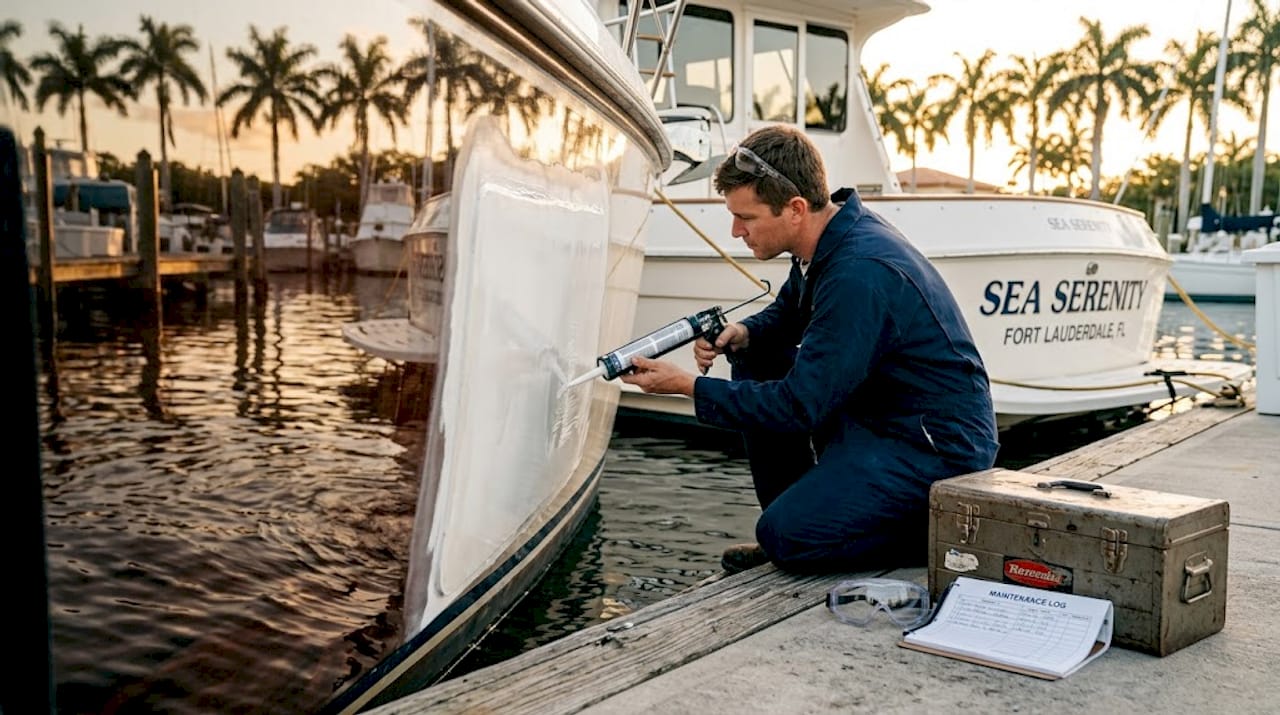
Pro Tip: Build your maintenance log as if you plan to sell the vessel tomorrow. Buyers and their surveyors will scrutinize every entry, and a complete, organized record is one of the strongest signals of a responsibly maintained vessel.
The discipline required here mirrors what we apply in yacht project management. Every subsystem, every service event, every clearance check is tracked with precision because gaps in the record are gaps in accountability. That standard does not change after delivery.
Commissioning, verification, and sea trials: Beyond static checks
With aftercare routines established, specialized verification steps take center stage. One of the most underappreciated elements of systematic aftercare is the commissioning and verification process, particularly after seasonal storage, refits, or any major system work. Static checks at the dock reveal only a fraction of what underway conditions expose.
Seasonal storage and refits require a thorough commissioning stage to ensure systems work under real operating conditions, and that includes sea trials as a core aftercare step. This is not a formality. Bilge pumps, stabilizer systems, propulsion controls, navigation electronics, and through-hull fittings all behave differently once load, speed, and sea motion are introduced. A system that appears functional at rest may reveal a pressure issue, a vibration anomaly, or a communications fault only under way.
Critical systems reactivation steps for post-storage or post-refit commissioning include:
- Engine and propulsion systems: Verify fluid levels, check for corrosion on connections, confirm cooling water flow, and test under progressive load.
- Electrical and navigation systems: Boot all electronics, verify AIS, radar, and chart plotter integration, and test emergency signaling equipment.
- Safety systems: Test all bilge pumps, fire suppression systems, life raft release mechanisms, and EPIRB registration.
- Stabilizer and steering systems: Confirm hydraulic pressures and test active stabilizers at speed in representative sea conditions.
- Plumbing and through-hull fittings: Inspect every seacock, check head systems, and verify wash-down drainage paths are unobstructed.
- HVAC and interior climate systems: Confirm chiller operation, check refrigeration systems, and test generator load under full interior electrical demand.
| Verification method | What it reveals | Limitations |
|---|---|---|
| Dockside static check | Obvious leaks, basic electrical function | Misses load-dependent faults |
| Engine room inspection | Visual wear indicators | Cannot test under operating temperatures |
| Sea trial underway | Integrated system behavior, vibration, real load | Requires qualified crew and test conditions |
Underway verification through sea trials is a key aftercare step to confirm integrated performance after modifications or major system work, because dockside checks alone cannot reveal all integrated system behavior. We have seen clients accept a vessel post-refit on the strength of a dock test alone, only to discover a stabilizer hydraulic fault or a generator overload issue on the first offshore passage. The sea trial is not optional.
Pro Tip: Schedule your sea trial immediately after any significant refit, before resuming luxury operations or committing to a passage plan. Even a short underway test at varying speeds reveals what static commissioning cannot.
Understanding how to properly prepare a yacht for resale starts here too. Buyers who commission professional surveys expect sea trial results. A vessel with no sea trial record after recent major work raises immediate flags. And evaluating yacht craftsmanship under real conditions is something experienced surveyors insist upon for good reason.
Aftercare and customization: Enhancing luxury and legacy
With systems verified, aftercare becomes the bridge to customization and living luxury at its fullest. Diligent aftercare does more than keep systems running; it creates the stable, well-documented platform from which meaningful customization can be safely and confidently executed. An upgrade introduced into a poorly maintained vessel risks compounding existing issues. An upgrade integrated into a vessel with a clean, comprehensive aftercare history is an investment that builds on a solid foundation.
Aftercare covers both warranty and planned maintenance across the vessel’s lifetime, which means every customization decision you make should be evaluated through that lens. Will this upgrade require recertification? Will it affect existing warranty coverage? How does it integrate with current service intervals? These questions are not obstacles; they are the sign of a sophisticated owner protecting their investment.
Upgrade categories that are directly supported and enabled by a thorough aftercare foundation include:
- Interior design and joinery enhancements: New materials, lighting systems, or bespoke furniture that requires careful integration with existing electrical and HVAC subsystems.
- Audio-visual and connectivity systems: Upgraded satellite communication, streaming infrastructure, and smart vessel control systems that interact with navigation and power management.
- Propulsion efficiency upgrades: Variable pitch propellers, hull coatings, or shaft alignment optimization that benefit from a clean service history as a baseline.
- Stabilization and ride quality improvements: Gyroscopic stabilizers or advanced fin systems that require structural assessments against the existing hull record.
- Exterior and deck customization: Tender garage modifications, custom davit systems, or extended swim platforms requiring engineering review against existing structural documentation.
Exploring luxury yacht upgrades is far more productive when the technical history of the vessel is fully documented. Engineers and designers can propose solutions with confidence when they know exactly what they are working with. Uncertainty about prior work forces conservatism in design, which limits what is ultimately possible.
Pro Tip: Before commissioning any bespoke upgrade, share your full maintenance log with the engineering team. It accelerates the design process, protects warranty continuity, and ensures the upgrade is matched to the actual condition of the vessel rather than assumptions.
Understanding the true value of yacht ownership means recognizing that exclusivity is built through sustained attention, not just initial acquisition. The most coveted vessels in any brokerage market are those whose owners treated aftercare and customization as two sides of the same coin.
The uncomfortable truth: Aftercare is what separates discerning owners from the rest
That brings us to a key insight most guides overlook. We have worked across enough ownership cycles to say this plainly: the gap between owners who experience lasting satisfaction and those who experience frustration and unexpected cost is almost never about what they bought. It is almost always about how they maintained it.
Market conversations in luxury yachting tend to gravitate toward flashy topics: new hull designs, exotic interior materials, the latest stabilization technology. Aftercare rarely generates the same enthusiasm. That is a mistake. The most visually spectacular vessel in any marina is worth significantly less, in financial terms and in personal enjoyment, if its bilge pumps are uncertified, its engine logs are incomplete, or its last sea trial happened before a major refit.
We see this dynamic play out in brokerage negotiations consistently. A buyer’s surveyor arrives, reviews the vessel, and asks for service records. When those records are thorough, organized, and show authorized dealer compliance, the negotiation proceeds smoothly and the seller’s asking price holds. When records are thin or inconsistent, that surveyor’s report introduces doubt, and doubt costs money. Long-term reliability insights make clear that deferred maintenance and incomplete documentation have measurable knock-on effects that extend well beyond the immediate repair cost.
Our position is that aftercare deserves the same passion, creativity, and budget discipline that owners bring to customization decisions. Approach your service schedule with the same intentionality you bring to choosing interior upholstery. Treat your maintenance log with the same care you give to your guest experience. The owners who adopt that mindset consistently get more from their vessels, spend less on emergency remediation, and command stronger prices when they eventually sell.
Next steps: Custom expertise and personalized yacht solutions
Ready to take the next step in yacht care and personalization? At Baranof Yachts, we bring the same conductor’s-eye precision to aftercare guidance that we apply to every custom build and project management engagement we lead.

Whether you are looking to configure your new yacht from the ground up, implement a structured aftercare program for a vessel already in your fleet, or explore luxury yacht upgrades that enhance both comfort and long-term value, our team is positioned to support every stage of that journey. We also specialize in bespoke yacht builds where aftercare planning is integrated from concept through delivery, so you never face the uncertainty of ownership without a clear, expert-backed plan. Connect with us to discuss how a personalized approach to aftercare can protect and elevate everything you have invested in.
Frequently asked questions
What does yacht aftercare include beyond basic maintenance?
Yacht aftercare covers warranty support, scheduled service, seasonal system checks, sea trials after refits, and customization planning, making it a continuous and structured discipline rather than a series of isolated repairs.
Why are sea trials essential after yacht modifications?
Sea trials confirm that upgraded or repaired systems operate flawlessly in real conditions because dockside checks alone cannot reveal integrated system behavior such as load-dependent vibration, hydraulic faults, or electrical anomalies that only appear underway.
How does aftercare affect yacht resale value?
Detailed aftercare records and consistent service elevate resale potential significantly because a complete maintenance history assures buyers and their surveyors that the vessel has been managed to a professional standard throughout its ownership lifecycle.
Do I need to use authorized dealers for aftercare services?
Yes, warranty and technical support often require service by authorized dealers with documented logging to maintain coverage, and bypassing that requirement even once can void protection on critical propulsion or electronic systems.
Can aftercare support yacht customization and upgrades?
Ongoing aftercare ensures custom upgrades are reliable and warranty-compliant because a thorough service record gives engineers the accurate baseline they need to design enhancements that integrate safely with existing systems.
Recommended
Sold Listings


Design Your Yacht
"*" indicates required fields
Maximus III - PNW
As you step aboard MAXIMUS III, the first impression is her scale.
At 120 feet with an 8-meter beam and 294 GT of interior volume, this 2025 Crescent Custom tri-deck immediately feels open, balanced, and estate-like. A timeless look while still feeling fresh from the shipyard.
Currently Available


Get your yacht value Estimate
"*" indicates required fields