
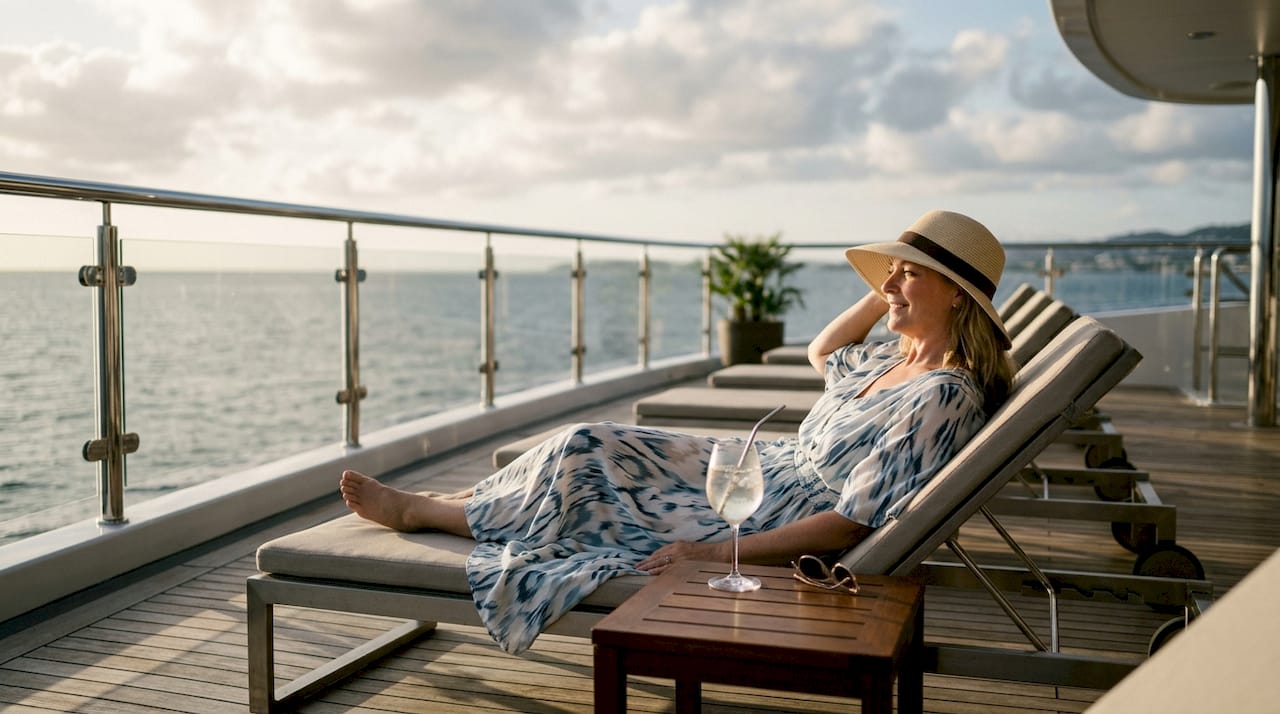
A yacht sundeck is defined as an open-air, upper-level deck dedicated entirely to leisure, sunbathing, and social entertainment on luxury vessels. Unlike navigational areas, the sundeck exists purely for guest enjoyment. Superyachts measuring 24 meters and above typically feature a dedicated sundeck as a signature outdoor space. At Baranofyachts, we consider the sundeck one of the most telling indicators of a yacht’s overall design philosophy. It is where comfort, craftsmanship, and lifestyle converge above the waterline.
What is a yacht sundeck and what defines it?
A yacht sundeck is the topmost open deck on a superyacht, positioned above the main and upper decks, and reserved exclusively for recreation. It is not a working deck. No helm controls, navigation equipment, or crew stations belong there. The space exists to give guests unobstructed sky, panoramic sea views, and the freedom to relax or socialize without operational interruptions.
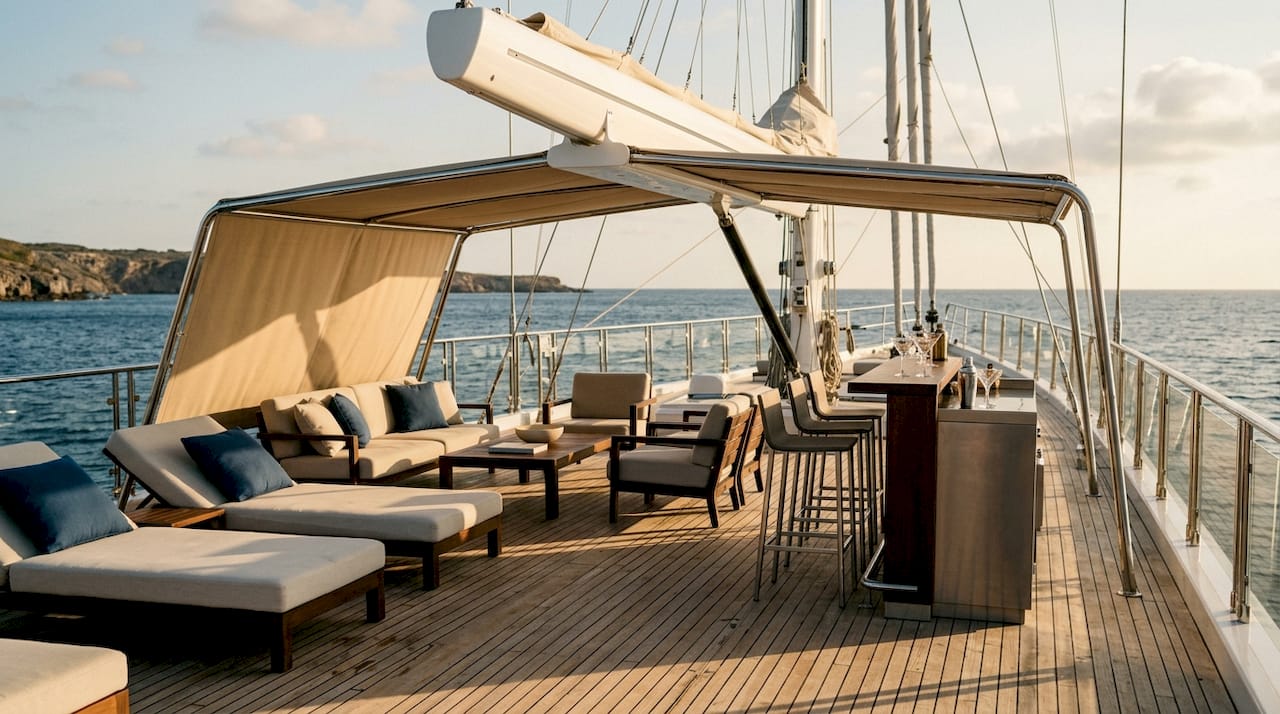
The distinction matters because buyers often confuse sundecks with flybridges. A flybridge serves dual roles, combining helm controls with some social amenities. A sundeck carries no navigational function whatsoever. Every square meter serves the guest experience.
Sundecks appear almost exclusively on vessels 24 meters and above, where the hull volume and superstructure height allow a full upper deck dedicated to leisure. On megayachts exceeding 60 meters, sundecks can span hundreds of square meters, functioning as full outdoor living rooms with multiple zones for dining, lounging, and entertainment. The scale of the space directly shapes what amenities are possible and how guests move through the deck throughout the day.
What features do yacht sundecks typically include?
Yacht sundeck features follow a clear hierarchy from passive relaxation to active social entertainment. The best-designed sundecks layer these elements so guests can transition between moods without feeling crowded or constrained.
Core amenities found on well-specified sundecks include:
- Sunpads and sunloungers: Wide, cushioned surfaces sized for full-body reclining, often arranged in groups to encourage conversation while sunbathing.
- Jacuzzis and plunge pools: Hydrotherapy features that double as social focal points. Some designs, like the Sanlorenzo SX120’s lift-and-slide mechanism, conceal pools beneath flush deck panels to preserve clean aesthetics when not in use.
- Shaded bar areas: Covered wet bars with refrigeration, ice makers, and seating, positioned to catch prevailing breezes and provide relief from direct sun.
- Integrated entertainment systems: High-fidelity audio, outdoor screens, and lighting rigs that allow the sundeck to shift from a quiet afternoon retreat to an evening party venue.
- Alfresco dining setups: Fixed or convertible dining tables that seat full guest parties for meals under open sky.
- Teak decking: Teak is favored for its natural durability, thermal comfort underfoot, and resistance to the combined stresses of UV exposure, saltwater, and foot traffic.
The material choices on a sundeck are not cosmetic decisions. Teak stays cooler underfoot than composite alternatives in direct sun, which matters when guests walk barefoot for hours. Upholstery fabrics must resist UV fading, saltwater saturation, and mildew without sacrificing the tactile softness that defines luxury seating.
How does a sundeck differ from a flybridge?
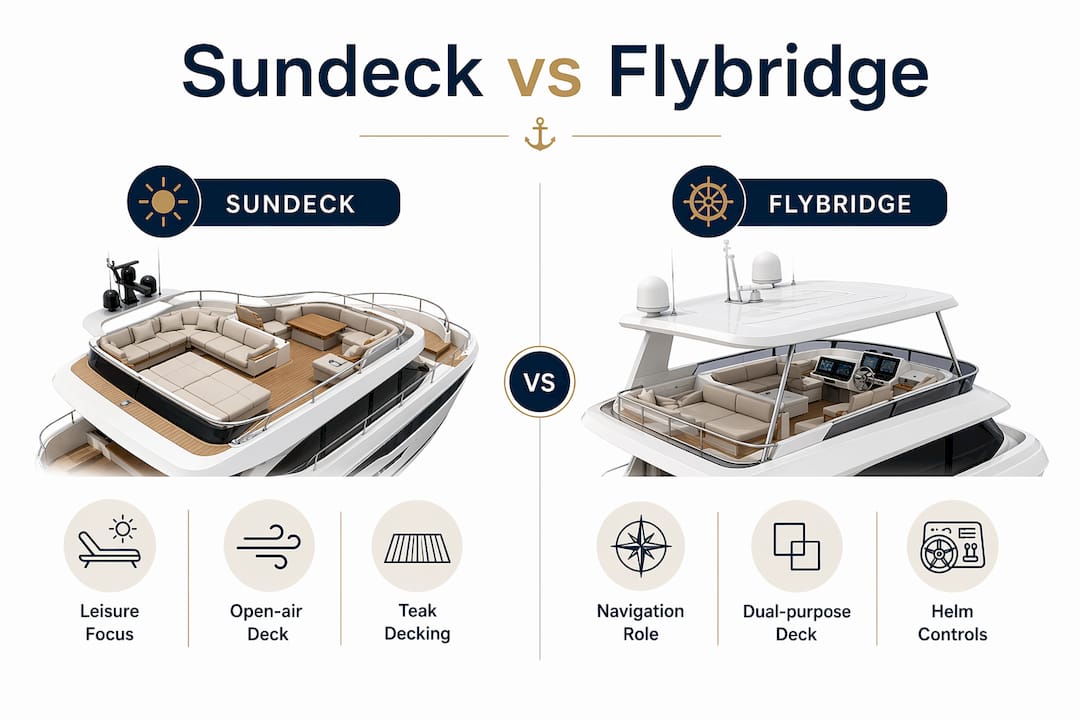
The flybridge and the sundeck occupy similar positions on a yacht but serve fundamentally different purposes. Understanding that difference helps buyers specify the right configuration for their intended use.
| Feature | Sundeck | Flybridge |
|---|---|---|
| Primary function | Leisure and social entertainment | Navigation and vessel control |
| Helm controls | None | Full helm station present |
| Guest focus | Exclusive | Shared with operational crew |
| Typical amenities | Sunpads, Jacuzzis, bars, dining | Helm seating, secondary controls, some lounge space |
| Design priority | Aesthetics and comfort | Visibility and operational access |
Sundecks are purely recreational, while flybridges serve dual navigation and entertainment roles. That operational overlap on a flybridge means designers must accommodate crew movement, sight lines to the helm, and safety clearances alongside guest comfort. A sundeck carries none of those constraints.
Modern design trends push toward hybrid configurations on mid-size superyachts, where a single upper deck incorporates a secondary helm position alongside full leisure amenities. These hybrid decks blur the line but still prioritize guest experience over operational function. For owners who want a true leisure-only space, a dedicated sundeck with no helm intrusion remains the cleaner solution. Baranofyachts works with clients early in the brief stage to clarify this distinction before it gets locked into the naval architecture.
How do you design a yacht sundeck for comfort and usability?
Sundeck design rewards specificity. Vague briefs produce generic spaces. The owners who get the most from their sundecks are the ones who define exactly how they intend to use the space before the first drawing is produced.
Ergonomics and furniture sizing
Sunlounger dimensions directly affect how long guests stay comfortable on deck. Lengths of 1,950–2,100 mm, seat heights of 300–400 mm, and multiple recline positions prevent the lower-back fatigue known in the industry as “yacht back.” A lounger that looks elegant in a catalog but forces guests to sit upright after 20 minutes fails its primary purpose.
Material selection for marine conditions
- Upholstery: Solution-dyed acrylic fabrics resist UV fading and dry quickly after spray or rain.
- Hardware: Marine-grade 316 stainless steel resists saltwater corrosion far longer than standard 304 grade.
- Decking: Teak contributes significantly to long-term durability and guest comfort, particularly in barefoot environments.
- Shade structures: Retractable carbon fiber or aluminum awnings provide UV protection without adding permanent visual weight to the deck profile.
Layout and spacing
Spacing between furniture zones determines whether a sundeck feels generous or cramped. A minimum of 900 mm of clear walkway between lounger groups allows crew to serve guests without disrupting relaxation. Social zones benefit from circular or semicircular seating arrangements that encourage eye contact and conversation. Private zones, positioned toward the bow or stern, use planters, screens, or level changes to create separation without hard walls.
Lighting and climate control
All-day usability requires planning for morning, afternoon, and evening conditions. Directional LED lighting on dimmers allows the deck to shift from bright functional light during setup to warm ambient tones for evening dining. Misting systems and deck fans extend comfortable use into peak afternoon heat. Radiant heaters mounted under shade structures extend the season into cooler months.
Pro Tip: Schedule a full cleaning and conditioning routine for teak and upholstery every 90 days at minimum. Salt residue accelerates UV damage to fabric and opens teak grain to moisture intrusion. A consistent maintenance calendar protects both the aesthetics and the structural integrity of the deck.
How does technical integration work on a yacht sundeck?
A sundeck’s technical systems are invisible when they work well and immediately obvious when they do not. Audio, lighting, and climate control must operate as a single coordinated system, not as separate components that crew must manage independently.
Open-air audio design must balance coverage, clarity, and dynamic range across a space exposed to wind, engine noise, and wave interference. Volume alone does not solve the problem. Intelligibility across the full deck, from the Jacuzzi to the dining table, requires careful speaker placement, zoning, and calibration. Systems must be zoned and calibrated for multiple guest areas to maintain balance and avoid harsh transitions between usage modes.
Key technical considerations for sundeck integration include:
- Control systems: Platforms like Crestron centralize audio, lighting, shading, and climate into a single interface. Crew can shift the deck from quiet lunch mode to evening party settings with a single scene selection.
- Crew-friendly interfaces: Successful systems are intuitive for staff while providing full ambiance control for guests. Complexity hidden behind a clean touchscreen prevents operational errors during service.
- Remote monitoring: Shore-side or bridge-based monitoring of deck systems allows the captain to verify status without sending crew topside.
- Charter value: Technical sophistication that operates without friction adds measurable appeal during charter marketing. Guests who experience effortless ambiance control remember it and request the same vessel again.
Pro Tip: Commission a full technical walkthrough with the captain and chief steward before the first charter season. Systems that are not fully understood by crew get bypassed, which defeats the investment entirely.
Why are yacht sundecks essential to luxury yachting value?
Outdoor living trends have transformed sundecks from passive sunbathing areas into dynamic social hubs with ergonomic design at their core. Owners and charter guests now expect the same level of design rigor outdoors as they receive in the main saloon. A poorly specified sundeck signals a compromised overall brief, regardless of how well the interior is executed.
The benefits of a well-designed sundeck extend well beyond guest comfort:
- Resale value: A sundeck with premium materials, integrated technology, and flexible layout commands a stronger position in the brokerage market. Buyers recognize the investment and price accordingly.
- Charter appeal: Charter guests select yachts based on outdoor living capability. A sundeck that photographs well and functions even better drives repeat bookings and higher weekly rates.
- Owner lifestyle: The sundeck is where owners spend the majority of their waking hours at sea. A space that reflects their personal taste, whether that means a minimalist teak platform or a fully equipped entertainment deck, directly shapes how much they use and enjoy the vessel.
- Social hospitality: Sundecks serve as key social hubs that reflect owner lifestyle and enhance charter appeal. The best sundecks create memories that guests associate with the yacht itself, not just the destination.
Exterior styling choices on a sundeck also communicate the yacht’s overall character. You can explore how exterior design decisions shape the perception and performance of a vessel’s outdoor spaces. For owners building from scratch, the sundeck brief deserves the same depth of thought as the master stateroom. It is the space guests photograph, remember, and talk about long after the voyage ends.
Key Takeaways
A yacht sundeck is the single most visible expression of a superyacht’s leisure philosophy, and its design quality directly determines guest satisfaction, charter value, and resale appeal.
| Point | Details |
|---|---|
| Definition and placement | A sundeck is a purely recreational upper deck on vessels 24 meters and above, with no navigational function. |
| Signature features | Sunpads, Jacuzzis, teak decking, shaded bars, and integrated entertainment systems define a well-specified sundeck. |
| Ergonomic sizing matters | Sunloungers should measure 1,950–2,100 mm in length with seat heights of 300–400 mm to prevent discomfort on long days at sea. |
| Technical integration | Crestron-based control systems allow crew to manage audio, lighting, and climate from a single interface without guest disruption. |
| Value contribution | A premium sundeck strengthens resale position, drives charter bookings, and reflects owner lifestyle more directly than any other deck space. |
The sundeck is where luxury yachting actually lives
I have spent years working through yacht briefs with owners who pour enormous energy into interior specifications, then treat the sundeck as an afterthought. That is the wrong order of priorities. In my experience, owners spend more waking hours on the sundeck than anywhere else on the vessel. The saloon is for evenings and weather. The sundeck is for everything else.
What I find most telling is how quickly a poorly designed sundeck reveals itself in practice. Loungers that force guests upright after an hour, audio that sounds thin at the dining table but overwhelming at the Jacuzzi, shade structures that cannot be deployed quickly when a cloud bank rolls in. These are not minor inconveniences. They are the details that determine whether an owner uses the yacht enthusiastically or lets it sit at the dock.
The shift toward treating sundecks with the same ergonomic rigor as interior spaces is the most important design trend in luxury yachting right now. It is not about adding more features. It is about making every feature work so well that guests stop noticing the technology and start noticing the experience. That is the standard we hold ourselves to at Baranofyachts, and it is the standard every owner should demand from their design team.
— Jason
Premium sundeck design starts with the right partner
At Baranofyachts, we work with owners from the earliest stages of a new build brief to make sure the sundeck delivers on every level, from material selection and furniture ergonomics to audio zoning and control system integration.

If you are planning a new build or evaluating a vessel for purchase, the sundeck specification is one of the first places we look. It tells us immediately how seriously the original design team took the guest experience. Explore next-generation yacht design to see how the most forward-thinking builds are approaching outdoor living in 2026. For owners ready to discuss a custom build, our team at Baranofyachts is available to walk through your brief in detail. You can also browse luxury yacht options to see how sundecks are specified across a range of vessel categories.
FAQ
What is a sundeck on a boat?
A sundeck is an open-air upper deck on a yacht dedicated entirely to leisure, sunbathing, and social activities, with no navigational equipment. It appears most commonly on superyachts measuring 24 meters and above.
How is a sundeck different from a flybridge?
A flybridge includes helm controls and serves both navigation and entertainment functions, while a sundeck is purely recreational with no operational role. The distinction matters for layout, crew access, and guest experience.
What materials are best for a yacht sundeck?
Teak is the preferred decking material for sundecks due to its natural durability, thermal comfort underfoot, and resistance to UV and saltwater. Upholstery should use solution-dyed acrylic fabrics, and hardware should be marine-grade 316 stainless steel.
What size should sundeck sunloungers be?
Ergonomic sunloungers for yacht sundecks should measure 1,950–2,100 mm in length with seat heights of 300–400 mm and multiple recline positions to support full-body comfort during extended use.
Do yacht sundecks add to resale value?
A well-specified sundeck with premium materials, integrated technology, and flexible layout strengthens a yacht’s position in the brokerage market. Charter guests and buyers both prioritize outdoor living capability when evaluating vessels.
Recommended
Sold Listings


Design Your Yacht
"*" indicates required fields
Maximus III - PNW
As you step aboard MAXIMUS III, the first impression is her scale.
At 120 feet with an 8-meter beam and 294 GT of interior volume, this 2025 Crescent Custom tri-deck immediately feels open, balanced, and estate-like. A timeless look while still feeling fresh from the shipyard.
Currently Available


Get your yacht value Estimate
"*" indicates required fields