

A flag state yacht is defined as a vessel registered under the jurisdiction of a specific country, which then governs every legal, regulatory, and operational aspect of that vessel. That country becomes the yacht’s legal nationality under the United Nations Convention on the Law of the Sea (UNCLOS), and the International Maritime Organization (IMO) holds flag states accountable for enforcing international standards aboard registered vessels. Whether you own a private cruiser or a commercial charter yacht, your flag state choice shapes your tax exposure, crew requirements, inspection schedule, and global operational freedom. Understanding what is a flag state yacht is the first step toward making an ownership decision that works for you financially and operationally.
What is a flag state yacht and why does it matter?
A flag state is the country under whose laws a yacht is registered, and that registration gives the vessel its legal nationality. Under UNCLOS, a yacht must carry official registration documents at all times. A vessel without valid registration is classified as stateless, which exposes it to seizure and serious legal sanctions in any port worldwide.
The IMO sets the international framework, but each flag state translates those rules into its own national law. This means two yachts sailing side by side in the Mediterranean can operate under entirely different safety codes, crew certification requirements, and environmental obligations. The flag state definition is not just administrative. It is the legal spine of your entire ownership structure.

Flag states also bear responsibility for their registered fleets under international law. The Paris Memorandum of Understanding (Paris MoU) monitors flag state performance and publishes annual White, Grey, and Black lists ranking flag states by their safety and environmental compliance records. A flag on the White List faces fewer port inspections and is preferred by insurers and charter companies worldwide. That ranking directly affects your operating costs and commercial opportunities.
What legal and regulatory responsibilities does a flag state impose?
Flag states enforce international maritime regulations covering safety, crewing, and environmental protection, and these obligations impact vessel operation and legal compliance at every level. The scope of those obligations depends on whether your yacht operates commercially or privately.
For commercial charter yachts, flag states typically apply the Large Yacht Code (LY3) or an equivalent national standard. This code sets requirements for fire suppression systems, life-saving equipment, stability testing, and crew-to-passenger ratios. Private yachts generally face lighter requirements, but they are never exempt from core safety and environmental rules.
Key regulatory obligations imposed by most flag states include:
- Annual or periodic surveys conducted by a recognized classification society such as Lloyd’s Register or Bureau Veritas
- Crew certification under the Standards of Training, Certification and Watchkeeping (STCW) convention
- Pollution prevention measures aligned with MARPOL regulations, covering oil discharge, sewage, and garbage management
- Manning certificates specifying the minimum number and qualifications of crew required on board
- Radio and navigation equipment standards verified at each survey cycle
Pro Tip: Ask your flag state authority for the full list of recognized classification societies before you commission a survey. Using an unrecognized society can invalidate your certificate of registry.
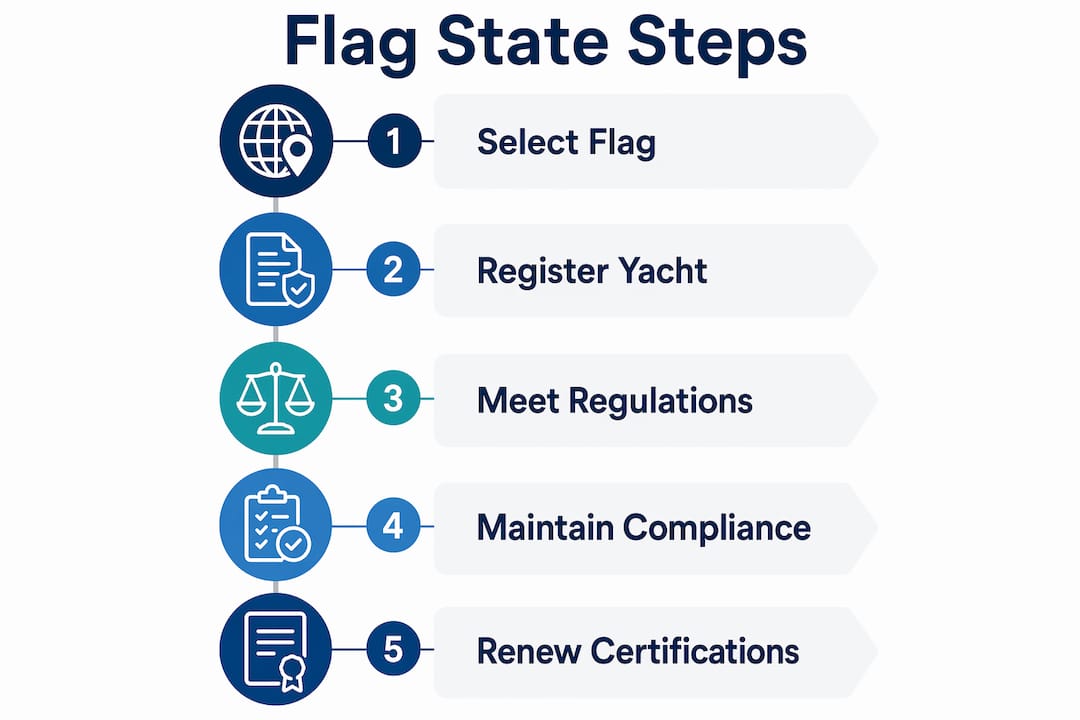
The practical overhead of these obligations is real. Survey fees, crew training costs, and documentation renewal all add up. Choosing a flag state with a well-organized registry and responsive administration reduces that overhead considerably.
How does selecting a flag state benefit owners financially and operationally?
The choice of flag state in 2026 is primarily influenced by tax optimization, regulatory burden, operational flexibility, and legal protection. Maltese-flagged yachts offer EU market access and VAT exemptions, while Marshall Islands registration provides flexibility and no income taxes on yacht earnings. Those differences translate directly into ownership economics.
Offshore registries offer tax relief, commercial charter viability, regulatory clarity, and access to global crew talent. The Cayman Islands and Marshall Islands are favored specifically because they impose no direct taxes and allow flexible manning plans. For owners operating corporate structures, these flags also support offshore holding arrangements that limit personal liability.
The Red Ensign Group, which includes the Cayman Islands, Gibraltar, and the Isle of Man, carries strong reputations for maritime support, global recognition, and surveyor networks. Insurers and port authorities worldwide recognize these flags without friction, which reduces delays and administrative costs during port calls.
The operational benefits of a well-chosen flag extend to chartering rights. Some flags grant open-charter permissions in multiple jurisdictions, while others restrict commercial activity to specific waters. Owners planning to charter bareboat or run crewed charters need a flag that explicitly permits that activity in their target cruising grounds.
Key financial and operational benefits to weigh include:
- VAT treatment: Malta and certain EU flags offer VAT leasing structures that reduce the effective tax rate on yacht acquisition
- Tonnage tax regimes: Some flags replace corporate income tax with a flat tonnage-based levy, which benefits high-revenue charter operations
- Charter permissions: Flags differ on where and how you may conduct commercial operations
- Privacy protections: Offshore registries often limit public disclosure of ownership details
- Resale value: Yachts registered under reputable flags sell faster and at stronger prices
Pro Tip: If you plan to charter in EU waters, confirm that your flag state’s VAT leasing arrangement is currently recognized by the EU member states where you intend to operate. Rules shift, and an outdated structure can trigger a large retroactive VAT bill.
What factors should you consider when choosing a flag state?
Owners should balance yacht purpose, cruising area, tax needs, and administrative ease when selecting a flag. No single flag is optimal for every owner. The right choice depends on your specific use case, and getting it wrong creates compliance problems that are expensive to unwind.
Work through these decision points in order:
-
Define your yacht’s purpose. A privately used vessel has different regulatory needs than a commercial charter yacht. Commercial operations require a flag that explicitly supports charter licensing and meets the safety standards required by charter guests’ insurers.
-
Map your primary cruising grounds. A yacht spending most of its time in EU waters benefits from a flag with recognized EU status, such as Malta or Gibraltar. A globally cruising vessel may prioritize a flag with broad port-state acceptance and minimal inspection friction.
-
Assess your tax residency. Your personal or corporate tax residency interacts with your flag state choice. Some jurisdictions tax yacht income regardless of where the vessel is registered. A maritime lawyer familiar with both your home jurisdiction and your target flag state is not optional here.
-
Check the Paris MoU performance list. Flags on the White List face fewer port state control inspections. Flags on the Grey or Black List attract additional scrutiny at every port call, which disrupts schedules and increases operating costs.
-
Evaluate registry responsiveness. A flag state authority that takes weeks to issue certificates or respond to queries creates real operational problems. Speak with other owners registered under your shortlisted flags before committing.
-
Consider insurance and resale implications. Underwriters price risk partly based on flag state reputation. A well-regarded flag lowers your insurance premium and makes the yacht easier to sell. You can read more about understanding yacht registration to see how these factors interact in practice.
How does flag state choice affect maintenance, crew, and compliance?
Registration is not a one-time event. Ongoing flag state obligations include annual inspections and crew certification renewals that must be scheduled around your operational calendar. Missing a survey window can suspend your certificate of registry, which grounds the yacht immediately.
Popular flag states have adopted international standards like STCW and the Maritime Labour Convention (MLC) to facilitate crew certifications and ease compliance across multiple jurisdictions. This matters because most luxury yachts carry internationally diverse crews. A flag that recognizes STCW certificates from a wide range of issuing countries gives you access to a larger talent pool and reduces the cost of crew training.
Different flag states impose varying requirements on vessel inspections, crew manning levels, and environmental standards, all of which affect operational cost and scheduling. Some flags allow reduced crew for private yachts, while others impose stricter commercial manning requirements regardless of the vessel’s use.
Practical maintenance and compliance obligations to plan for include:
- Annual flag state surveys coordinated with your classification society’s schedule
- STCW refresher training for all watchkeeping officers, typically every five years
- MLC compliance audits covering crew contracts, rest hours, and onboard living standards
- MARPOL logbook maintenance for oil record books and garbage management records
- Emergency drill documentation required at defined intervals and subject to inspection
Preparing your vessel for these inspections requires advance planning. Baranofyachts recommends reviewing a custom yacht inspection guide well before your survey date to avoid last-minute deficiencies that delay certification.
Key Takeaways
Flag state selection is the single most consequential legal and financial decision a yacht owner makes after the purchase itself.
| Point | Details |
|---|---|
| Flag state defines legal nationality | Under UNCLOS, a yacht without valid registration risks seizure and legal sanctions in any port. |
| Paris MoU White List status matters | White List flags face fewer port inspections and are preferred by insurers and charter companies. |
| Tax benefits vary significantly by flag | Malta offers EU VAT structures; Marshall Islands and Cayman Islands impose no direct taxes on yacht earnings. |
| Ongoing compliance is mandatory | Annual surveys, STCW crew renewals, and MARPOL records are recurring obligations, not optional extras. |
| Purpose and cruising grounds drive the choice | The right flag for a private Mediterranean cruiser differs from the right flag for a global commercial charter vessel. |
Why flag state strategy deserves more attention than it gets
Most owners I work with treat flag state selection as a box to check during the purchase process. They pick the flag their broker recommends, sign the paperwork, and move on. That approach works until it doesn’t, and when it fails, the consequences are serious.
The flag state implications I see owners miss most often are not the obvious ones. Everyone knows about tax. What catches people off guard is the interaction between their flag state’s manning requirements and their actual crew plan. A flag that demands a licensed chief engineer aboard at all times sounds reasonable until you realize your preferred engineer holds a certificate not recognized by that flag. Suddenly you are paying for a second engineer or scrambling to requalify your existing one.
The other overlooked issue is Paris MoU performance. Owners sometimes choose a flag for its tax benefits without checking its inspection record. A flag on the Grey List means your yacht gets pulled for extended port state control inspections at a rate that disrupts charter schedules and frustrates guests. The tax saving evaporates quickly when you are paying idle-day costs and refunding unhappy charterers.
My honest advice is to treat flag state selection the way you treat the yacht’s structural specification. Get it right at the start, because changing flags mid-ownership is possible but expensive and time-consuming. Consult a maritime lawyer who specializes in flag state law, not just a general maritime attorney. And revisit your flag state’s Paris MoU status every year, because flags do move between lists. The regulatory environment is not static, and neither should your compliance strategy be.
— Jason
How Baranofyachts helps owners get flag state decisions right
Choosing the right flag state is one of the most consequential decisions in the yacht ownership process, and it deserves the same level of care as the vessel’s design and construction.

At Baranofyachts, we work with owners from the earliest planning stages to align registration strategy with operational goals, tax structure, and cruising plans. Our project oversight approach treats flag state selection as a core part of the build and acquisition process, not an afterthought. Whether you are commissioning a bespoke custom build or acquiring an existing vessel, we connect you with the maritime legal and registration specialists who get this right the first time. Reach out to our team to discuss how flag state strategy fits into your broader ownership plan.
FAQ
What is a flag state for a yacht?
A flag state is the country under whose laws a yacht is registered, establishing its legal nationality and governing its safety, crew, and environmental obligations under UNCLOS and IMO frameworks.
Which flag states are most popular for luxury yachts?
The Cayman Islands, Malta, Marshall Islands, Gibraltar, and Isle of Man are among the most widely used flags for luxury yachts, each offering distinct tax, regulatory, and operational advantages.
Does flag state affect yacht taxes?
Flag state directly affects tax exposure. Malta offers EU VAT leasing structures, while the Cayman Islands and Marshall Islands impose no direct taxes on yacht earnings, making them attractive for commercial charter operations.
How often does a flag state require yacht inspections?
Most flag states require annual surveys conducted by a recognized classification society, with additional inspections triggered by port state control authorities, particularly for flags on the Paris MoU Grey or Black List.
Can you change a yacht’s flag state after registration?
Changing flag states is possible but involves administrative costs, new surveys, and potential gaps in certification. Selecting the right flag from the outset avoids this disruption entirely.
Recommended
Sold Listings


Design Your Yacht
"*" indicates required fields
Maximus III - PNW
As you step aboard MAXIMUS III, the first impression is her scale.
At 120 feet with an 8-meter beam and 294 GT of interior volume, this 2025 Crescent Custom tri-deck immediately feels open, balanced, and estate-like. A timeless look while still feeling fresh from the shipyard.
Currently Available


Get your yacht value Estimate
"*" indicates required fields