
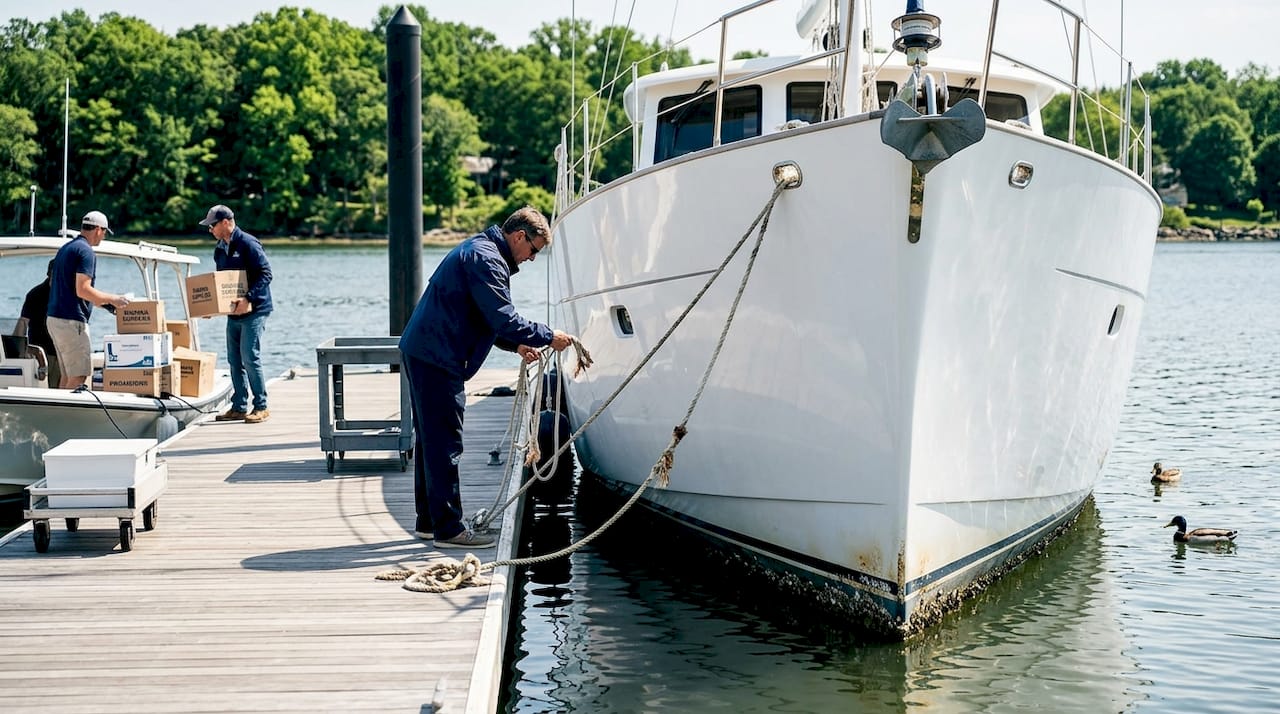
If you’ve spent any time researching yacht hull types, you’ve probably encountered the term “displacement hull yacht” without a clean, practical explanation. Understanding what is a displacement hull yacht matters more than most buyers realize, because the hull form you choose shapes everything from your cruising range and fuel costs to the quality of your ride in open-water conditions. This guide breaks down the displacement hull definition, how these yachts move through water, what makes them ideal for offshore use, and how modern design has refined them without sacrificing the characteristics that make them exceptional long-range vessels.
Table of Contents
- Key takeaways
- What is a displacement hull yacht and how it moves through water
- Key features and design characteristics
- Advantages and disadvantages of displacement hull yachts
- Displacement, semi-displacement, and planing hulls compared
- Modern innovations in displacement hull design
- My honest perspective on displacement hull yachts
- Find the right displacement yacht for your needs
- FAQ
Key takeaways
| Point | Details |
|---|---|
| Hull speed governs performance | Displacement hulls have a physical speed ceiling calculated from waterline length, which determines practical cruising speed. |
| Fuel efficiency is a core advantage | Displacement hull yachts cruise between 7 and 10 knots with far lower fuel burn than planing hull vessels. |
| Design favors comfort and range | Rounded, deeper-draft hulls deliver smoother motion in offshore conditions and greater interior volume for extended voyages. |
| Modern materials have shifted trade-offs | Carbon fiber composites now reduce vessel weight significantly, improving range and responsiveness without abandoning displacement principles. |
| Hull choice must match your use case | Displacement hulls suit long-range cruising and liveaboard use; planing hulls are better suited for performance-focused, short-distance passages. |
What is a displacement hull yacht and how it moves through water
A displacement hull is any hull that moves through the water by pushing it aside rather than rising on top of it. The term “displacement” comes directly from a foundational principle in maritime engineering: displacement equals vessel weight), meaning the hull displaces a volume of water equal to the total weight of the yacht, including fuel, crew, provisions, and cargo. The hull sits in the water at all times, supported by buoyancy.
This is the defining behavioral difference between a displacement hull and a planing hull. A planing hull generates hydrodynamic lift as speed increases, eventually rising out of the water and skimming across the surface. A displacement hull never does this. It always moves through the water, creating a bow wave that travels alongside the hull.
That bow wave is also the reason displacement hulls have a theoretical speed ceiling. Hull speed is calculated as 1.34 times the square root of the waterline length in feet. A yacht with a 64-foot waterline length, for example, has a theoretical hull speed of approximately 10.7 knots. Here is why that number matters:
- As the yacht approaches hull speed, the bow wave grows in length until it matches the waterline length of the hull.
- At that point, the yacht would need to climb its own wave to go faster, requiring exponentially more power.
- The Froude number for displacement mode sits below 0.40, and once wave resistance dominates, adding engine power generates almost no useful speed increase.
- Trying to exceed hull speed creates what engineers call a “resistance wall,” making additional power economically pointless.
This is not a flaw. It is a design philosophy. Displacement hull yachts are built to operate comfortably and efficiently within that speed range, and everything about their construction reflects that priority.
Key features and design characteristics
The physical form of a displacement hull yacht is immediately recognizable once you know what to look for. These vessels have rounded, full-bodied hull sections, a deeper draft, and a hull shape that prioritizes volume and stability over streamlined speed. The fuller form allows maximum interior space and improves seakeeping during offshore passages.
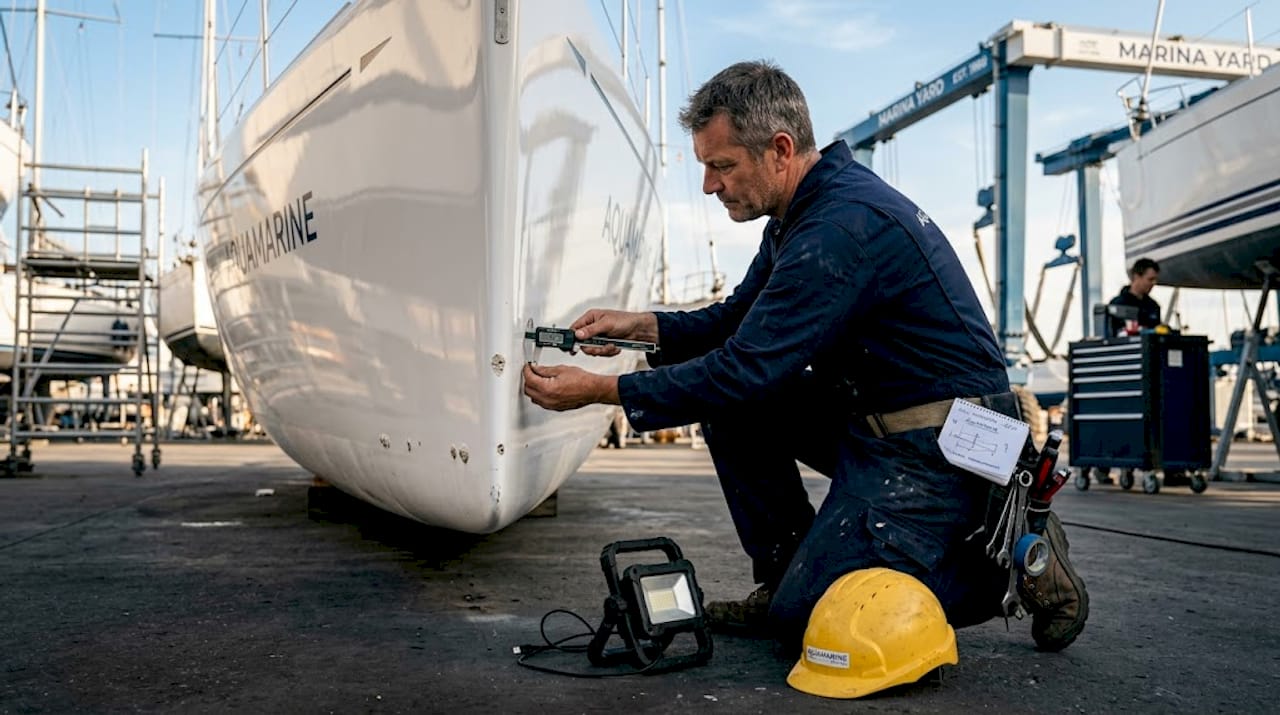
Construction materials vary, but traditional displacement yachts have long favored steel or fiberglass reinforced hulls for durability and structural integrity over long ocean passages. More on modern materials later. Propulsion typically relies on efficient inboard diesel engines, sized conservatively relative to the vessel’s displacement. Because these engines never need to push the yacht above hull speed, they run at lower power settings for extended periods, which reduces wear and fuel consumption alike.
Here is how displacement hull characteristics translate to real-world performance:
| Feature | Displacement hull | Planing hull |
|---|---|---|
| Cruising speed | 7 to 10 knots | 20 to 35+ knots |
| Fuel efficiency | High at cruising speed | Low at planing speed |
| Ride quality in chop | Smooth, stable | Harder, more impact |
| Interior volume | Generous for vessel length | Limited by thinner hull form |
| Draft | Deeper | Shallower |
| Typical use | Long-range cruising, liveaboard | Day trips, short coastal runs |
Displacement hull yachts typically cruise between 7 and 10 knots, powered by smaller, efficient diesel engines running well within their rated output. That combination of modest speed and efficient power is what makes them exceptional platforms for long-range ocean passages.
Pro Tip: When evaluating a displacement yacht, look at the engine’s rated horsepower relative to the vessel’s displacement tonnage. A well-matched displacement yacht should be able to reach hull speed comfortably at 70 to 80 percent of rated engine output, not at full throttle. That reserve capacity is a sign of proper design.
Advantages and disadvantages of displacement hull yachts
The benefits of displacement yachts are most apparent when you consider them against the demands of real offshore use. Speed is seductive when you’re shopping for a yacht. But at sea for multiple days, comfort, range, and reliability matter far more.
What displacement hulls do exceptionally well:
- Fuel economy over distance. Lower operating costs over time make displacement yachts the practical choice for anyone planning long-range coastal or offshore passages. A planing hull burning four times the fuel at twice the speed does not reach the same destination more economically.
- Ride quality. The rounded hull form and deep draft absorb ocean swells rather than slamming into them. Passengers eat, sleep, and function normally underway, which matters considerably on multi-day passages.
- Interior volume. The full hull sections that generate displacement support also create more usable space below decks. Staterooms, engine rooms, and storage areas benefit directly from this form.
- Seaworthiness. These hulls were built for ocean passages. Their stability characteristics and motion comfort in confused seas are well documented in offshore cruising practice.
- Reduced mechanical complexity. Smaller engines running at steady loads require less maintenance than high-performance planing yacht powerplants that spend time at or near peak output.
Where displacement hulls require realistic expectations:
- Speed is genuinely limited. You will not outrun weather or make up time on a tight schedule. Passage planning for displacement hull yachts requires honest time-and-distance calculations.
- Deeper draft limits access to shallow anchorages and certain marinas that faster, shallower planing yachts can use easily.
- Initial purchase costs for quality, ocean-capable displacement yachts are typically higher, reflecting the structural requirements and interior volume involved.
Pro Tip: One of the most overlooked advantages in displacement hull ownership is propeller efficiency. Because these yachts operate at steady, lower shaft speeds, you can specify a larger-diameter, slower-turning propeller that converts engine power to thrust with much better efficiency than the smaller, high-speed props required by planing hulls.
Displacement, semi-displacement, and planing hulls compared
Understanding displacement hull sailing and design means placing these vessels on a spectrum of hull types, not treating them as an isolated category. The three primary forms, displacement, semi-displacement, and planing, each represent a different philosophy about how a vessel interacts with water.
Semi-displacement hulls operate in a transition speed range where buoyancy provides partial support and hydrodynamic lift begins to contribute. They are not pure displacement vessels, but they cannot fully plane either. This middle ground offers a performance compromise that some owners find attractive, particularly in motor yachts designed for ranges of 12 to 20 knots.
Planing hulls ride on top of the water at speed, with hydrodynamic lift supporting the majority of the vessel’s weight. They require significantly more engine power, consume substantially more fuel at operating speeds, and deliver a harder ride in any meaningful sea state. For day trips, watersports, or short coastal runs where elapsed time matters, they excel. For a week at sea in the North Atlantic, they are the wrong tool.
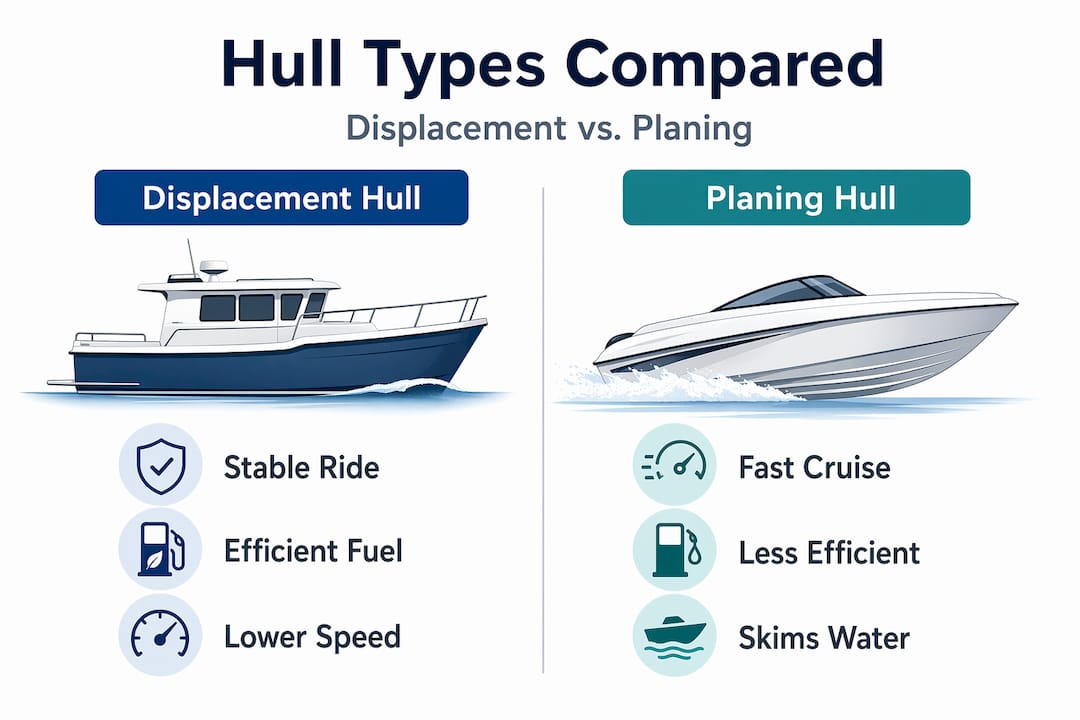
Here is how these hull types line up across key performance categories:
| Category | Displacement | Semi-displacement | Planing |
|---|---|---|---|
| Speed range | 6 to 10 knots | 10 to 20 knots | 20 to 40+ knots |
| Fuel efficiency | Excellent | Moderate | Low |
| Sea comfort | Excellent | Good | Variable |
| Range | Very long | Long | Short to medium |
| Interior volume | Maximum | Good | Limited |
| Best use case | Offshore, liveaboard | Coastal cruising | Day trips, sport |
You can often identify hull type visually. Displacement hulls have a deep forefoot, full midship sections, and a rounded underbody. Semi-displacement hulls begin to show a flatter run aft and a more pronounced deadrise angle. Planing hulls feature broad, flat sections aft that generate lift efficiently at speed.
Modern innovations in displacement hull design
The displacement hull has not stood still. Naval architects at firms like Global Yacht Technology continually work to find the optimal balance between displacement efficiency and reduced structural weight, using modern materials to push the envelope of what these vessels can achieve.
The most significant development in recent years is the adoption of carbon fiber composites in hull construction. Advanced displacement yachts using carbon fiber can achieve up to 60% weight reduction compared to conventional builds, dramatically improving range and motion response without altering the fundamental displacement behavior that makes these hulls suited to ocean use.
Hydrodynamic refinements to bow shape, stern geometry, and appendage design further reduce wave-making resistance, allowing modern displacement yachts to operate more efficiently at the upper end of their hull speed range. The result is a vessel that can cross an ocean comfortably, carry generous provisions and fuel, and arrive with reserves that older, heavier displacement builds could not match.
Naval architects at Global Yacht Technology describe the goal as “merging displacement efficiency with modern speed and lightweight design” through advanced materials, a philosophy that is reshaping what long-range yachts can accomplish.
Pro Tip: If you’re comparing displacement yacht builds, ask specifically about the weight distribution between hull, superstructure, and systems. Carbon fiber topsides on a steel hull achieve only partial weight savings. The most capable modern displacement yachts apply lightweight materials consistently throughout the structure, keeping the center of gravity low.
My honest perspective on displacement hull yachts
I’ve spent years working alongside clients who arrived certain they needed speed and left certain they needed range. The pattern is consistent enough that it has shaped how we at Baranofyachts approach every hull type conversation.
The appeal of planing hulls is real. There is something undeniably satisfying about a vessel that accelerates and lifts onto plane. But what I’ve seen repeatedly is that owners who prioritize speed for coastal passages quickly discover that 90% of their actual time aboard is spent at anchor, in port, or crossing passages where the weather window, not the engine, controls the schedule. In those conditions, a displacement hull’s ride quality, range, and interior comfort become the dominant factors in whether ownership feels like a privilege or a chore.
What I’ve also learned is that pushing a displacement hull beyond its hull speed is one of the more misunderstood ownership mistakes. Exceeding hull speed does not produce a proportional speed gain. It produces a disproportionate fuel penalty and measurably more hull stress. Owners who fight this physics spend more money to go marginally faster and arrive more fatigued.
The modern displacement hull designs we work with today have genuinely shifted some of those old trade-offs. Lighter structures mean more range per tank. Better hull form refinements mean less wave drag at the top of the cruising speed range. But the core argument for displacement hull yachts has not changed. If your real goal is to go far, sleep well underway, and arrive without mechanical drama, this hull form is built for you.
— Jason
Find the right displacement yacht for your needs
At Baranofyachts, we work with clients from the first question through delivery, and hull selection is where that conversation almost always begins. Whether you’re drawn to the proven range and comfort of a traditional displacement design or the efficiency gains of a modern carbon fiber build, the right configuration depends on how and where you plan to use the vessel.

Our team brings the kind of practiced, hands-on knowledge that turns those questions into confident decisions. From custom build options tailored to displacement hull designs, to working with a yacht broker who understands the performance trade-offs at every price point, we offer the structured guidance that luxury yacht buyers deserve. We also have financing strategies specifically suited to the investment range these vessels represent. Reach out to our team, and let’s start with what matters most to you.
FAQ
What is a displacement hull yacht in simple terms?
A displacement hull yacht is a vessel that moves through the water by pushing it aside, supported entirely by buoyancy at all speeds. Unlike planing hulls, it never rises out of the water, which makes it more efficient and stable for long-range cruising.
What is the speed limit of a displacement hull yacht?
Hull speed is calculated as 1.34 times the square root of the waterline length in feet, meaning a 64-foot waterline yields a theoretical top speed of around 10.7 knots. Exceeding this creates a resistance wall that makes additional power economically impractical.
Why is a displacement hull better for offshore cruising?
Displacement hull yachts offer superior fuel efficiency, a smoother ride in open-ocean swells, and greater interior volume compared to planing hull vessels. These characteristics make them the preferred choice for multi-day offshore passages and liveaboard use.
How does a displacement hull differ from a semi-displacement hull?
A displacement hull is always supported by buoyancy and operates below hull speed, while a semi-displacement hull generates partial hydrodynamic lift and can operate in a speed range from roughly 10 to 20 knots. Semi-displacement designs trade some efficiency and comfort for higher top speed.
Do modern displacement hull yachts use advanced materials?
Yes. Many modern displacement yachts now incorporate carbon fiber composites, which can reduce structural weight by up to 60% compared to traditional builds. This weight reduction improves range, responsiveness, and efficiency while preserving the core seakeeping advantages of the displacement hull form.
Recommended
Sold Listings


Design Your Yacht
"*" indicates required fields
Maximus III - PNW
As you step aboard MAXIMUS III, the first impression is her scale.
At 120 feet with an 8-meter beam and 294 GT of interior volume, this 2025 Crescent Custom tri-deck immediately feels open, balanced, and estate-like. A timeless look while still feeling fresh from the shipyard.
Currently Available


Get your yacht value Estimate
"*" indicates required fields