

A motor yacht is genuinely ready for a transatlantic crossing when it can carry 4,000 to 5,000 nautical miles of operational range at an economical cruise speed, backed by mechanical redundancy and a trained crew. Smaller yachts, even those near 50 feet, have made the crossing after targeted upgrades. Range, redundancy, and crew readiness are the three variables that decide feasibility, and the sections below walk through each one.
TL;DR:
- A transatlantic-ready motor yacht should have a range of at least 4,000 to 5,000 nautical miles at economical cruise speeds, with mechanical redundancy and trained crew onboard.
- Critical onboard systems needing redundancy include fuel management, propulsion, watermakers, navigation, and communications, with proper testing before departure.
- Crew size typically ranges from two to four members, with a full-time captain and engineer, and a strict watch rotation to maintain alertness during 10 to 14-day crossings.
- Owners should plan a minimum two-year preparation period for new builds, including staged sea trials and system stress tests, before attempting their first ocean crossing.
- Insurance policies must explicitly cover ocean passages, including salvage, towing, liability, and storm exclusions, with proper documentation and prior survey requirements.
Table of Contents
- How Much Range Does a Transatlantic Motor Yacht Actually Need?
- What Onboard Systems Need Redundancy for an Ocean Passage?
- How Many Crew Do You Need for a Transatlantic Crossing?
- How Long Should You Wait Before Crossing a New Build?
- What Real Crossings Reveal About Yacht Readiness
- What Insurance Do You Need for an Ocean Passage?
- What Legal and Customs Steps Are Required to Cross?
- What Communication Equipment Do You Need Beyond Satcom?
- How Do You Handle Repairs Mid-Crossing?
- How Do Crews Prepare Mentally for a Long Ocean Passage?
- How Baranof Thinks About Ocean-Ready Yachts
- Get Professional Guidance Before You Cross
- Sources
- FAQ
How Much Range Does a Transatlantic Motor Yacht Actually Need?
Hull form dictates fuel burn long before engine choice does. A full-displacement hull pushes through water efficiently at low speeds and rewards patient owners with exceptional range. A semi-displacement hull splits the difference, offering moderate speed with moderate efficiency. A fast-displacement or planing hull burns significantly more fuel per mile once pushed toward higher cruise speeds, which is why almost no true ocean crossers are built that way.
For most Atlantic routes, whether from the Canaries to the Caribbean or from Bermuda to the Azores, a range of thousands of nautical miles at cruise speed is a sensible planning floor, accounting for a direct-line passage plus a workable margin. Owners who want genuine breathing room, particularly for weather routing detours, target an even greater range.
- Cruise speed matters more than top speed. Dropping from 12 knots to 9 knots can extend range by 30 percent or more on the same hull.
- Hotel load eats into range. Air conditioning, stabilizers, and galley equipment all draw fuel indirectly through generator runtime.
- Builder claims should be read carefully. Some explorer-class superyachts, including Dynamiq’s 170-foot Gran Turismo series, are engineered specifically around transatlantic range claims exceeding 4,000 to 5,000 nautical miles at economical speeds.
Getting this calculation right early shapes everything downstream, from tank placement to range planning that accounts for cruise speed and hotel load before a single system upgrade gets specified.
What Onboard Systems Need Redundancy for an Ocean Passage?
Range on paper means nothing if a clogged fuel filter or a failed alternator strands you a thousand miles from the nearest port. The systems below are where transatlantic preparation actually lives.
Fuel systems come first because fuel problems are the most common cause of mid-ocean breakdowns. Tank capacity matters, but so does the ability to move and clean that fuel. Reserve allowances should cover at least 25 to 30 percent beyond your calculated adverse-weather burn, and a proper fuel-polishing system prevents sediment stirred up by heavy seas from clogging filters at the worst possible moment.
Propulsion and power redundancy means spare belts, filters, and injectors on board, plus a second generator capable of running critical loads if the primary fails. Backup steering and battery banks round this out.
Sustainability systems cover the watermaker, waste handling, and refrigeration. A watermaker sized for the crossing, with reliable TDS monitoring and automatic flush cycles, removes one of the largest failure points on long passages.
Communications and navigation redundancy means satcom plus a backup, long-range radar or FLIR for night watches, multiple GPS sources, and paper charts as the final fallback.
- Fuel: tankage, transfer pumps, polishing systems, spare filters
- Power: second generator, backup batteries, alternate steering
- Water and waste: sized watermaker, TDS monitoring, waste redundancy
- Navigation: satcom backup, radar/FLIR, GPS redundancy, paper charts
Pro Tip: Run your fuel-polishing system for a full engine cycle before departure, not just at idle. Sediment behaves differently under load than it does sitting at the dock.
How Many Crew Do You Need for a Transatlantic Crossing?
Crew size and discipline matter as much as any mechanical system. Industry veterans who’ve made the crossing on smaller boats consistently point out that transatlantic capability depends more on fuel logistics, mechanical redundancy, and crew readiness than on length alone.
- Crew numbers scale with yacht class. A 50 to 60-foot motor yacht typically runs with two to four crew on rotating watches; a full-time captain, plus an engineer with real diesel experience, is the minimum for anything crossing an ocean.
- Watch rotations usually run in three-hour shifts, long enough to stay alert without exhausting anyone over a 10 to 14-day passage.
- Essential skills on board should include diesel engineering, celestial or long-range electronic navigation, first aid or basic medical training, and emergency seamanship.
- Discipline never stops. Experienced skippers keep an active ship’s whiteboard tracking mechanical and rigging health, logging fuel consumption and system checks every watch. Electronics monitor the boat, but a whiteboard forces a human to actually look.
Structured crew training before departure turns these habits into muscle memory rather than checklist theater.
How Long Should You Wait Before Crossing a New Build?
Patience is the least glamorous part of ocean preparation, and it’s the part owners most often skip. Most experienced builders and delivery captains recommend a two-year lead time between taking delivery of a new build and attempting a transatlantic crossing, largely because warranty work, debugging, and crew familiarization simply take that long to surface and resolve.
A staged shakedown plan exposes faults while help is still nearby:
- Local trials: dock and harbor testing of every system under load
- Coastal cruises: multi-day runs testing fuel transfer and generator cycling
- Island-hopping legs: overnight passages that stress the watermaker and crew rotation
- The ocean leg itself: only attempted once the previous three stages run clean
Each stage should include engine load tests, full fuel transfer cycles, and watermaker endurance runs, since these are the systems most likely to fail quietly before they fail completely.
What Real Crossings Reveal About Yacht Readiness
Documented crossings tell you more than any spec sheet. Owners of the Elling E6, a production motor yacht well under 60 feet, completed an Atlantic crossing only after adding fuel-polishing systems, extended fuel capacity, and upgraded satellite communications. The related Elling E4 has logged legs as long as 2,580 nautical miles from the Canary Islands to the Caribbean, a real demonstration that well-prepared production boats can make ocean passages under favorable routing.
Smaller production motor yachts have succeeded on ocean passages when owners retrofitted watermakers, fuel-polishing systems, and added redundancies. These upgrades are tactical and measurable, not theoretical.
Nordhavn’s long-range trawler community tells a similar story from the other direction: mechanical failures and deck gear issues are what force crews to improvise mid-ocean, and trained crew with staged shakedowns behind them handle those moments far better than crews who haven’t rehearsed them. At the top of the market, builders like Dynamiq engineer explorer yachts specifically around the 5,000 nautical mile benchmark, confirming that the range target scales up, not down, as boats get more capable.
What Insurance Do You Need for an Ocean Passage?
Standard coastal or Mediterranean yacht insurance policies typically exclude ocean crossings entirely, or restrict coverage to specific named routes and seasons. Before departure, owners need to confirm their policy explicitly names the intended passage, the vessel’s route corridor, and the departure window, since insurers price transatlantic risk differently from coastal cruising risk.
Key coverage points worth confirming with a marine insurance broker include:
Hull and machinery coverage should extend to salvage and towing costs specific to open-ocean recovery, which can run dramatically higher than coastal towing. Crew and liability coverage needs to reflect the actual number of people aboard for the passage, not the policy’s default coastal crew count. Many insurers also require a named, qualified delivery captain or a minimum logged offshore experience threshold before they’ll extend coverage for the crossing at all.
Weather routing and named-storm exclusions deserve particular attention. Some policies suspend coverage during named tropical systems even outside the yacht’s immediate area, which affects how flexible your departure window can be. It’s worth requesting written confirmation, not a verbal assurance, that the policy covers the specific route and season you plan to sail.
Finally, review the survey requirements. Many insurers require a current out-of-water survey before extending or renewing ocean-passage coverage, and that survey can also surface mechanical issues worth fixing before departure rather than after.
What Legal and Customs Steps Are Required to Cross?
Departure and arrival formalities differ by flag state and destination, but a few requirements are close to universal for a transatlantic motor yacht. Before leaving, the vessel needs current registration documents, a valid radio license if operating satcom or VHF, and proof of the crew’s passports and any required visas for the arrival country.
Customs clearance at departure typically requires filing an outbound clearance with the port authority, especially when carrying duty-free stores, fuel, or provisions purchased under export allowances. Arrival customs and immigration procedures vary widely: some Caribbean nations require advance notice through a maritime portal before the yacht enters territorial waters, while others expect the captain to clear in person at a designated port of entry within a set number of hours of arrival.
Crew lists, done correctly, save hours at both ends. A complete crew list with full names, passport numbers, and nationalities, prepared before departure and matching exactly what’s presented on arrival, avoids the single most common cause of customs delays. Firearms, medications, and any controlled substances aboard need explicit declaration; undeclared items found during an arrival inspection create problems disproportionate to their size.
Owners planning an international delivery or a build project that will eventually cross an ocean benefit from folding these requirements into construction and project management planning early, rather than treating customs paperwork as a departure-week afterthought.
What Communication Equipment Do You Need Beyond Satcom?
Satellite communication is the backbone of an ocean passage, but it isn’t the whole system. AIS (Automatic Identification System) broadcasts your position, course, and speed to nearby vessels and coastal stations, and it’s what other ships use to avoid you in low visibility or heavy traffic near shipping lanes. A functioning AIS transponder, not just a receiver, is standard equipment on any yacht attempting a transatlantic crossing.
An EPIRB (Emergency Position Indicating Radio Beacon) is the last line of defense if the vessel is disabled or abandoned. It should be registered to the vessel and crew, tested annually, and mounted where it can be manually deployed in seconds. A separate personal locator beacon for each crew member on watch adds a layer of protection if someone goes overboard at night.
Redundant communication means layering these tools rather than relying on one: primary satcom for routine position reports and weather downloads, a backup satellite phone as a secondary channel, VHF for close-range vessel-to-vessel contact, and the EPIRB reserved strictly for genuine emergencies. SSB (single-sideband) radio, while less common now, still gives some long-range crews an independent voice channel that doesn’t depend on satellite infrastructure.
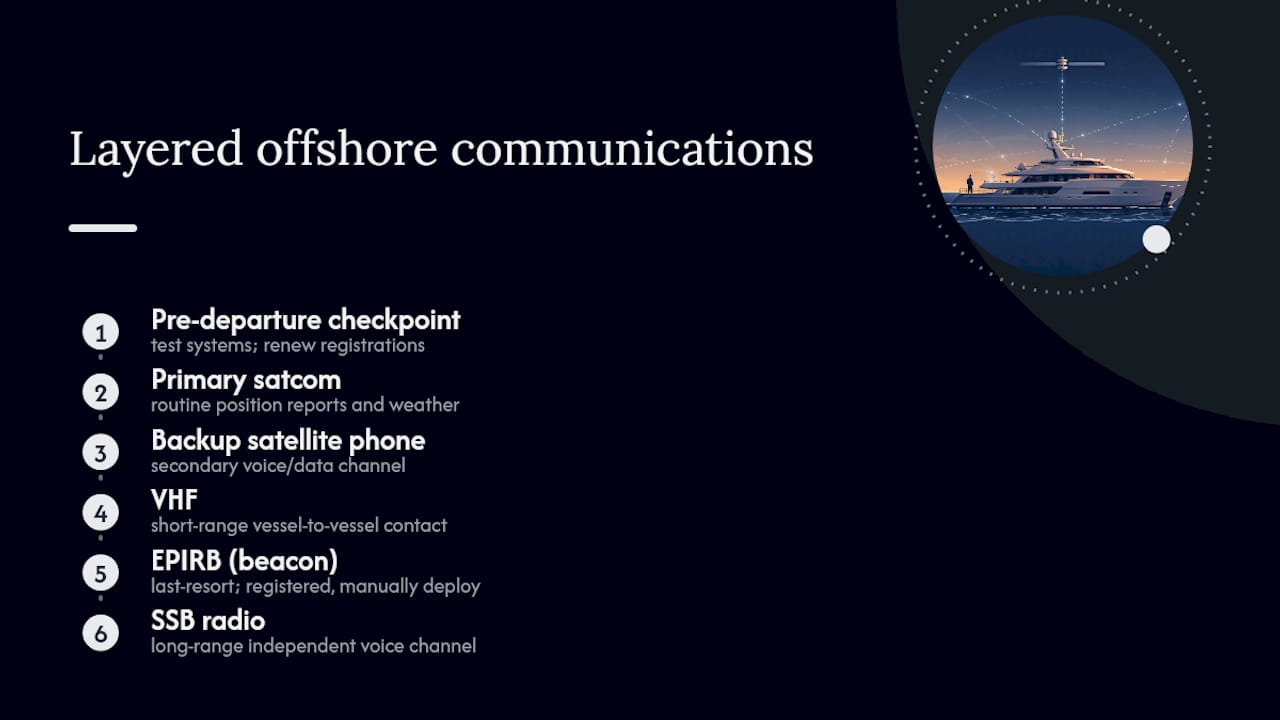
Testing every one of these systems before departure, not assuming they work because they’re installed, catches the dead batteries and expired registrations that otherwise surface at the worst possible moment.
How Do You Handle Repairs Mid-Crossing?
Something will need attention during a ten-to-fourteen-day passage. The question is whether the crew can fix it underway or has to divert.
A well-stocked spare parts inventory is the foundation: filters, belts, impellers, injectors, and the specific fasteners and gaskets unique to your engine model, not generic equivalents that may not fit under pressure. An engineer who can actually diagnose a problem, not just swap parts, is worth more than any single spare on the shelf.
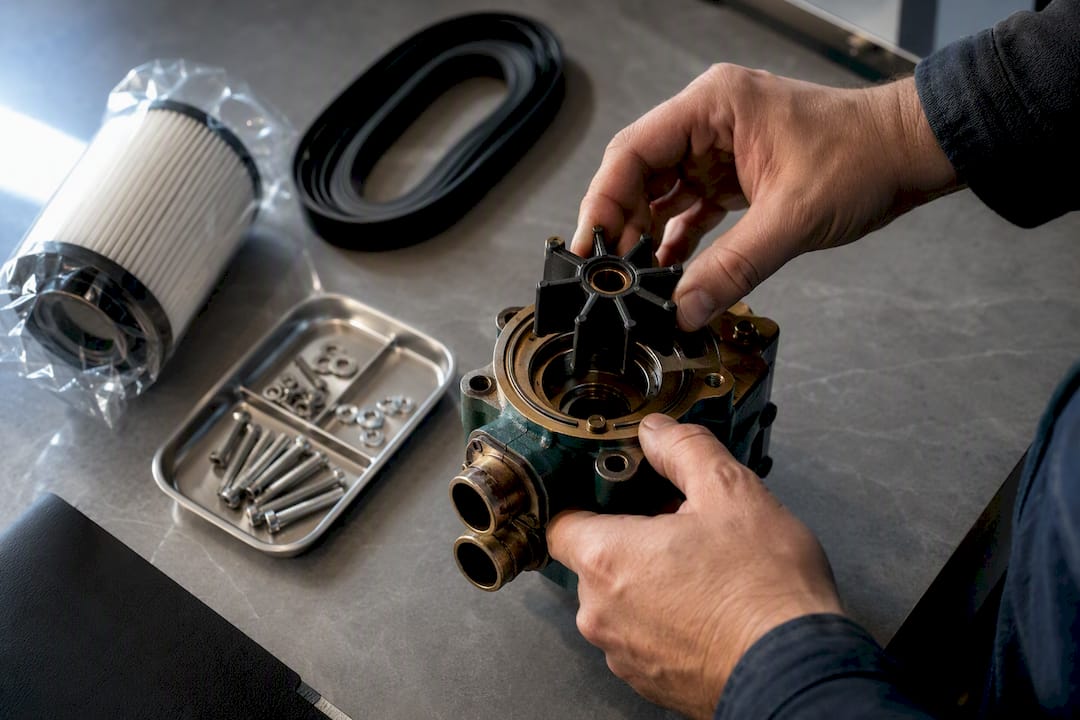
Diagnostic capability matters as much as spares. Modern engines increasingly rely on electronic monitoring, and a crew that can read fault codes and cross-reference them against a printed manual, independent of an internet connection, solves problems faster than one waiting on a satellite call to a shoreside technician.
Fuel and filtration issues are the most common mid-crossing repair, which is why fuel-polishing capability and a stock of spare filters matter more than almost anything else aboard. Beyond that, most crews carry contingency plans for steering failure, generator loss, and watermaker breakdown, each with a documented workaround that doesn’t require reaching port. Divert points, ports along the route capable of handling an emergency stop, should be identified and logged before departure, not looked up mid-emergency.
How Do Crews Prepare Mentally for a Long Ocean Passage?
Fatigue and isolation affect judgment long before they show up as obvious exhaustion. A ten-to-fourteen-day crossing puts crew through sleep disruption, sensory monotony, and the psychological weight of being genuinely far from help, and none of that shows up on a systems checklist.
Rotating watch schedules, discussed earlier, exist as much for mental sharpness as physical rest. Crews that maintain a predictable daily rhythm, meals at set times, a consistent watch handover routine, and scheduled downtime, report fewer errors than crews who let the schedule drift. Boredom and monotony, not panic, are what typically erode attention on the fourth or fifth day at sea.
Clear roles reduce anxiety. Crew who know exactly what they’re responsible for, and who to report to when something changes, handle stress better than crews operating on assumed authority. Briefing everyone on emergency procedures before departure, not during an actual emergency, matters as much for confidence as for competence.
Provisioning also plays a role here that goes beyond calories. Fresh food, varied meals, and a stocked galley noticeably improve morale on longer legs, which is one more reason detailed provisioning planning deserves attention well before departure, alongside practical guidance from charter specialists on provisioning for extended voyages.
How Baranof Thinks About Ocean-Ready Yachts
We scope every refit or new-build conversation around one question: what does this owner actually plan to do with the boat? A yacht built for coastal cruising and a yacht built to cross an ocean share a hull shape and little else underneath. Our project management approach walks owners through range calculations, redundancy specification, and shipyard selection in that order, because sequencing matters. Getting the fuel and systems architecture right before the interior design conversation starts saves owners from expensive retrofits later.
— Jason
Get Professional Guidance Before You Cross
There are other routes to ocean readiness: DIY retrofits pieced together from forum advice, or a generic yard that’s never spec’d a transatlantic system before. Neither carries the accountability of a dedicated project manager who scopes fuel range, redundancy, and shipyard selection as one connected decision instead of three separate ones.
We work alongside owners on exactly the decisions this article covers: specifying tankage and cruise speed for real range targets, choosing shipyards experienced with ocean-capable systems, managing custom refit projects from fuel polishing to watermaker upgrades, and coordinating pre-purchase surveys before commitment to a boat. We keep the claims realistic. An inspection or consultation comes first, before any commitment, so you know exactly what a given hull needs before spending on it. If you’re evaluating a yacht for transatlantic capability or planning a refit toward that goal, start with a look at our new-build planning guidance and reach out to talk through your specific route and timeline.
Sources
- Dynamiq’s New 170-Foot Superyacht Will Be Its Largest Vessel Yet — Robb Report
- By Way Of Greenland: Crossing the Atlantic on a Elling E6 — Power & Motoryacht
- Crossing the Atlantic — YATCO blog
- How to prepare for an Atlantic crossing — Yachting World
- Transatlantic rigging failure — Professional BoatOwner (PBO)
FAQ
What Size Motor Yacht Can Cross the Atlantic?
Motor yachts as small as roughly 50 feet, like the Elling E6 and E4, have completed Atlantic crossings after upgrades to fuel capacity, fuel polishing, and communications, though most experienced crews prefer 60 feet or larger for comfort and redundancy margin.
Can a 100-Foot Yacht Cross the Atlantic?
Yes. A motor yacht with 4,000 to 5,000 nautical miles of range, mechanical redundancy, and a trained crew is well within the capability range that experienced builders and delivery captains consider transatlantic-ready.
What Is the Best Type of Yacht for a Transatlantic Voyage?
Full-displacement and semi-displacement hulls built for economical cruise speeds are best suited for ocean crossings, since they deliver the fuel efficiency needed to reach 4,000 to 5,000 nautical miles of range without excessive tankage. Baranofyachts works with owners specifically on this hull-and-range tradeoff during the specification phase.
How Long Does It Take to Cross the Atlantic by Motor Yacht?
Most transatlantic motor yacht crossings take between 10 and 14 days, depending on route, cruise speed, and weather routing decisions made along the way.
Do You Need Special Insurance to Cross the Atlantic?
Yes. Standard coastal yacht insurance typically excludes ocean crossings, so owners need a policy that explicitly names the transatlantic route, season, and crew count before departure.
Recommended
Sold Listings
Design Your Yacht
"*" indicates required fields
Maximus III - PNW
As you step aboard MAXIMUS III, the first impression is her scale.
At 120 feet with an 8-meter beam and 294 GT of interior volume, this 2025 Crescent Custom tri-deck immediately feels open, balanced, and estate-like. A timeless look while still feeling fresh from the shipyard.
Currently Available


Get your yacht value Estimate
"*" indicates required fields