

Plan on roughly 12 to 15% of purchase price per year to operate a privately owned 40 to 50 meter superyacht, with crew, maintenance, and berthing driving most of that spend. A $30 million yacht in this range typically runs $3.6 million to $4.5 million annually, before refit spikes. Larger, older, or chartered vessels commonly push past 15%, sometimes into the 20% range.
TL;DR:
- Crew costs typically account for 30 to 40 percent of annual expenses, with salaries and benefits rising significantly on larger or more senior yachts.
- Maintenance, insurance, and berthing costs vary widely based on yacht size, age, and usage, with larger vessels often exceeding 15 percent of purchase price annually.
- Operating a 40 to 50 meter yacht usually costs between 1.8 to 3.15 million dollars per year, depending on usage, age, and charter activity.
- Major refits and scheduled surveys can drastically increase costs, with refits often reaching into the millions for larger yachts.
- Building a detailed, vessel-specific operational budget with contingency and reserve funds provides a more accurate financial outlook than relying on broad percentage estimates.
Table of Contents
- Superyacht Operating Costs Broken Down by Category
- What Do Superyacht Operating Costs Look Like by Size?
- What Does It Cost to Staff a Superyacht Crew?
- When Do Maintenance and Refit Costs Spike?
- How Much Should Insurance and Compliance Cost?
- How Do Location and Season Change Berthing Costs?
- How Do You Estimate Superyacht Fuel Costs?
- What Do Management Fees and Discretionary Costs Include?
- What Is the True Five-Year Cost of Superyacht Ownership?
- How Do You Build a Bottom-Up Annual Operating Budget?
- Why Professional Oversight Changes the Numbers
- Where to Verify These Superyacht Operating Cost Figures
- Sources
Superyacht Operating Costs Broken Down by Category
The old 10% rule was never wrong so much as incomplete. Industry working ranges still cluster between 10 and 15% of purchase price, but that top-line number hides enormous variation between a lightly used 35 meter and a heavily chartered 60 meter with an aging engine room. Here’s how the money actually splits:
- Crew (30 to 40%): Salaries, benefits, training certifications, flights, and uniforms. This is almost always the single largest line item, and it rises with both yacht size and crew seniority.
- Maintenance and spare parts (10 to 20%): Routine engine servicing, hull cleaning, and consumable parts. This category is lumpy. Quiet years get followed by expensive ones.
- Insurance (roughly 2 to 4% combined): Hull and Machinery (H&M) plus Protection and Indemnity (P&I) coverage, with rates shaped by cruising region and claims history.
- Berthing and itinerary (5 to 15%, highly variable): Marina fees swing wildly based on season and destination.
- Fuel, provisioning, and consumables (5 to 10%): Tied directly to engine hours and guest usage.
- Management fees and contingency (5 to 10%): Administrative oversight plus a buffer for the unexpected.
Every one of these categories moves independently, which is exactly why a single blended percentage only gets you so far.
What Do Superyacht Operating Costs Look Like by Size?
Size drives cost, but so does age and how hard the yacht works. A 10 year old charter yacht will cost meaningfully more to run than a five year old vessel used only by its owner, even at the same length. Here are realistic annual bands:
- 30 meters: $710,000 to $1.25 million, mostly driven by crew and berthing.
- 40 meters: $1.1 million to $1.95 million for privately operated programs.
- 50 meters: $1.8 million to $3.15 million, with insurance and maintenance climbing sharply.
- 60 meters: roughly $3.5 million to $5.5 million, where full-time engineering staff becomes mandatory.
- 80 meters and above: frequently $6 million to $10 million or more, particularly with helicopter or submersible support.
Age typically adds 3 to 5 percentage points to your operating ratio once a yacht passes its ten-year mark, largely from rising maintenance frequency. Chartering adds another layer: commercial registration means more inspections, higher insurance tiers, and faster wear on interiors and tenders. Before locking in a budget, weigh your actual planned usage, not the yacht’s category on paper, against these bands. An owner who cruises eight weeks a year with a skeleton crew will land near the bottom of the range; one running a full charter season will not.
What Does It Cost to Staff a Superyacht Crew?
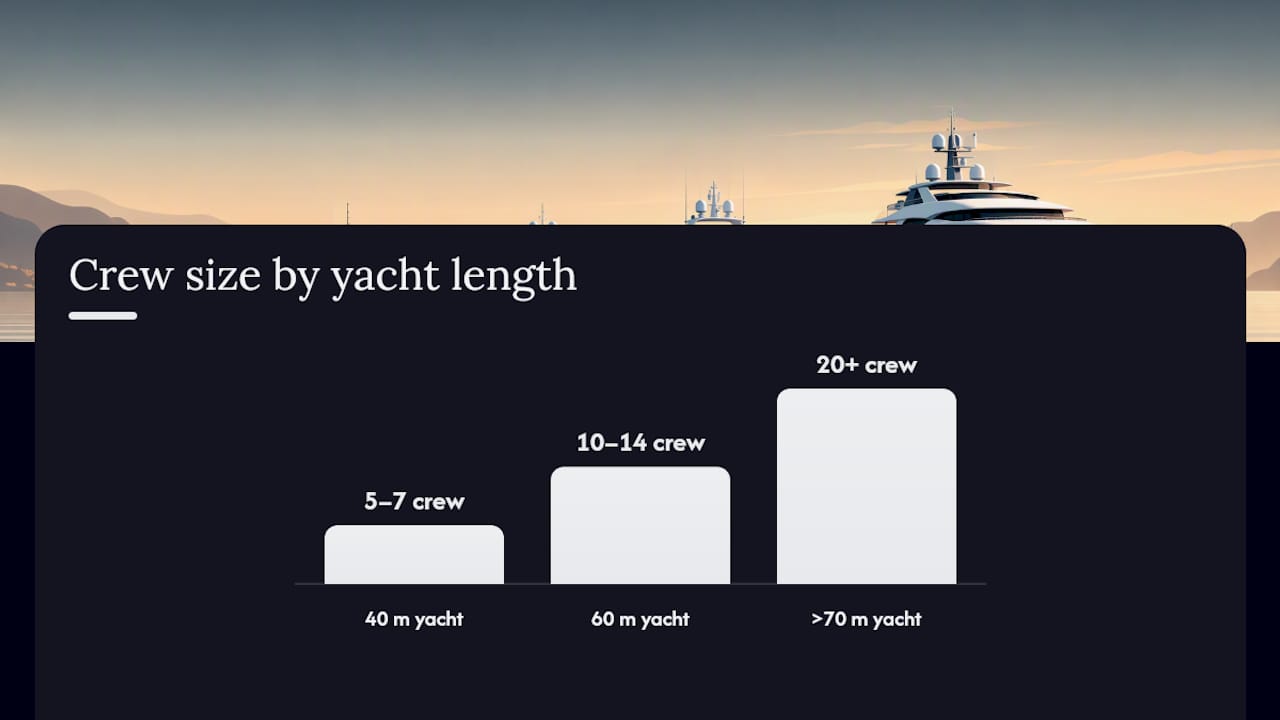
Crew accounts for 30 to 40% of total annual operating cost, and it is the line item most owners underestimate going in. A 40 meter yacht typically carries five to seven crew; a 60 meter needs ten to fourteen; anything above 70 meters often requires twenty or more, including specialized engineering and hospitality roles.
Salary bands vary sharply by seniority and yacht size:
- Captains: $8,000 to $15,000 per month on 40 to 50 meter yachts, climbing well beyond $20,000 on larger vessels.
- Chief engineers and first officers: $6,000 to $10,000 per month depending on class certifications.
- Chefs, stewardesses, and deckhands: $3,500 to $7,000 per month based on experience and yacht program.
Beyond base pay, owners carry medical coverage, repatriation insurance, social charges depending on flag state, and flights home for rotational leave. A “time-for-time” rotation, where crew work equal time on and off, keeps morale high but roughly doubles staffing costs compared to year-round crews, since you’re effectively paying two people for one position.
Pro Tip: Charter activity spikes crew costs beyond salary. Guest turnover means more provisioning runs, more laundry, more overtime, and often a temporary chef or extra stewardess brought in for peak weeks. Budget a charter season separately from your baseline crew cost, not as an add-on.
Understanding role-by-role responsibilities helps clarify where crew budgets actually go, especially when comparing rotational versus permanent staffing models.
When Do Maintenance and Refit Costs Spike?
Routine maintenance sits in the mid-teens percent range in most years: engine servicing, hull cleaning, watermaker upkeep, and general systems checks. The real budget shock comes from scheduled events.
- Annual haul-out and inspection: Predictable, usually built into routine maintenance spending.
- Five-year special surveys: Class society requirements that often trigger deeper inspections of tanks, machinery, and structural elements.
- Major refits: Can run into the millions for a 40 to 50 meter yacht, particularly when interior refreshes coincide with mechanical overhauls.
Deferred maintenance rarely saves money. It compounds, turning a $50,000 fix into a $500,000 one two years later. Owners planning a major refit should treat it as its own project with its own budget and timeline, not an extension of routine annual spend.
How Much Should Insurance and Compliance Cost?
Hull and Machinery insurance typically runs 0.8 to 1.5% of insured value annually, with Protection and Indemnity cover adding further expense depending on crew size and cruising region.
- Cruising in hurricane-prone or high-traffic waters raises premiums measurably.
- Claims history follows the vessel, not just the owner, so a yacht with prior incidents costs more to insure regardless of who’s aboard.
- Flag state and class society fees recur annually and scale with tonnage and survey frequency.
- Commercial charter registration increases both insurance tiers and inspection frequency compared to private-use-only vessels.
A clear insurance strategy built early prevents unpleasant renewal surprises later.
How Do Location and Season Change Berthing Costs?
Berthing is the most volatile line item on any operating budget. A premium slip during Monaco Grand Prix week or the Cannes Film Festival can run tens of thousands of dollars for a matter of days, while an off-season berth in a quieter marina might cost a fraction of that per month.
- Splitting a season between two cruising grounds, say the Mediterranean and the Caribbean, often doubles combined annual berth spend once transit costs and seasonal premiums are factored in.
- Booking well ahead of peak events secures better rates than last-minute arrangements.
- Many owners negotiate annual marina contracts at a home port to stabilize costs, then budget separately for transient premium berths during peak travel weeks.
Matching your itinerary to your actual usage pattern, rather than chasing every marquee event, keeps this category from overwhelming the rest of the budget.
How Do You Estimate Superyacht Fuel Costs?
Fuel spend scales directly with engine hours, generator load, and cruising speed. A mid-size superyacht might burn 100 to 150 gallons per hour underway, plus continuous generator draw for hotel loads like air conditioning, lighting, and galley equipment.
A simple estimation method:
- Estimate annual cruising hours based on your planned itinerary.
- Multiply hours by your yacht’s typical fuel burn rate per hour.
- Multiply that total by current marine diesel price per gallon.
- Add 15 to 20% for generator and hotel-load consumption on top of propulsion fuel.
Owners looking to reduce this line often cruise at more efficient speeds, minimize unnecessary generator runtime, and plan tighter itineraries that cut transit distance between destinations.
What Do Management Fees and Discretionary Costs Include?
Professional yacht management typically runs from a few thousand dollars monthly for smaller vessels to well over $10,000 per month for larger, more complex operations. Scope usually covers crew payroll administration, compliance tracking, vendor coordination, and financial reporting.
- Owner discretionary spending covers guest travel, provisioning upgrades, private chef requests, and communications packages like satellite internet.
- In-house management gives owners more direct control but requires more of their own time and attention.
- Outsourced management costs more upfront but shifts administrative burden and compliance risk onto a dedicated team.
Most owners of yachts above 40 meters find the tradeoff favors outsourcing, particularly once charter activity or multi-region cruising enters the picture.
What Is the True Five-Year Cost of Superyacht Ownership?
Depreciation compounds with annual operating cost to form the real financial picture. Yachts typically lose 10 to 20% of value in year one, then settle into 6 to 8% annual depreciation through year five.
- A $30 million yacht might depreciate to roughly $18 million to $20 million by year five, while accumulating $18 million to $22 million in operating costs over that same span at a 12 to 15% annual rate.
- Combined, that’s frequently an eight-figure total cost of ownership over five years for a mid-size superyacht.
- Charter income can offset some annual operating expense in disciplined programs, but it rarely covers depreciation for most private owners, and often falls short of fully offsetting opex too.
Modeling both depreciation and operating cost together, rather than focusing only on the annual percentage, gives a far more honest picture of what ownership actually costs over time.
How Do You Build a Bottom-Up Annual Operating Budget?
A percentage-of-purchase-price estimate is a starting point, not a plan. A bottom-up budget built from your vessel’s specification and intended program produces far more reliable numbers.
- Define your program: weeks of use per year, home base, and secondary cruising grounds.
- List every fixed cost line: crew salaries, insurance, management fees, berthing contracts.
- List every variable cost line: fuel, provisioning, transient berths, charter-related expenses.
- Estimate each line using size and age benchmarks rather than a single blended percentage.
- Add a contingency line of 5 to 10% for unplanned repairs and price volatility.
- Add a separate refit reserve line at 0.5 to 1% of hull value annually.
A quick mini-worksheet for a 45 meter yacht might show $1.2 million in crew, $250,000 in insurance, $180,000 in berthing, $150,000 in fuel, $120,000 in management fees, and $100,000 in contingency and refit reserve combined, landing near $2 million annually. Your own operational budget will shift based on usage weeks and cruising region, which is exactly why the worksheet approach beats a flat percentage every time.
Why Professional Oversight Changes the Numbers
The better question every prospective owner should ask isn’t “what percentage should I budget?” It’s “what annual commitment am I comfortable making for the next five years, in dollars, not percentages?”
Our approach is built around that distinction. Through brokerage, custom build, and project management services, we help owners scope realistic budgets before signing anything, not after the first surprise invoice arrives. Professional oversight earns its cost most clearly during three moments: pre-purchase inspection, delivery acceptance, and refit scoping, where an experienced eye catches issues that turn into six-figure problems later.
When you interview a prospective manager, ask about reporting cadence, financial transparency, and what specific metrics they track against budget. A manager who can’t answer those questions clearly isn’t ready to manage your program.
— Jason
Where to Verify These Superyacht Operating Cost Figures
For deeper research, the First Owner’s Reference covers the 10% rule’s limits and depreciation curves. The Hype Luxury breakdown offers size-by-size dollar ranges. CNN’s reporting on hidden costs documents real owner surprises worth reading before you budget.
Sources
- Superyacht running costs and the 10 percent rule | The First Owner’s Reference
- The Real Annual Cost of Running a Superyacht in 2026: A Complete Breakdown by Size – Hype Luxury Blog
- The hidden costs of owning a superyacht
Recommended
Sold Listings


Design Your Yacht
"*" indicates required fields
Maximus III - PNW
As you step aboard MAXIMUS III, the first impression is her scale.
At 120 feet with an 8-meter beam and 294 GT of interior volume, this 2025 Crescent Custom tri-deck immediately feels open, balanced, and estate-like. A timeless look while still feeling fresh from the shipyard.
Currently Available


Get your yacht value Estimate
"*" indicates required fields