

Start the shipyard slot booking process 12 to 18 months ahead for a new build, and 6 to 12 months ahead for a major refit. Securing the slot itself comes down to three moves: arrive with a detailed tender and specification, prove you have the financing in place, and negotiate a milestone-based contract with a superintendent overseeing every inspection. Owners who skip any one of the three often find their “confirmed” date quietly slipping.
TL;DR:
- Securing a shipyard slot requires arriving with a detailed tender, proof of financing, and a milestone-based contract; skipping these steps can delay your booking.
- Most yard bookings need to be made 12 to 18 months ahead for new builds and 6 to 12 months for refits due to capacity constraints and supply chain lead times.
- Contracts should include milestone-based payments, pre-agreed change-order rates, and specific delay remedies to protect owners from schedule and cost overruns.
- Preparing a comprehensive tender with detailed specifications, serial numbers, and scope clarity speeds approval and reduces change orders during construction.
- Early engagement and ongoing owner involvement are crucial to maintain schedule, avoid scope creep, and ensure your slot remains secure throughout the project.
Table of Contents
- Shipyard Slot Booking Timeline: When Should You Start?
- What Do Shipyards Check Before Accepting a Booking?
- How Contracts and Payment Milestones Protect Your Slot
- Building a Tender That Wins the Slot You Want
- Negotiating Terms That Actually Hold the Slot
- Keeping Your Slot on Schedule Once the Build Begins
- Why Early Engagement Beats Contract Language Every Time
- Get Expert Help Booking and Managing Your Shipyard Slot
- Sources
Shipyard Slot Booking Timeline: When Should You Start?
Yards allocate capacity years out, and the best berths for large or complex projects go to owners who show up early with a real plan, not just an inquiry. Industry guidance consistently points to 12 to 18 months of lead time for large new-build slots and 6 to 12 months for major refits, with the longer end of that range reserved for very large yachts or yards with backed-up dry-dock schedules.
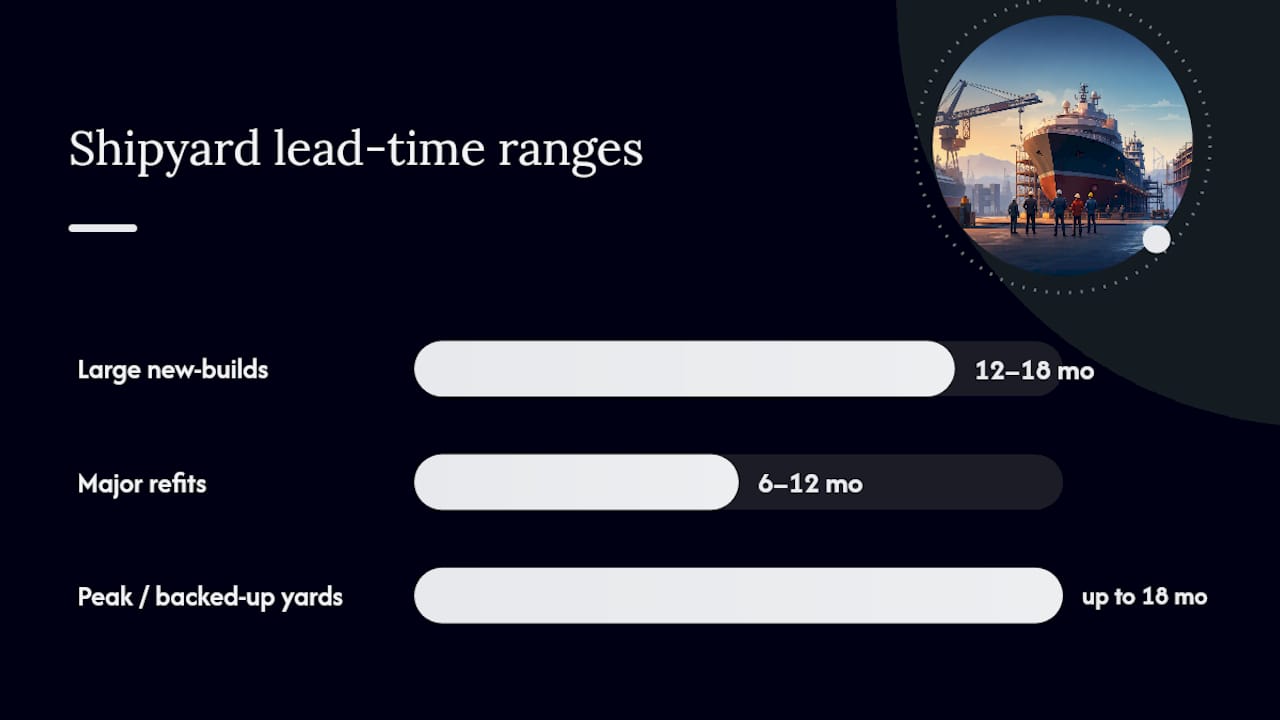
Several forces push those windows further out. Dry-dock cycles at busy yards book solid a year or more in advance. Long-lead OEM equipment, main engines, generators, stabilizers, often carries its own multi-month manufacturing queue that has to sync with the yard’s calendar. Specialist subcontractors, painters, teak layers, AV integrators, get booked by multiple yards simultaneously and become scarce during peak refit season.
Before approaching any yard, have these ready:
- Board or family-office sign-off on the project budget and financing structure
- A preliminary scope of work, even if not yet finalized
- Class society and flag state requirements identified for your vessel type
- A named project manager or superintendent who will represent you through the process
Arriving without these tells the yard’s planning team you are not yet a serious booking, and that reads as risk they would rather avoid.
What Do Shipyards Check Before Accepting a Booking?
Every shipyard slot is a bet the yard makes on you as much as you make on them. Before a berth is confirmed, most yards run an internal feasibility review that weighs three things: whether your scope is realistic, whether your budget can actually fund it, and whether your project fits their skill set and equipment. Owners who appear underfunded or culturally misaligned with the yard’s working style get quietly declined, often without a clear explanation.
To pass that review, come prepared with:
- Detailed technical specifications, drawings, and equipment lists
- Serial numbers and running hours for existing machinery (refits especially)
- Class and flag documentation confirming the vessel’s current compliance status
- Proof of funds or a financing commitment letter
- A documented service history for any vessel entering refit
References matter more than most owners expect. A short summary of prior projects, who managed them, what yard performed the work, and how the timeline held up, gives the yard confidence you understand what a build or refit actually demands.
Pro Tip: Ask your project manager or naval architect to compile a one-page “owner profile” summarizing past vessels, budget history, and decision-making structure. Yards read this the way a bank reads a credit file, and it can shave weeks off the vetting stage.
How Contracts and Payment Milestones Protect Your Slot
A verbal slot offer means nothing until it is backed by a signed contract with payment terms that protect you, not just the yard. Standard shipyard contracts are typically drafted to favor the yard, so the burden falls on the owner’s side to negotiate real protections before signing.
Four contract features separate a genuinely protected slot from a paper promise:
- Milestone-based payments tied to inspectable deliverables. Tie payment tranches to verified stages, hull completion, systems installation, sea trials, final handover, rather than calendar dates. A calendar date can slip with no consequence to the yard; a milestone can’t be invoiced until it’s actually done.
- A formal change-order procedure with pre-agreed unit rates. Every refit uncovers surprises. Locking labor rates and material markups before work starts prevents the yard from pricing emergent work at a premium once you’re already committed.
- Deposit and refund terms specific to the slot reservation. Spell out what happens to your deposit if the yard reschedules or cancels, not just what happens if you walk away.
- Delay remedies and warranty provisions. Define what compensation or schedule credit applies if the yard misses agreed dates, and how long workmanship warranties run after delivery.
Rather than handing over a large upfront deposit with no protection, consider escrow arrangements, bank guarantees, or staged deposits released only as milestones clear. These structures cost a little more in legal setup but dramatically reduce your exposure if a yard runs into financial trouble mid-project.
Building a Tender That Wins the Slot You Want
An accurate quote depends entirely on the quality of the tender package you hand the yard. Detailed technical information, serial numbers, running hours, drawings, and a clearly defined “ideal work scope,” gives the yard far less room to under-quote and then hit you with change orders later.
A strong tender package includes:
- Full scope of work broken down by system (hull, propulsion, electrical, interior)
- Existing drawings and as-built documentation
- OEM contacts and equipment serial numbers for anything being replaced or serviced
- Performance specifications and any class or flag constraints affecting the work
- A clear statement of what’s fixed scope versus what’s exploratory
Granular specs speed up yard approval because the estimating team isn’t guessing. This matters most for refits, where hidden corrosion, wiring, or structural issues tend to surface once panels come off. If yard capacity is tight, propose a phased start, mechanical work first, interior fit-out later, rather than losing the slot entirely to a competing project with a more flexible schedule.
Negotiating Terms That Actually Hold the Slot
A slot isn’t secure until the confirmation and the deposit are tied together in writing, with explicit terms for what happens if either side needs to move. Demand a written slot confirmation that specifies refund or transfer conditions if your timeline shifts, and get the yard’s commitment in the same document, not a follow-up email.
- Negotiate pre-agreed labor and unit rates, plus an escalation index for multi-year new builds, so emergent-work pricing can’t drift upward unchecked.
- Require a detailed project schedule naming specific subcontractors and OEM delivery commitments, not just phase labels like “outfitting.”
- Push for a defined decision-response window (yard must reply to change-order requests within a set number of days) so ambiguity doesn’t stall the build.
Pro Tip: If a yard resists naming subcontractors upfront, treat that as a signal. Yards confident in their supply chain will commit to names; yards still scrambling for capacity tend to stay vague, and vague commitments are the first ones to slip.
Keeping Your Slot on Schedule Once the Build Begins
The booking is only half the job. What happens inside the yard determines whether your delivery date holds. A superintendent or technical adviser earns their fee many times over here: inspecting work before milestone payments release, catching scope gaps early, and coordinating specialists so nothing sits idle waiting on another trade.
- Insist on written approval for every change order, including price and timeline impact, before work proceeds.
- Hold back a percentage of each milestone payment until the superintendent signs off on quality.
- Pre-book OEM deliveries and specialist technicians as early as contractually possible; supply-chain delays are a leading cause of schedule drift.
- Build contingency, both budget and time, into the plan from day one, since emergent discoveries during refits are the norm, not the exception.
Owners sourcing spares or long-lead parts from overseas suppliers should also look into logistics details early. A resource like bonded warehouse planning for U.S. shipments can save weeks when equipment needs to clear customs before it’s needed on the yard floor.
Why Early Engagement Beats Contract Language Every Time
Contracts protect you on paper. What actually keeps a build or refit on schedule is a stable owner team, the same project manager, naval architect, and superintendent, staying involved from the first yard conversation through delivery. Owners who swap advisers mid-project lose design intent, and yards end up re-explaining decisions that were already settled months earlier.
We’ve seen this play out in miniature on refit projects where the owner locked pre-agreed labor rates and a written change-order threshold before the vessel ever touched the dock. When the yard found corroded wiring behind a bulkhead nobody expected, the pricing conversation took an afternoon instead of a month, because the rate and the approval process were already settled. That’s the difference early clarity buys you.
Specialist teams work with owners at exactly this stage, helping assemble the tender documents and financial evidence yards want to see before they’ll commit a berth. If you’re weighing how shipyards shape construction outcomes for your specific project, that’s the conversation worth having first.
— Jason
Get Expert Help Booking and Managing Your Shipyard Slot
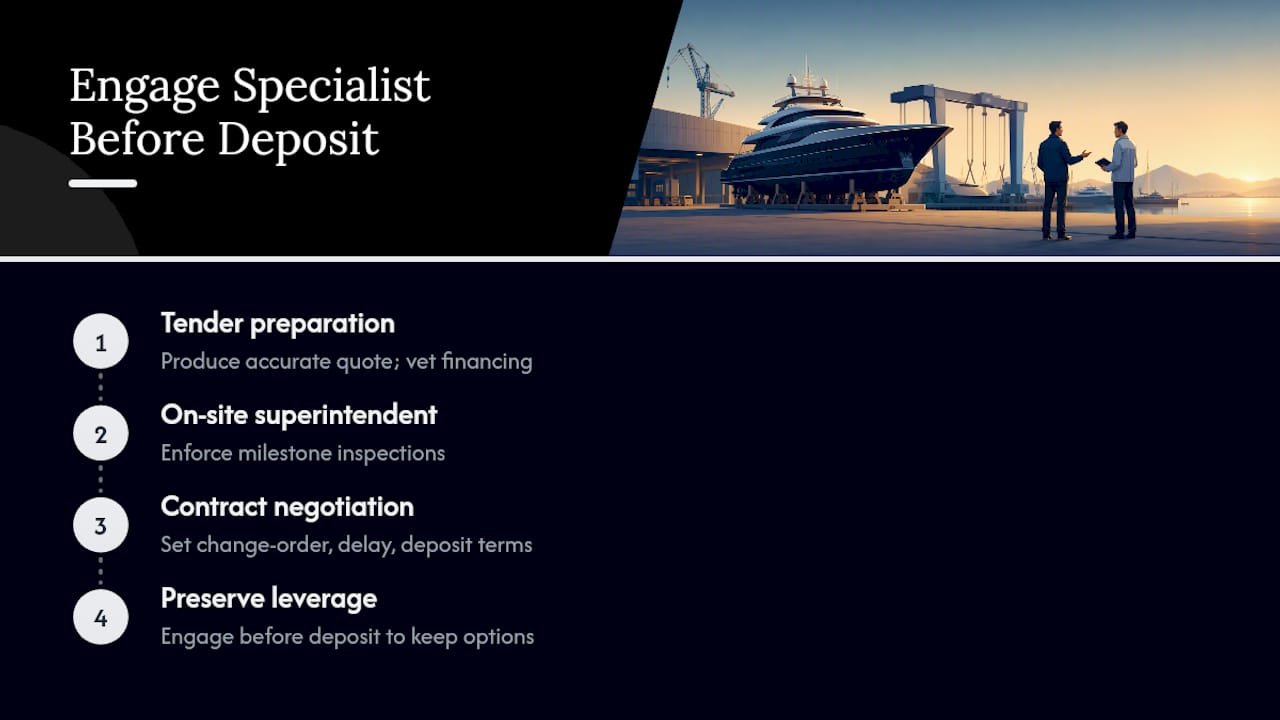
Specialist yacht project advisors can prepare your tender package, vet financing readiness, and negotiate milestone contracts to help your slot stay booked instead of quietly slipping to next quarter.

Owners typically need help at three points in this process: assembling a tender that produces an accurate quote instead of a low-ball estimate that balloons later, placing a superintendent on-site to enforce milestone inspections, and negotiating contract language, change-order rates, delay remedies, deposit terms, before signature, not after. Skipping any one of these is how owners end up renegotiating mid-build from a weaker position.
Engaging a specialist before you approach a yard preserves your leverage. Once a yard has your deposit, your negotiating position changes; before that point, you still have options. Our yacht construction management service is built around this exact window, walking owners through tender prep, financial documentation, and contract review before a single dollar changes hands.
If you’re planning a new build or major refit in the next 12 to 18 months, reach out through our project oversight services to schedule a consultation and get your tender in front of the right yards while capacity is still open.
Sources
- Owner – Preparation is everything
- How to make superyacht build contracts watertight
- Superyacht Shipyards & Refit | Good practice before entering a yard
- What should a shipyard contract include to protect the yacht owner?
Recommended
Sold Listings
Design Your Yacht
"*" indicates required fields
Maximus III - PNW
As you step aboard MAXIMUS III, the first impression is her scale.
At 120 feet with an 8-meter beam and 294 GT of interior volume, this 2025 Crescent Custom tri-deck immediately feels open, balanced, and estate-like. A timeless look while still feeling fresh from the shipyard.
Currently Available


Get your yacht value Estimate
"*" indicates required fields