
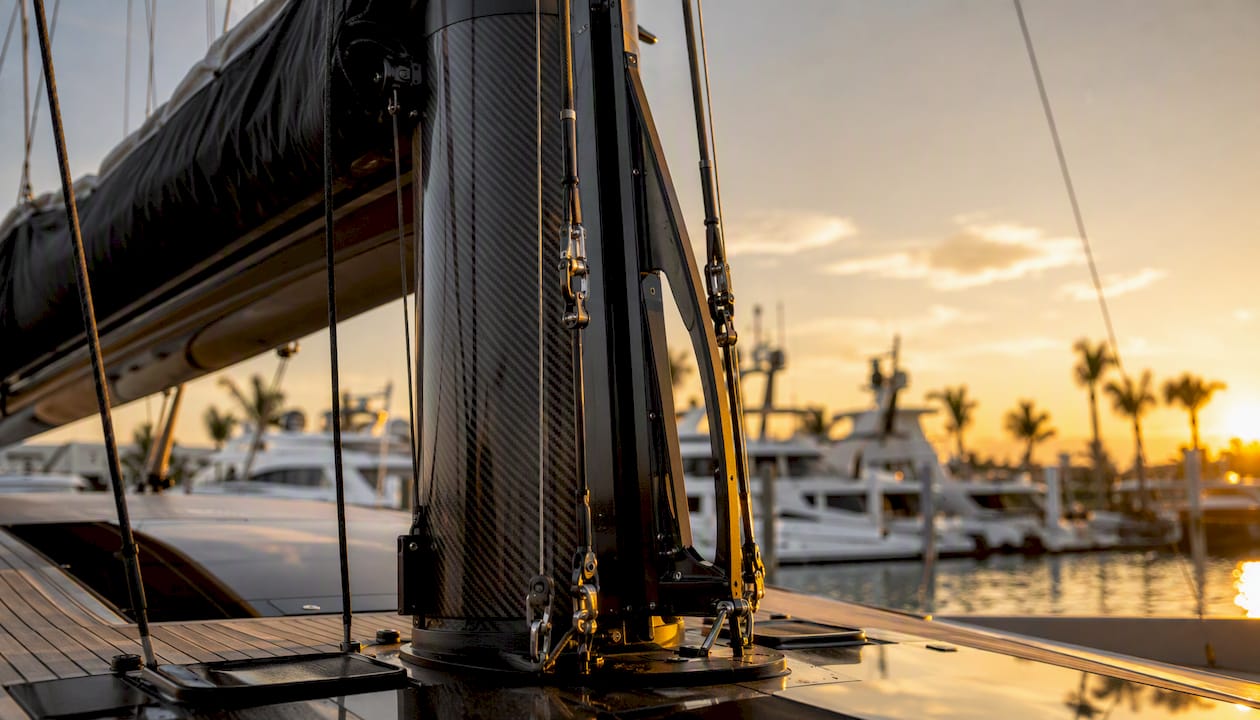
The largest sailing vessel in the world is the Orient Express Corinthian, a passenger sailing cruise ship with a length overall (LOA) of approximately 220 meters, classified by Bureau Veritas and built by Chantiers de l’Atlantique. That title, however, applies specifically to the sailing cruise ship category. Among private sailing yachts, the largest is Koru, owned by Jeff Bezos, at approximately 127 meters LOA. If sail-assisted motor yachts are included in the private category, Sailing Yacht A at 142 meters (465 feet) takes that position.
The distinction matters because “largest sailboat in the world” means something different depending on how you define the category:
- Sailing cruise ships: Passenger vessels with sail propulsion (hybrid or primary), typically over 100 m LOA, operated commercially. Orient Express Corinthian leads here.
- Sail-assisted motor yachts: Private vessels where engines are the primary drive and sails supplement propulsion. Sailing Yacht A leads this group.
- Pure private sailing yachts: Vessels designed to move primarily under sail, privately owned. Koru currently holds the top position.
Throughout this article, we rank vessels by LOA as the primary metric, with gross tonnage (GT) and displacement as supporting columns where available.
Key Takeaways
Orient Express Corinthian holds the title of the world’s largest sailing vessel at 220 meters LOA, while Koru leads among pure private sailing yachts at approximately 127 meters, and Sailing Yacht A tops the sail-assisted motor yacht category at 142 meters.
| Point | Details |
|---|---|
| Largest sailing vessel overall | Orient Express Corinthian, ~220 m LOA, is the world’s largest sailing ship by any measure. |
| Largest pure private sailing yacht | Koru, ~127 m LOA, currently holds the top position among privately owned pure sailing yachts. |
| Largest sail-assisted motor yacht | Sailing Yacht A, 142 m LOA, leads the sail-assisted private category with a ~3,747 m² sail area. |
| LOA is the primary ranking metric | Length overall is the standard used by YachtWorld, SuperYachtTimes, and builder press releases for size rankings. |
| Baranofyachts for large-yacht projects | Baranofyachts provides brokerage, project management, and builder introductions for clients commissioning or acquiring large sailing yachts. |
Table of Contents
- How is “largest” actually measured for a sailing vessel?
- What are the largest sailing vessels in the world, ranked by category?
- What engineering makes these record-sized sailing vessels possible?
- How has the title of “largest sailing vessel” shifted over time?
- What should you know before buying or commissioning a very large sailing yacht?
- How we compiled these rankings and specs
- Why the largest sailing vessels matter more than their dimensions suggest
- Baranofyachts works with clients building and acquiring large sailing yachts
- Sources
How is “largest” actually measured for a sailing vessel?
The answer changes depending on which ruler you use, and that is precisely why the “largest sailboat” question produces so many conflicting answers across yachting publications.
Length overall (LOA) measures the vessel from the foremost point of the bow to the aftermost point of the stern, including any fixed overhangs. It is the most widely used ranking metric because it is unambiguous, publicly verifiable from builder specs, and directly reflects the physical scale a reader imagines when they picture a giant sailboat. Industry databases like YachtWorld use LOA as the default ranking variable for this reason.

Waterline length (LWL) measures only the hull in contact with the water. It is more relevant to speed calculations than to size rankings, so we use it only as a supplemental reference.
Gross tonnage (GT) is a volumetric measure of enclosed ship space, not weight. A vessel with a large superstructure, like a cruise ship, will have a much higher GT relative to its LOA than a sleek private sailing yacht. Orient Express Corinthian’s GT exceeds 26,000, which would place it in a different regulatory tier than any private sailing yacht regardless of LOA. GT matters for port fees, crewing requirements, and SOLAS classification.
Displacement is the actual weight of water the hull displaces, expressed in tonnes. It reflects structural mass and is the figure naval architects use for stability calculations. Orient Express Corinthian displaces approximately 15,000 tonnes in weight, while a large private sailing yacht like Koru displaces a fraction of that.
Air draft is the height from the waterline to the top of the highest fixed structure, usually the masthead. For giant rigs, this is a critical operational constraint: many canals, bridges, and even some marina approaches become inaccessible above certain air drafts. Sailing Yacht A’s mainmast reaches approximately 100 meters, which closes off a significant portion of the world’s inland waterways.
Sail area measures the total working canvas in square meters or square feet. A larger sail area does not always mean a larger vessel, but it is the most direct indicator of sailing power and rig ambition.
The practical takeaway: LOA tells you how big the boat is; GT tells you how it is regulated; displacement tells you how heavy it is; and sail area tells you how seriously it sails.
What are the largest sailing vessels in the world, ranked by category?
We separate the leaderboards by category because combining them without context produces a misleading list where a 220-meter cruise ship and a 77-meter private sloop appear to compete on equal terms.
Sailing cruise ships and passenger sailing vessels
The Orient Express Corinthian stands alone at this scale. No other sailing cruise ship currently approaches its LOA. The vessel carries approximately 130 passengers in 54 suites and requires a crew of around 170. Its three SolidSail masts, each approximately 100 meters tall, rotate 360 degrees and are engineered to provide meaningful propulsion rather than serve as a marketing gesture. During sea trials, the Corinthian achieved approximately 12 knots under sail alone in 20-knot winds, a result that validates the hybrid propulsion concept at cruise-ship scale.
Sail-assisted motor yachts (private)
Sailing Yacht A) is the largest private sail-assisted motor yacht ever built. Its three freestanding carbon-fiber rotating masts were fabricated by Magma Structures, with the mainmast reaching approximately 100 meters. The yacht has an exceptionally large sail area, reflecting advanced rig design for a private vessel, yet the yacht’s primary propulsion remains diesel engines. Doyle Sailmakers and Future Fibres contributed to the rig system and furling booms. The vessel also features an underwater observation pod built into the keel, a detail that underscores the ambition of the entire project.
Pure private sailing yachts
These LOA figures come from builder press releases and consolidated industry databases, cross-referenced against the Wikipedia list of large sailing yachts.
A few per-vessel notes worth flagging:
- Koru is a three-masted schooner built by Oceanco in the Netherlands, currently the largest pure sailing yacht by LOA among privately owned vessels.
- Black Pearl uses a variant of the DynaRig system and can generate electricity under sail through regenerative propulsion, a feature that blurs the line between pure sailing and hybrid operation.
- Maltese Falcon pioneered the modern DynaRig concept at private-yacht scale, with fully automated sail handling that a small crew can operate from a single control station.
- Aquijo is a ketch with twin carbon masts, built by Oceanco and Vitters, and represents the upper end of the traditional sailing-yacht form factor.
- Mirabella V held the record for the world’s tallest single mast at launch and remains one of the most technically ambitious single-masted sailing yachts ever constructed.
What engineering makes these record-sized sailing vessels possible?
Scale introduces problems that smaller yachts never encounter. A mast that works perfectly at 30 meters becomes a structural and operational challenge at 100 meters, and the solutions developed for these giant rigs have reshaped what is possible across the entire industry.
Rotating carbon-fiber masts and rigid sail systems
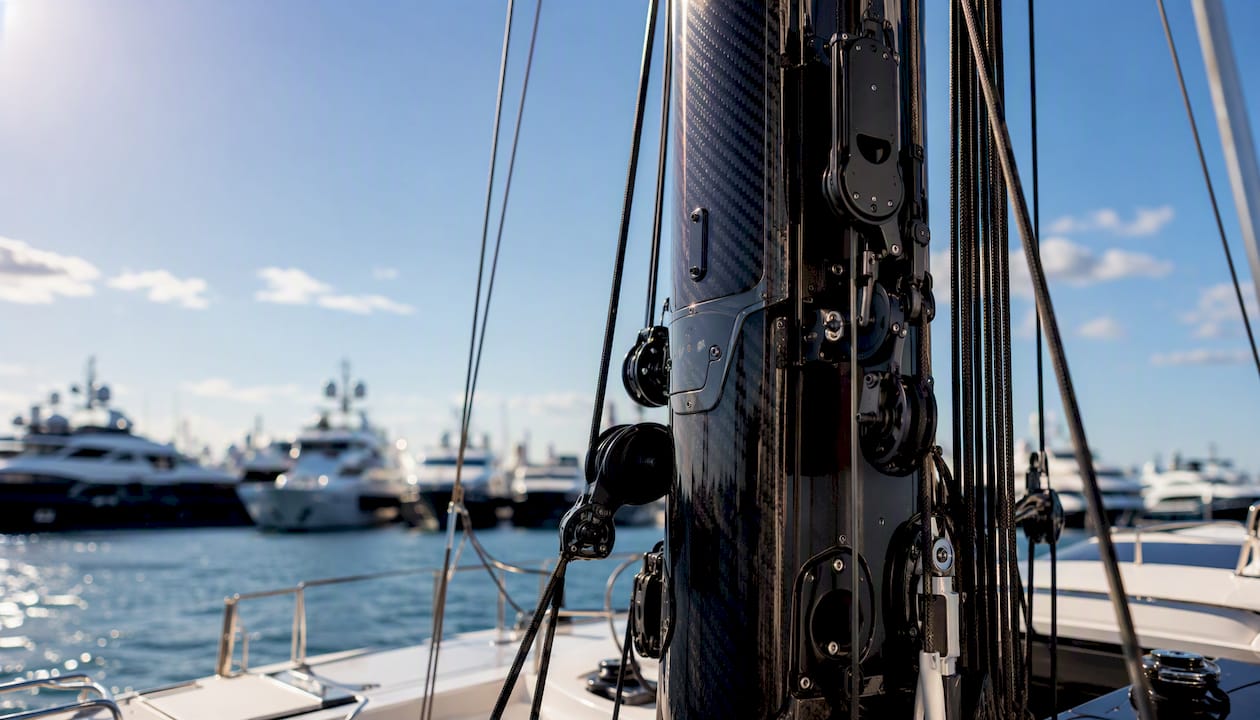
The defining technology across the largest modern sailing vessels is the rotating carbon-fiber mast. Unlike a conventional aluminum or steel mast, a rotating carbon spar allows the sail to present its optimal aerodynamic profile to the wind at any point of sail, functioning more like an aircraft wing than a traditional canvas sail. Sailing Yacht A’s masts, built by Magma Structures, are freestanding, meaning they carry no standing rigging. This eliminates the windage and weight of shrouds and stays, but demands extraordinary structural engineering in the mast itself.
The SolidSail system on Orient Express Corinthian takes this concept further. Each sail is a rigid composite panel that rotates with the mast, and the system was developed over roughly a decade by Chantiers de l’Atlantique specifically to provide reliable propulsion on a hull too large for conventional soft sails to manage efficiently. The result during sea trials, approximately 12 knots under sail in 20 knots of wind, demonstrates that rigid rotating systems can deliver real propulsion at cruise-ship scale, not just reduce fuel burn marginally.
DynaRig and automated sail handling
The DynaRig, first deployed at scale on Maltese Falcon and later refined for Black Pearl, uses rotating carbon masts with fixed yards that carry square sails. The entire system is automated: a single operator can set, reef, or furl all sails from a control station without sending crew aloft. At 88 meters LOA, Maltese Falcon carries a sail area that would require a large professional crew to handle manually. Automation brings that requirement down to a manageable watch-keeping team, which is a critical factor for private owners who are not running a racing program.
Hybrid propulsion and fuel efficiency
At very large scales, pure sail propulsion is rarely sufficient for schedule-keeping or port maneuvering. The practical model for the largest vessels is hybrid: sails provide meaningful drive in favorable conditions, reducing engine hours and fuel consumption, while diesel or LNG engines handle the rest. Orient Express Corinthian is LNG-capable, which aligns with IMO emissions regulations and positions the vessel for long-term compliance. Black Pearl’s regenerative system takes a different approach, converting propeller rotation under sail into electrical power rather than simply reducing engine load.
Pro Tip: On vessels with masts above 60 meters, air draft management is an operational discipline in itself. Masts on some DynaRig and SolidSail vessels are engineered to tilt or rotate for bridge clearance, but the planning required to transit specific waterways, including the Panama Canal’s Bridge of the Americas at approximately 61.3 meters air clearance, must be built into the voyage plan well before departure. Engaging a specialized routing service that tracks real-time air draft constraints is standard practice on the largest private sailing yachts.
How has the title of “largest sailing vessel” shifted over time?
The leaderboard has changed more in the past two decades than in the century before, driven by a combination of private wealth concentration, advances in composite materials, and a renewed commercial interest in sail-assisted propulsion.
- 2004: Mirabella V launches as the world’s largest single-masted sailing yacht, with a mast height that set a record for a monohull sloop. Her 77.6-meter LOA placed her at the top of the pure private sailing yacht category.
- 2006: Maltese Falcon enters service, introducing the DynaRig to the private superyacht world at 88 meters LOA. The automated rig system demonstrates that very large sail plans are operationally viable without a racing crew.
- 2017: Sailing Yacht A is delivered at 142 meters LOA, immediately becoming the largest private sail-assisted motor yacht ever built. Her freestanding carbon masts and 3,747 m² sail area set benchmarks that remain unmatched in the private sector.
- 2018: Black Pearl launches at approximately 106 meters, taking the top position among pure sailing yachts and introducing regenerative propulsion as a practical feature on a private vessel.
- 2023: Koru is delivered to Jeff Bezos at approximately 127 meters LOA, displacing Black Pearl as the largest pure private sailing yacht. Built by Oceanco, Koru’s three-masted schooner rig represents the current ceiling for privately commissioned pure sailing yachts.
- 2025: Orient Express Corinthian enters service at 220 meters LOA, redefining what “largest sailing vessel” can mean. The vessel is not a private yacht but a commercial passenger ship, and its entry into service shifted the entire conversation about sail-capable vessels toward cruise-scale applications.
The Corinthian’s arrival is significant beyond its dimensions. It signals that large-scale sail propulsion is commercially viable, not just a luxury indulgence, and that the next generation of “largest sailing vessel” records may be set by passenger ships rather than private owners.
What should you know before buying or commissioning a very large sailing yacht?
Moving from research to acquisition at this scale requires a structured approach. The complexity of a 60-plus-meter sailing yacht, let alone a 100-plus-meter vessel, means that decisions made early in the process have significant financial and operational consequences years later.
Early-stage checklist:
- Yard selection: Not every shipyard can build or refit a large sailing yacht. Yards with proven experience in composite construction, large rig installation, and classification society relationships are a short list. Understanding how shipyards shape construction outcomes before you sign a build contract is one of the highest-value steps you can take.
- Naval architect and rig designer: At large scales, the naval architect and the rig designer must work in close coordination from the earliest concept phase. Changes to sail area or mast placement after the hull lines are finalized create expensive knock-on effects across stability calculations, keel design, and structural reinforcement.
- Classification society: Bureau Veritas, Lloyd’s Register, and DNV are the primary classification bodies for large sailing yachts. Their rules govern structural scantlings, stability criteria, and crew safety requirements. Engaging a classification society early, rather than after the design is complete, avoids costly redesigns.
- Build timeline: A large custom sailing yacht typically requires three to five years from contract signing to delivery. Sail-assisted vessels with complex rig systems can run longer. Budget for delays.
- Operating and crewing costs: A 60-meter sailing yacht typically requires a professional crew of eight to twelve. At 100-plus meters, that figure rises significantly, and specialized crew for automated rig systems commands a premium. Annual operating costs at this scale routinely reach seven figures.
- Berthing constraints: Air draft and LOA together determine where a vessel can go. Many Mediterranean marinas cannot accommodate vessels above 80 meters, and some of the most desirable anchorages have draft restrictions that affect keel design choices.
- Regulatory and environmental considerations: IMO Tier III NOx requirements, EU ETS carbon pricing for vessels above certain GT thresholds, and flag state requirements all affect operating costs and route flexibility. These factors should be part of the feasibility study, not an afterthought.
For buyers considering the yachting market in 2026, the current environment favors buyers with clear specifications and pre-arranged financing, as yard slots at the top European builders remain competitive.
Pro Tip: Engage a brokerage or project manager before the design brief is finalized, not after. The most expensive mistakes in large-yacht commissioning happen when a client falls in love with a concept and then discovers mid-design that the rig system, the intended cruising grounds, and the marina infrastructure are incompatible. A project manager with experience across multiple large builds will identify those conflicts in the concept phase, where changes cost time but not steel.
How we compiled these rankings and specs
Our primary ranking metric is LOA, sourced from builder press releases, classification society records, and reputable yachting press. Where LOA figures differ between sources, we use the builder’s stated figure as the primary reference and note any discrepancy.
Primary sources consulted:
- Builder press releases and classification society records: Chantiers de l’Atlantique and Bureau Veritas for Orient Express Corinthian; Oceanco for Koru; builder statements for Sailing Yacht A, Black Pearl, Maltese Falcon, Aquijo, and Mirabella V.
- BairdMaritime: Used for Orient Express Corinthian’s full specification set and classification details, including GT and displacement figures.
- Robb Report: Used for SolidSail technical descriptions and sea-trial performance data for Orient Express Corinthian.
- YachtWorld’s “Largest Sailing Yachts” research list: Used as a cross-reference database for private sailing yacht LOA figures and category definitions.
- Wikipedia’s “List of large sailing yachts” and “A (sailing yacht)” entries: Used for historical timeline entries and Sailing Yacht A specifications, cross-checked against builder and press sources before inclusion.
- SuperYachtTimes: Consulted as a supplemental cross-reference for private yacht LOA and launch year data.
Ambiguous cases, specifically vessels where sail propulsion is clearly secondary to engine power, are listed in the sail-assisted motor yacht category rather than the pure sailing yacht category. This follows the editorial convention used by YachtWorld and SuperYachtTimes. Specs were last cross-referenced in early 2026.
Why the largest sailing vessels matter more than their dimensions suggest
There is a temptation to treat vessels like Orient Express Corinthian or Sailing Yacht A as outliers, curiosities built for billionaires or brand marketing. We think that reading misses what is actually happening.
Every record-setting sailing vessel in the past two decades has functioned as a proof-of-concept for technologies that eventually reach the broader market. The DynaRig that debuted on Maltese Falcon in 2006 influenced rig design thinking across the industry. The carbon-fiber freestanding masts on Sailing Yacht A demonstrated structural solutions that composite builders now apply at smaller scales. And Orient Express Corinthian’s SolidSail system, developed over a decade by Chantiers de l’Atlantique, is the most credible large-scale demonstration yet that sail propulsion can be commercially viable on a passenger vessel, not just aesthetically appealing.
For owners, designers, and brokers, these vessels set the reference points for what is achievable. When a client asks whether a 60-meter sailing yacht can carry a meaningful rig without sacrificing interior volume, the answer now comes with real engineering precedent rather than theoretical models. That precedent raises the ambition of every serious build conversation. At Baranofyachts, we work with clients who are thinking at exactly this level, connecting them with the yards, naval architects, and project structures that can translate that ambition into a vessel that actually performs.
Baranofyachts works with clients building and acquiring large sailing yachts
Clients who reach this level of research are rarely browsing. They are evaluating a real decision, whether that is acquiring an existing large sailing yacht through brokerage, commissioning a new build with a complex rig system, or restructuring a refit project that has stalled. Baranofyachts provides the project management, brokerage expertise, and builder network to move those decisions forward with precision.

We coordinate naval architecture introductions, yard selection, classification society engagement, and feasibility studies for clients considering vessels at the upper end of the private sailing yacht market. Our approach treats every large-yacht project the way a conductor treats a complex score: every subsystem, from rig engineering to interior specification, must be sequenced correctly or the knock-on effects compound. If you are ready to move from research to a structured conversation about building or acquiring a large sailing yacht, we are the right starting point. You can also explore our full project management and brokerage services to understand how we structure engagements from concept through delivery.
Sources
The following sources were used to verify specifications, rankings, and technical claims in this article. Builder press releases and classification society records are the most reliable starting point for spec verification; industry databases are useful for cross-referencing and historical context.
- Orient Express Corinthian – World’s largest sailing cruise ship
- Orient Express Corinthian, the World’s Largest Sailing Yacht, Sets Off
- Largest Sailing Yachts In The World
When verifying specs independently, always prioritize the builder’s own press release or the classification society’s published record over secondary databases. LOA figures occasionally differ by one to two meters between sources due to measurement conventions (fixed bowsprit included or excluded), so noting the source of your figure is good practice.
Recommended
Sold Listings


Design Your Yacht
"*" indicates required fields
Maximus III - PNW
As you step aboard MAXIMUS III, the first impression is her scale.
At 120 feet with an 8-meter beam and 294 GT of interior volume, this 2025 Crescent Custom tri-deck immediately feels open, balanced, and estate-like. A timeless look while still feeling fresh from the shipyard.
Currently Available


Get your yacht value Estimate
"*" indicates required fields