

An ice-class yacht is a vessel built or reinforced to operate safely in ice-prone waters, with strengthened plating, protected propulsion, and certification from a recognized classification society. You need one only if you are planning genuine polar itineraries, Svalbard, the Northwest Passage, Antarctica, rather than the occasional brush with a cold-weather anchorage. Classification societies including Lloyd’s Register and DNV issue the notations that define what “ice-capable” actually means, and experienced yacht brokers and project managers help buyers translate those notations into a build or refit that matches their real mission.
TL;DR:
- Light ice notations suffice for occasional Arctic or Antarctic trips, but sustained polar seasons require heavier ice classifications with thicker hull plating.
- Steel remains the standard hull material for serious ice work, offering better impact tolerance and field repair options than aluminum.
- Proper ice hull reinforcement includes a reinforced waterline belt, a rounded bow shape, and protected propulsion systems with redundancy, essential for safe polar navigation.
- Accurate interpretation of classification society notations from Lloyd’s, DNV, or ABS is critical to ensuring real polar capability beyond marketing claims.
- Cost considerations involve significant hull reinforcement, propulsion upgrades, and certification, with custom builds taking longer but providing tailored specifications.
Table of Contents
- What Makes a Yacht an Ice-Class Vessel?
- What Structural Features Actually Enable Ice Operations?
- How Do You Read an Ice-Class Notation?
- Should You Buy, Build, or Refit for Ice Capability?
- What Does Polar Operation Actually Require Day to Day?
- How Baranof Manages an Ice-Capable Build or Refit
- What Environmental Rules Govern Ice-Class Yachts?
- How Do Interiors Change for Polar Expeditions?
- Ready to Explore Ice-Capable Yacht Options?
- When Ice Capability Is Worth It, and When It Isn’t
- Sources
- FAQ
What Makes a Yacht an Ice-Class Vessel?
An ice-class yacht is designed from the keel up to absorb the load of pack ice, brash ice, or first-year floes without compromising the hull, propulsion, or crew safety. That is a fundamentally different engineering brief than a standard explorer yacht, which might have a rugged hull and long range but no certified ice rating at all. The distinction matters because “explorer-styled” and “ice-classed” get used interchangeably in brokerage listings, and they are not the same thing.
These yachts exist to enable specific mission profiles: multi-season polar cruising, extended remote expeditions where the nearest shipyard is weeks away, and long endurance passages through regions with no reliable fuel infrastructure. Every design decision shifts to serve that mission. Speed gives way to displacement and stability. Waterline length grows to improve seakeeping in open ocean approaches to the ice edge. Interior volume gets allocated to fuel and stores rather than entertainment spaces.
Hull material is the first fork in the road:
- Steel remains the standard for serious ice work because it tolerates impact and abrasion better than any alternative, and it is straightforward to repair in the field.
- Aluminum cuts weight and improves fuel efficiency but demands more careful engineering to match steel’s ice tolerance, and repairs are harder to source in remote ports.
If your itinerary is truly polar rather than occasionally cold, steel construction paired with a proper ice notation, not just a “rugged look”, is the baseline worth insisting on. Our explorer yacht design guidance covers how these mission priorities reshape naval architecture from the first sketch.
What Structural Features Actually Enable Ice Operations?
The ice band, a reinforced belt of shell plating running along the waterline and extending above and below it, is the single most important number on a set of drawings. Thicker plating and closer-spaced internal framing in that band absorb the crushing and abrasive loads of ice contact that would tear open an unreinforced hull. Ask your naval architect to show you the ice belt’s thickness and vertical extent relative to your expected loading and trim, not just a headline steel gauge.
Bow form matters just as much as plating. A properly raked, rounded bow rides up onto ice and breaks it downward under the vessel’s weight, rather than punching straight through it. Request drawings that show stem angle and waterline entry specifically for ice performance, alongside standard seakeeping data.
Propulsion is where redundancy earns its keep. Diesel-electric and hybrid systems dominate serious ice-capable designs because they deliver precise low-speed torque control for maneuvering through leads and brash ice, along with built-in redundancy if one generator or motor fails far from help. That same logic drove the PILOT 16 ICE workboat design, rated for ice up to 50 centimeters thick using diesel-electric propulsion for exactly this kind of low-speed control.
Beyond the hull and drivetrain, verify:
- Rudder and propeller protection, typically a skeg or ice knife ahead of the running gear
- Reinforced shafting rated for ice-strike loads, not standard cruising specifications
- Heating and anti-icing systems for deck equipment, tanks, and exterior piping
Pro Tip: Ask for the ice-strengthening calculations separately from the general structural survey. Builders sometimes bundle them, and a separate document forces clarity on what is actually certified versus what is simply “heavy duty.”
How Do You Read an Ice-Class Notation?
Classification societies exist to verify that a yacht’s ice claims match its engineering, and reading their notations correctly is the difference between buying real polar capability and buying a marketing phrase. Lloyd’s Register and DNV are the two names you will encounter most often in yacht ice classification, alongside the American Bureau of Shipping, and each issues its own notation scheme layered against the IMO Polar Code framework governing polar operations globally.
Notations are not interchangeable, and a higher number does not always mean simply “stronger” in every dimension. A lighter notation, something like a 1D or C-class rating, typically signals suitability for occasional light first-year ice, fine for shoulder-season Arctic cruising but not for extended pack-ice transits. Heavier notations imply thicker ice bands, closer framing, and stronger machinery mounts built for sustained heavy-ice operation. The 114-meter yacht Nausicaä, for example, carries a Lloyd’s Register ice class 1D notation that suits light ice work paired with tropical-season flexibility, a reasonable fit for an owner who wants both polar and warm-water itineraries rather than a dedicated Antarctic explorer.
Before you sign anything, verify:
- The current, in-force class certificate, not an expired or superseded one
- Original hull drawings showing ice reinforcement extent, matched against the actual build
- Class society survey records confirming no open deficiencies against the ice notation
Our breakdown of yacht classification and why it matters goes deeper into how these certificates affect resale value and insurability well beyond the ice question.
Should You Buy, Build, or Refit for Ice Capability?
Three paths lead to an ice-capable yacht, and each carries a different cost and risk profile. Buying an existing ice-classed vessel is fastest but limits you to what the market currently offers. A custom new build gives you exact specification but demands patience. Refitting a strong existing hull sits in between, cheaper than a new build but bounded by whatever structural bones the donor vessel already has.
Cost drivers cluster around a predictable set of line items:
- Hull reinforcement: additional plating, framing, and welding, especially costly on a refit where existing structure must be opened up
- Propulsion upgrades: diesel-electric conversion or redundant drivetrain components sized for ice loading
- Tankage and heating: expanded fuel and water capacity plus anti-icing systems for exposed piping and deck gear
- Certification work: engineering calculations, class society surveys, and documentation to earn the notation you are paying for
A new build typically runs on a multi-year timeline with milestones at design freeze, steel cutting, hull completion, systems installation, and sea trials. A major refit can compress that timeline but introduces its own risk: you will not know everything hiding behind existing plating until the yard opens it up. Every choice here trades against another. More displacement for ice strength costs you speed. More fuel tankage for range costs you interior volume. More structural redundancy costs you comfort space that could otherwise go to guest cabins.
Pro Tip: Get an independent naval architect’s opinion on refit candidates before committing. A hull that looks ice-ready on a spec sheet can hide decades of corrosion or fatigue that only a proper survey will surface.
Our guide to customizing a yacht step by step walks through the milestone sequence in more detail for buyers weighing new build against refit.
What Does Polar Operation Actually Require Day to Day?
Endurance planning changes completely once ice enters the equation. Expedition voyages routinely run weeks between resupply, so fuel and provisions capacity has to be sized for the longest realistic gap between ports, not average cruising range. Owners who plan La Datcha style itineraries with submersibles, helicopter operations, or extended Antarctic legs need tankage and mission systems built around endurance first, speed second.
Crew requirements shift too. Ice navigation experience is not optional, and neither is medical capability once you are days from the nearest hospital. Expect to budget for:
- An ice pilot or ice-experienced master for genuinely polar itineraries
- Onboard medical support scaled to the remoteness of the route
- Expedition staff if you are running Zodiac operations, wildlife viewing, or shore landings
Insurance for polar cruising is its own specialized market, and underwriters will want to see your class certificate, your crew’s ice experience, and a documented expedition support plan before quoting. Reliable weather intelligence matters just as much as the hull. Tools like the marine forecasting apps covered in this guide to boating weather apps become part of daily operations rather than a convenience once you are routing around ice fields.
How Baranof Manages an Ice-Capable Build or Refit
Managing ice-capable projects requires coordination like a conductor managing a symphony: every subsystem has to hit its cue at the right moment, or the whole performance suffers. Our role covers specification development, builder selection, technical oversight through construction, survey coordination, and delivery acceptance.
On an ice-capable project, owners working with us should expect a documented specification tying ice notation to actual hull drawings, regular yard inspections timed to key structural milestones, and a delivery acceptance process that verifies class compliance before final sign-off. Our Yacht Construction Management service exists specifically to keep those pieces aligned from concept through handover.
What Environmental Rules Govern Ice-Class Yachts?
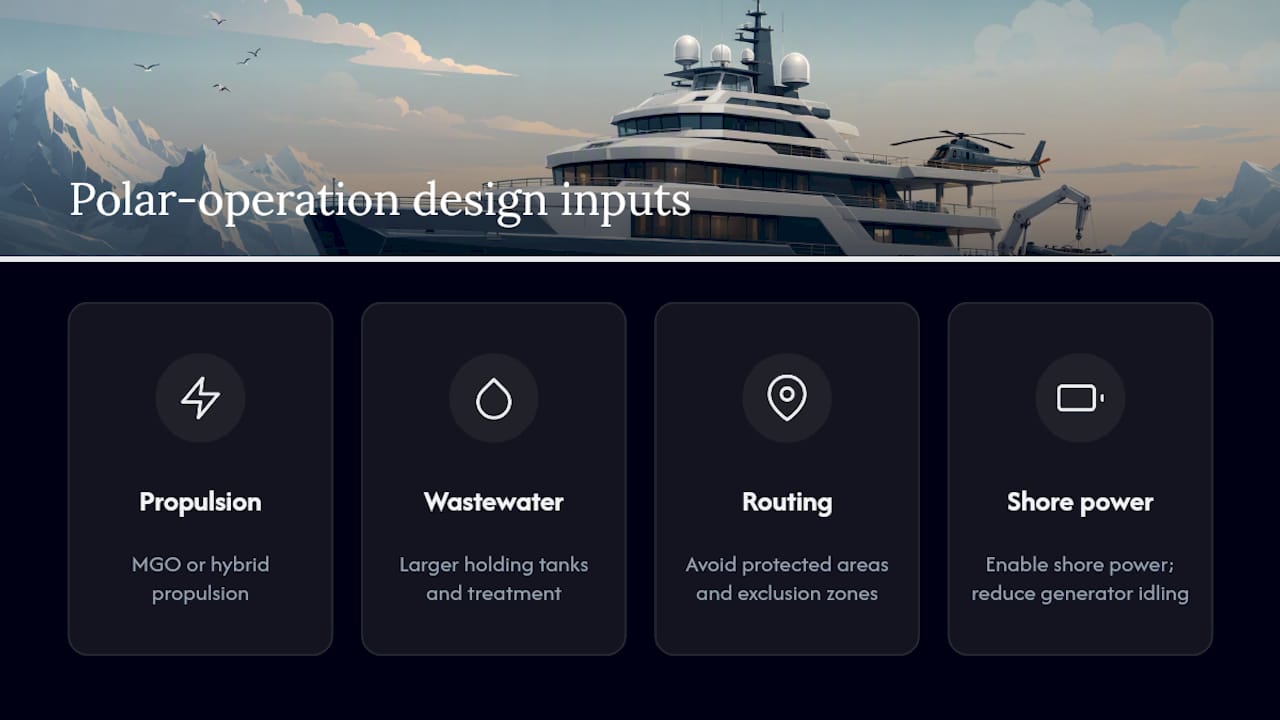
Polar operation carries environmental obligations that go well beyond standard yacht compliance. The IMO Polar Code, which governs vessels operating in Arctic and Antarctic waters, sets requirements around fuel type, discharge limits, and waste management specifically because polar ecosystems recover from pollution far more slowly than temperate ones.
Heavy fuel oil is effectively off the table for compliant polar operation, pushing owners toward marine gas oil or, increasingly, hybrid propulsion that reduces both emissions and the fuel volume needed for long legs. Wastewater and gray water discharge limits in designated polar waters are tighter than general MARPOL requirements, which means holding tank capacity and treatment systems need sizing for extended no-discharge zones, not just typical coastal cruising.
Sustainable operation in practice means route planning that respects designated protected areas, wildlife exclusion zones during breeding seasons, and strict at-sea waste retention until proper disposal is available. Owners increasingly ask for shore power capability and efficient hybrid systems not purely for cost savings but because idling generators in pristine anchorages runs against the reason most owners want to go to the ice in the first place. A well-specified ice-capable yacht should treat these requirements as design inputs from day one rather than compliance afterthoughts bolted on before departure.
How Do Interiors Change for Polar Expeditions?
Interior design on an ice-class yacht answers to endurance and function first, aesthetics second, though the best builds manage to deliver both. Mudrooms and gear-drying spaces near the exterior doors are not optional extras; they are where wet expedition clothing, boots, and dive gear get staged before they track water and salt through the main living areas. Expect dedicated lockers for parkas, boots, and technical gear sized for a full guest complement, not an afterthought closet.
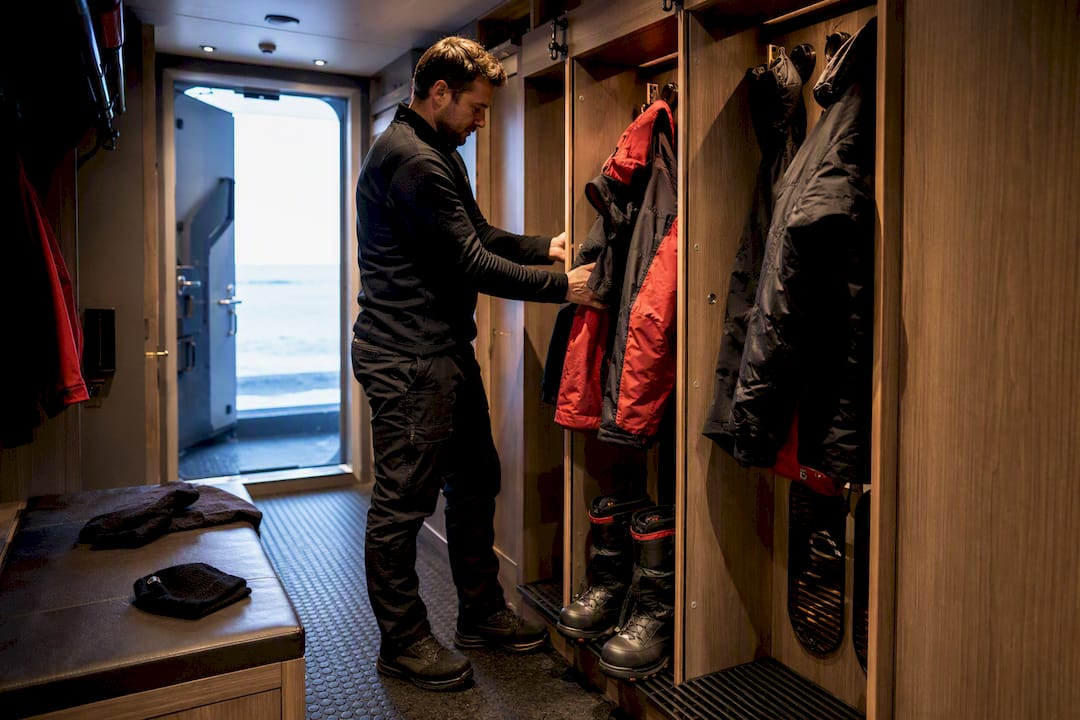
Heating throughout the vessel needs to handle sustained sub-freezing exterior temperatures, which means upgraded HVAC capacity, heated interior glazing to prevent condensation and frost buildup, and insulated hull liners that a tropical-cruising yacht would never need. Window placement often shifts too, smaller and better protected on lower decks, larger on upper decks where ice-strengthened glazing gives guests uninterrupted views of the landscape without compromising hull integrity below the waterline.
Storage allocation swings hard toward mission equipment. Expedition yachts dedicate real square footage to dive gear, kayaks, snowmobiles, or submersible support rather than the spa and beach club layouts typical of warm-water yachts. Garages and launch systems for Zodiacs and work boats need to function reliably in freezing conditions, with heated stowage to keep engines and hydraulics operational. The best interior layouts on ice-capable yachts treat comfort and expedition readiness as complementary goals rather than competing ones, warm, well-lit social spaces paired with hard-working utility zones built for genuine polar use.
Ready to Explore Ice-Capable Yacht Options?
Whether you’re eyeing an existing ice-classed vessel on the brokerage market or specifying a custom build for genuine polar work, the right partner treats classification, propulsion, and structural detail as engineering decisions, not brochure language. A comprehensive yacht service provider can bring specification, builder selection, technical oversight, and delivery acceptance under one accountable process, so an ice notation on paper actually matches what gets welded into the hull.
Our Custom Builds and Yacht Construction Management services cover exactly this kind of project, from initial feasibility review through sea trials and acceptance. If you already own a vessel you’re considering refitting for ice work, or you’re weighing a sale before committing capital to a new build, our brokerage support can help you evaluate that trade-off with real market data behind it. The next step is straightforward: reach out for a feasibility review of your intended itinerary and current or prospective hull, and we’ll help you map what ice capability actually costs against what your mission requires.
When Ice Capability Is Worth It, and When It Isn’t
The biggest mistake I see buyers make is over-specifying ice capability for itineraries that do not need it. A heavy ice notation adds displacement, cost, and complexity that only pays off if you are genuinely committed to polar seasons year after year. If your plan is one Svalbard trip every few years alongside warm-water cruising the rest of the time, a lighter notation like the 1D class Nausicaä carries makes far more sense than over-building for ice you will rarely see. True ice capability earns its cost on resale only when the next buyer shares your mission. Match the notation to the itinerary you will actually run, not the one you imagine.
— Jason
Sources
- Classification & Certification services | Lloyd’s Register
- Yacht classification and services | American Bureau of Shipping (ABS/Eagle mirror)
- Ship classification | DNV
- Vessel review: Nausicaä — durable, versatile 114m yacht for polar and tropical destinations | Baird Maritime
FAQ
What Yacht Does Tom Brady Own?
Public reporting on celebrity yacht ownership changes frequently and specific current ownership details are not reliably documented in industry classification sources. For buyers focused on ice-class vessels specifically, ownership of any particular celebrity yacht has no bearing on classification requirements or specification decisions.
What Is the 12 Person Rule on a Yacht?
The rule about passenger numbers generally refers to international maritime regulations that impose stricter safety, crewing, and certification requirements once a vessel carries more passengers, treating it more like a commercial passenger vessel. This threshold affects lifesaving equipment, crew certification, and safety management systems, and it applies independently of whether a yacht also carries an ice classification.
Who Owns the Ice Yacht?
“Ice yacht” most commonly refers to ice-classed expedition vessels rather than a single specific yacht, and ownership varies by vessel since many ice-capable yachts operate under private ownership or charter management. If you’re asking about a specific named vessel, ownership records are typically held privately and not published in classification society databases.
Are Ice-Capable Boats Expensive to Buy?
Ice-capable yachts cost more than comparable non-ice-classed vessels because of reinforced hull plating, upgraded propulsion redundancy, and the engineering and certification work required to earn a class notation. The exact premium depends on the notation level, hull material, and whether you’re buying an existing vessel or commissioning a custom build; Baranof Yacht Sales can provide project-specific cost guidance during a feasibility review.
How Do I Choose Between a Light Ice and Heavy Ice Notation?
Match the notation to your actual itinerary rather than the highest rating available: light ice notations suit occasional shoulder-season Arctic or Antarctic cruising, while heavy ice notations suit sustained pack-ice operation over multiple polar seasons. Reviewing your planned routes and season length with a naval architect or project manager before finalizing specifications prevents costly over-building.
Recommended
Sold Listings
Design Your Yacht
"*" indicates required fields
Maximus III - PNW
As you step aboard MAXIMUS III, the first impression is her scale.
At 120 feet with an 8-meter beam and 294 GT of interior volume, this 2025 Crescent Custom tri-deck immediately feels open, balanced, and estate-like. A timeless look while still feeling fresh from the shipyard.
Currently Available


Get your yacht value Estimate
"*" indicates required fields