

Multi-vessel fleet operations management is defined as the coordinated oversight of two or more vessels through centralized systems that govern voyage planning, maintenance, crew scheduling, compliance, and performance analysis. Knowing how to organize multi-vessel fleet operations separates fleets that run at a loss from those that generate measurable returns. The International Maritime Organization’s safety and environmental standards set the compliance floor, but operational efficiency depends on the management architecture you build above that floor. At Baranofyachts, we work with fleet owners who discover that the gap between owning multiple vessels and operating them profitably comes down to structure, not vessel count. A centralized, phase-based approach is the single most reliable way to reduce cost, improve reliability, and maintain full visibility across every hull in your fleet.
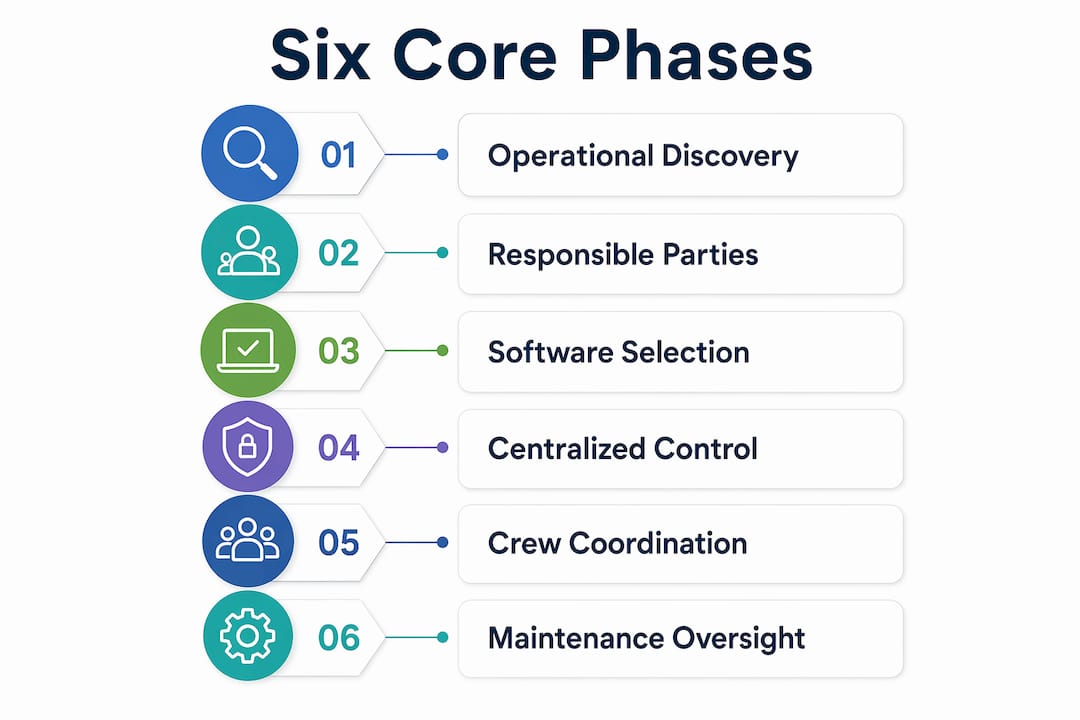
How to organize multi-vessel fleet operations: the six core phases
Effective multi-vessel coordination follows a standardized operational cycle built on six phases: voyage planning, port coordination, maintenance, crew management, compliance and safety, and performance analysis. Each phase feeds the next. A delay in port coordination, for example, cascades into crew overtime and missed maintenance windows. Managing these phases in isolation is the root cause of most fleet inefficiencies.
Here is what each phase demands in practice:
- Voyage planning: Route selection, fuel load calculations, weather routing, and ETA commitments to charterers or owners. Poor planning here creates fuel waste and schedule failures downstream.
- Port coordination: Berth reservations, customs clearances, provisioning schedules, and agent communication. Overlapping vessel arrivals at the same port require advance deconfliction.
- Maintenance: Scheduled and unscheduled work orders, dry dock bookings, and spare parts procurement. Maintenance that is not planned at the fleet level creates yard bottlenecks.
- Crew management: Rotation schedules, certification tracking, rest-hour compliance under the Maritime Labour Convention, and performance reviews. Learn more about crew management priorities for luxury fleets specifically.
- Compliance and safety: Flag state requirements, class surveys, ISM Code audits, and MARPOL documentation. Non-compliance on one vessel can ground the entire fleet’s commercial reputation.
- Performance analysis: Fuel consumption per nautical mile, idle time, route efficiency, and KPI benchmarking across vessels.
Pro Tip: Map each phase to a named responsible party before you select any software. Software cannot fix an accountability gap; it only makes the gap more visible.
Which organizational model best supports fleet coordination?
The structural management model you choose early shapes long-term efficiency and determines whether your fleet scales without bottlenecks. Three models dominate the industry.

| Model | How it works | Best for | Key risk |
|---|---|---|---|
| Centralized | One shore office controls all scheduling, procurement, and reporting | Fleets of 3 or more vessels with uniform operations | Shore team becomes a bottleneck if understaffed |
| Federated | Each vessel captain holds operational autonomy with minimal central oversight | Small fleets where captains are highly experienced | Reporting inconsistency and communication silos |
| Hybrid | Central office sets standards and KPIs; captains execute within defined parameters | Growing fleets transitioning from 1 to multiple vessels | Requires clear role definitions to prevent overlap |
The federated model works well when you have two vessels and two captains you trust completely. Add a third vessel and the coordination layer grows exponentially with fleet size, making informal communication unreliable. Most fleets above three vessels perform better under a hybrid or centralized model.
Pro Tip: Define your reporting framework before you add your second vessel. Retrofitting a reporting structure onto an existing fleet is three times harder than building it from the start.
How can digital tools and data analytics improve fleet performance?
Integrated fleet management platforms are the operational backbone of any well-run multi-vessel fleet. Real-time predictive analytics shift maintenance from reactive to proactive, catching equipment degradation before it causes an unplanned stop. Fleet operators who implement real-time management software that monitors idle time, speeding, and routing reduce fuel consumption by 12–20% within the first year. That is a material cost reduction on any fleet operating more than 1,000 nautical miles per month.
The data layer of a fleet management platform should cover these core functions:
- Real-time vessel tracking: AIS integration with position, speed, and heading overlaid on a single chart for all vessels simultaneously.
- Fuel monitoring: Consumption per voyage leg, idle time alerts, and deviation flags when actual consumption exceeds the planned figure by more than 5%.
- Predictive maintenance: Engine hour counters, vibration sensors, and oil analysis data feeding automated work order triggers.
- KPI dashboards: Normalized fleet-wide KPIs for fuel consumption, emissions, and utilization rates allow objective benchmarking across vessels of different sizes and ages.
- User role management: Clearly defined access rights prevent operational blind spots. A captain needs voyage data; a shore accountant needs cost data. Mixing those access levels creates confusion and security risk.
Optimizing itineraries across multiple vessels also depends on data quality. A fleet that tracks routing efficiency at the voyage level can identify which routes consistently underperform and reroute proactively. Luxury fleet operators in regions like Phuket’s charter market have demonstrated that data-driven routing decisions reduce both fuel cost and guest dissatisfaction simultaneously.
What are best practices for crew and maintenance coordination?
Maintenance coordination across multiple vessels requires standardizing equipment and engine-hour measurements so that dry dock scheduling and yard capacity can be managed as a single resource pool rather than vessel-by-vessel. A fleet that books three vessels into the same yard in the same month without coordination pays premium rates and waits longer. Staggering dry dock cycles by 60–90 days per vessel, based on standardized engine-hour thresholds, keeps yard relationships productive and costs predictable.
Best practices for crew and maintenance coordination include:
- Shared spare parts inventory: Pool critical spares across vessels rather than duplicating stock on each hull. A centralized parts register reduces procurement cost and eliminates the scenario where one vessel sits idle waiting for a part that another vessel has in its stores.
- Cross-training and rotation planning: Crew members trained across vessel types give you scheduling flexibility when illness or certification gaps arise. Build rotation plans at least 90 days in advance.
- Certificate expiry monitoring: Track STCW certifications, medical certificates, and flag state endorsements for every crew member across every vessel in a single register. A single expired certificate can delay a departure and breach charter agreements.
- Unified maintenance scheduling: Use a shared calendar that shows all planned maintenance windows fleet-wide. Overlapping schedules create resource conflicts; a shared view prevents them before they occur.
Pro Tip: Treat your spare parts inventory as a fleet asset, not a vessel asset. Centralizing procurement authority for critical components cuts average lead times and prevents duplicate orders.
Coordinating owner briefings across multiple vessels also requires a structured approach. Clear frameworks for owner communication reduce the time captains spend on administrative reporting and keep owners informed without creating information overload.
What common pitfalls should fleet managers avoid?
The most costly mistake fleet managers make is purchasing fleet management software before mapping their existing workflows. Buying software before mapping workflows accelerates bad processes rather than fixing them. A fleet with inconsistent reporting practices will generate inconsistent data faster once software is introduced, not better data.
The five pitfalls that consistently damage multi-vessel fleet performance are:
- Skipping operational discovery. Before selecting any platform, document every workflow, identify every data source, and name every decision owner. This process typically takes two to four weeks and prevents months of software reconfiguration.
- Choosing the wrong organizational model. A federated model applied to a five-vessel fleet creates reporting silos that shore management cannot see through. Match the model to fleet size and growth trajectory, not personal preference.
- Uncoordinated maintenance scheduling. Booking multiple vessels into dry dock simultaneously without advance planning creates yard bottlenecks and cost spikes. Build a fleet-wide maintenance calendar at the start of each fiscal year.
- Inconsistent KPI definitions. If one vessel reports fuel consumption in liters per hour and another reports in nautical miles per ton, benchmarking becomes meaningless. Standardize units and reporting periods across the fleet before the first dashboard goes live.
- Undefined user roles in digital systems. When captains, shore managers, and owners all have unrestricted access to the same platform, decision-making authority blurs. Define who can approve, who can view, and who can edit before go-live.
Key Takeaways
Effective multi-vessel fleet operations require a centralized management structure, standardized KPIs, and digital tools deployed only after thorough workflow mapping.
| Point | Details |
|---|---|
| Choose your model early | Centralized or hybrid models prevent bottlenecks as fleet size grows beyond two vessels. |
| Map workflows before buying software | Operational discovery before platform selection prevents bad processes from accelerating. |
| Standardize KPIs fleet-wide | Normalized fuel and emissions data enables objective benchmarking across all vessels. |
| Pool maintenance and spare parts | Shared inventory and staggered dry dock cycles reduce cost and idle time across the fleet. |
| Define user roles at go-live | Clear access rights in fleet software prevent blind spots and protect decision-making clarity. |
What I have learned from scaling fleet operations
The question I get most from fleet managers is which software platform to buy. My honest answer is that the platform matters far less than the structure you build before you open the app. I have watched well-funded fleets deploy enterprise-grade systems and still produce chaotic reporting, because nobody agreed on what a “voyage” meant before the data started flowing.
The structural decision, centralized versus hybrid, is the one that keeps me up at night on behalf of clients. Get it wrong at two vessels and you will feel the pain at four. Get it right at two and scaling to six feels like adding instruments to an orchestra that already knows the score.
I also believe the industry underestimates the value of regular performance reviews at the fleet level, not just the vessel level. A monthly review that compares fuel consumption, maintenance costs, and crew utilization across every hull forces conversations that individual vessel reports never surface. That is where the real inefficiencies hide.
Technology is a multiplier. If your operations are well-structured, the right platform makes them significantly better. If your operations are disorganized, the same platform makes the disorganization faster and more expensive. Plan first. Buy second.
— Jason
Baranofyachts and the art of coordinated fleet management
Fleet coordination at the luxury end of the market carries a higher standard. Owners expect precision, captains expect clear authority, and guests expect zero operational friction.
Baranofyachts brings the same conductor’s-eye approach to fleet management that we apply to custom yacht builds. We work with owners and captains to structure reporting frameworks, coordinate maintenance cycles, and build the crew management systems that keep multi-vessel fleets running without surprises. Whether you are managing two vessels or planning to grow to five, our yacht management strategies give you the operational foundation to do it well. For owners thinking about what the next generation of fleet-ready vessels looks like, our guide to next-gen yacht design connects design decisions to long-term operational performance.
FAQ
What is the first step in organizing a multi-vessel fleet?
Conduct a full operational discovery before selecting any software or management model. Map every workflow, data source, and decision owner across the fleet to avoid accelerating existing inefficiencies.
How many vessels require a centralized management model?
Fleets of three or more vessels generally perform better under a centralized or hybrid model. Federated structures create reporting silos that become unmanageable as coordination complexity grows with fleet size.
How much can fleet software reduce fuel costs?
Fleet operators implementing real-time management software that monitors idle time, speeding, and routing can reduce fuel consumption by 12–20% within the first year.
Why does KPI standardization matter across multiple vessels?
Normalized KPIs allow objective benchmarking of fuel consumption and emissions across vessels of different sizes and ages. Without standardized units and reporting periods, fleet-wide performance comparisons are unreliable.
How should spare parts be managed across a multi-vessel fleet?
Treat spare parts as a fleet asset rather than a vessel asset. A centralized parts register reduces procurement cost, cuts lead times, and prevents one vessel from sitting idle while a needed component sits unused on another hull.
Recommended
Sold Listings
Design Your Yacht
"*" indicates required fields
Maximus III - PNW
As you step aboard MAXIMUS III, the first impression is her scale.
At 120 feet with an 8-meter beam and 294 GT of interior volume, this 2025 Crescent Custom tri-deck immediately feels open, balanced, and estate-like. A timeless look while still feeling fresh from the shipyard.
Currently Available


Get your yacht value Estimate
"*" indicates required fields