

Eco-friendly yacht design means engineering for low-energy operation and onboard renewable generation without sacrificing comfort or performance. The chief levers are hybrid-electric propulsion, hull efficiency, insulation, systems design, and renewable-material specification. Get these right and owners see lower fuel bills, quieter cruising, and a vessel built for decades of service rather than a decade of depreciation.
TL;DR:
- Setting specific targets for electric cruising percentage, daily energy use, and backup fuel limits during the design phase drives more efficient and cost-effective sustainability features.
- Hybrid propulsion systems, like Solsea’s, can achieve up to 80% electric cruising on transoceanic passages, significantly lowering fuel costs during long deployments.
- Hull form choices such as slender monohulls or catamarans improve efficiency and increase hydrogeneration potential, directly impacting energy supply and emission reduction.
- Sustainable interior materials, including reclaimed woods and recycled composites, match traditional finishes while reducing sourcing impact and ensuring repairability for long-term maintenance.
- Insulation, thermal storage, and efficient onboard systems can reduce energy consumption by up to eight times compared to conventional setups, greatly enhancing overall sustainability.
Table of Contents
- What Are the Core Design Principles Behind Eco-Friendly Yachts?
- How Do Electric, Hybrid, and Hydrogen Propulsion Compare?
- Why Does Hull Form Matter More Than Most Owners Realize?
- What Sustainable Materials Fit a Luxury Interior?
- How Do Onboard Systems Cut Energy and Water Use?
- What Do the Solsea and Project Zero Projects Actually Prove?
- How Do You Brief a Shipyard for a Sustainable Yacht?
- How Baranof Yacht Sales Supports Sustainable Yacht Projects
- What Should Owners Expect From a Sustainable Build?
- Start Your Sustainable Yacht Project With Baranof
- Sources
- FAQ
What Are the Core Design Principles Behind Eco-Friendly Yachts?
Sustainable yacht architecture works best when it starts as a design constraint, not a bolt-on feature added after the hull drawings are finished. We tell clients the same thing every time a sustainable build comes across our desk: retrofitting efficiency into a finished yacht is expensive and incomplete. Baking it into the concept phase changes the entire cost and performance equation.
That means setting owner-facing metrics before the naval architect touches a keel line:
- Target percentage of electric-only cruising at cruising speed
- Daily hotel-load budget in kWh, covering HVAC, galley, lighting, and entertainment systems
- An acceptable ceiling for backup fossil-fuel use on long passages
- Lifecycle targets covering material sourcing, refit intervals, and end-of-life recycling
Every one of these targets forces a trade-off. More battery capacity means more weight and less usable volume elsewhere. More solar deck area competes with lounge space. Higher upfront investment in insulation and hull efficiency usually pays back through lower fuel and maintenance costs over the ownership period.
Pro Tip: Ask your designer to model two scenarios, a baseline diesel configuration and a hybrid-electric configuration, side by side on the same hull. Seeing the kWh and fuel numbers next to each other makes the trade-offs concrete instead of theoretical.
How Do Electric, Hybrid, and Hydrogen Propulsion Compare?
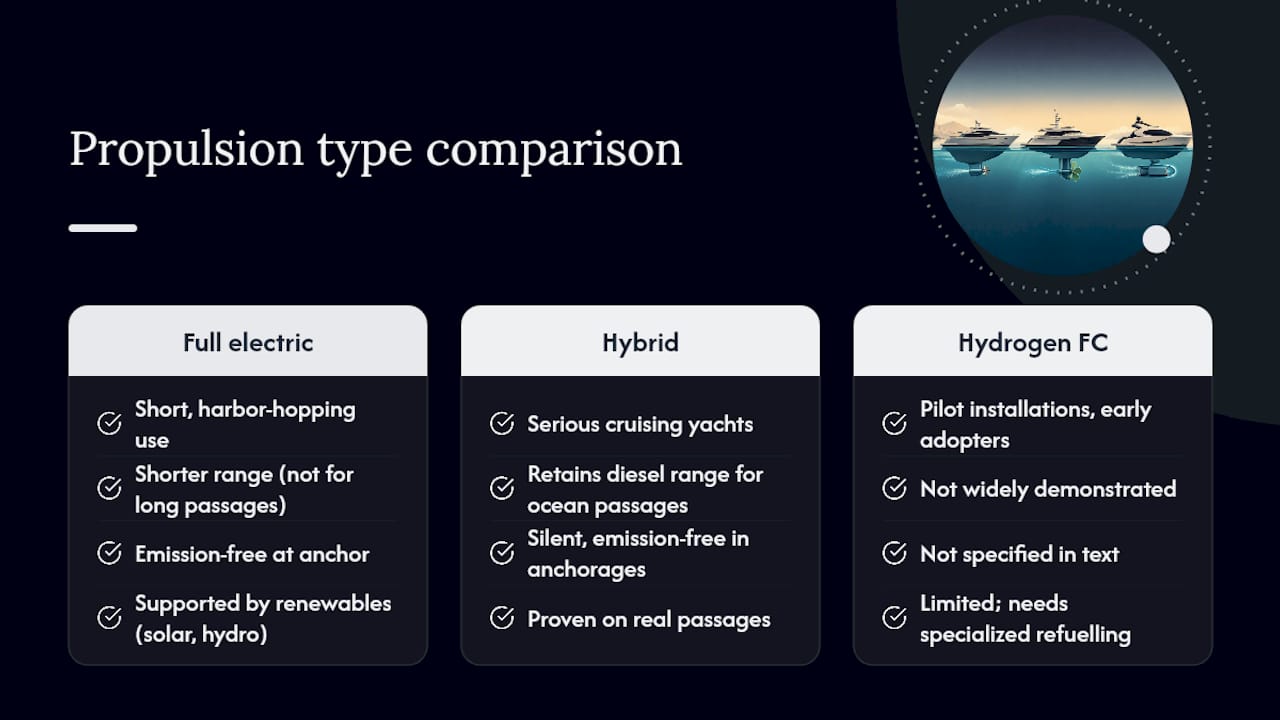
Three propulsion architectures dominate current sustainable yacht design: full electric, hybrid (series or parallel), and emerging hydrogen fuel-cell systems. Full electric suits shorter-range, harbor-hopping use. Hybrid systems dominate serious cruising yachts because they let owners run silent and emission-free in anchorages while retaining diesel range for open-ocean passages. Hydrogen remains promising but is still early, limited mostly to pilot installations and specialized refueling infrastructure.
Renewable generation supplements rather than replaces these systems. Solar arrays, particularly photovoltaic-thermal (PVT) panels integrated into hardtops or deck surfaces, contribute meaningfully but compete for space with lounging and tender storage. Hydrogeneration under sail can produce 230 to 250 kilowatts at optimal speeds, a substantial contribution on a well-designed sailing hull. Small wind turbines add modest supplemental output but rarely move the needle on their own.
Battery bank sizing drives the biggest weight and volume decisions in the whole project. Larger banks mean longer electric range but eat into payload and require careful placement to preserve trim and stability.
Solsea’s hybrid-electric catamaran achieves up to 80% electric cruising during transatlantic crossings, with fuel and operating costs falling substantially during cruising and dropping to zero during wintering in port.
That figure matters because it shows what a well-engineered hybrid platform can deliver on real ocean passages, not just harbor demonstrations.
Why Does Hull Form Matter More Than Most Owners Realize?
Naval architecture decisions made in the first weeks of a project often outweigh every piece of equipment installed later. A long, slender hull or a catamaran platform reduces the power needed to maintain cruising speed, which lowers battery drain and stretches every kWh generated onboard.
- Slender monohulls and catamarans cut wetted-surface drag, reducing propulsion demand at a given speed
- Efficient prop and pod selection improves both propulsive efficiency and hydrogeneration recovery under sail
- Lighter structural materials reduce displacement, which compounds efficiency gains across the entire power budget
Hydrogeneration performance depends directly on hull speed and drag characteristics. A hull optimized for low resistance recovers more energy under sail for the same wind conditions, which is part of why Project Zero’s design team treated hull efficiency as inseparable from the energy-generation plan rather than a separate engineering track.
What Sustainable Materials Fit a Luxury Interior?
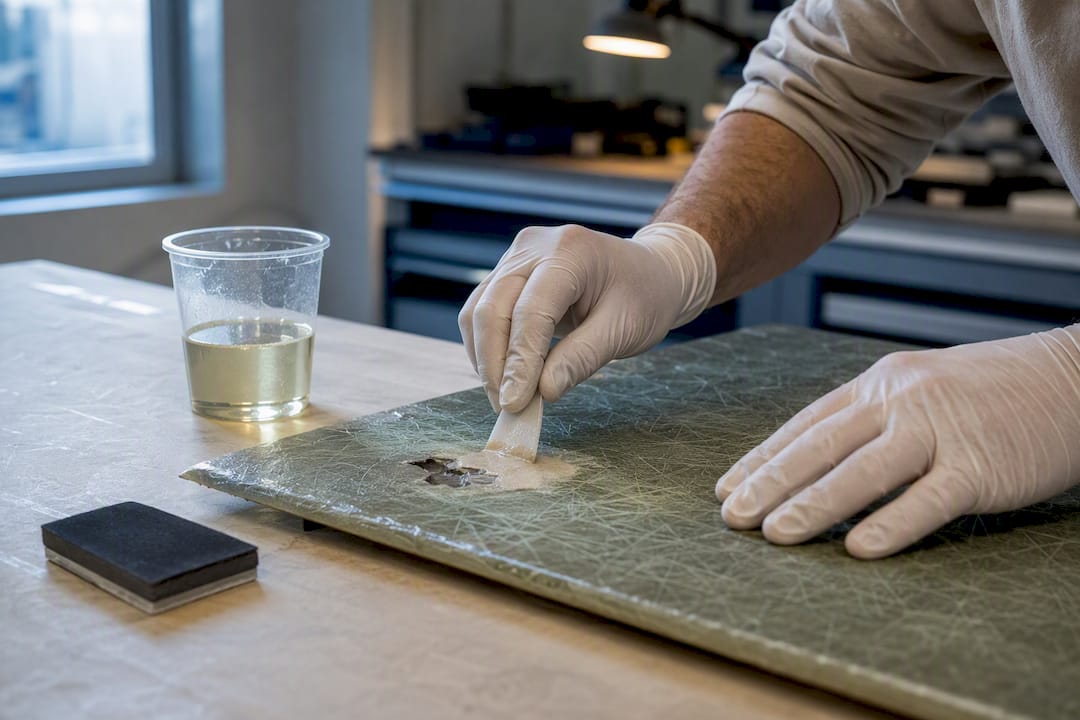
Renewable materials in yacht design no longer mean compromising on finish quality. Certified sustainable woods, reclaimed veneers, and low-VOC lacquers now match traditional joinery in appearance while cutting sourcing impact. Bio-based and recycled composites are entering structural and non-structural applications, though owners should verify strength and repairability specifications before committing, since availability and certification still vary by supplier and project.
- Certified or reclaimed hardwoods for veneer and trim work
- Low-VOC adhesives and finishes for interior air quality and lower production impact
- Recycled or bio-based composite panels for non-structural bulkheads and furniture
- Modular interior systems designed for disassembly, repair, and eventual material recovery
Baranofyachts covers material selection in depth in our guide to key yacht building materials, which walks through strength, weight, and longevity trade-offs for owners weighing these options.
Pro Tip: Request repairability data alongside sustainability claims. A recycled composite that cannot be patched or refinished in the field creates a maintenance headache years down the line.
How Do Onboard Systems Cut Energy and Water Use?
HVAC and water systems quietly consume more onboard energy than most owners expect, which makes them a high-leverage target for efficiency work. Chilled-panel cooling, waste-heat-driven chillers, and improved natural ventilation reduce the mechanical cooling load dramatically compared to conventional systems.
- Chilled-water or molten-salt thermal storage lets excess solar or hydrogeneration output cool the yacht later, smoothing demand peaks
- Waste-heat recovery from engines or generators can supply hot water or supplemental cabin heating at near-zero marginal cost
- Efficient watermakers paired with rainwater and condensation capture cut freshwater demand and generator runtime
- Graywater reuse for non-potable applications reduces both water consumption and holding-tank turnover
Project Zero’s engineering team reported cooling systems roughly eight times more efficient than conventional setups, contributing to daily energy savings in the hundreds of kWh once combined with insulation upgrades and ventilation redesign. That single data point explains why systems engineering, not just propulsion, decides whether a sustainable yacht meets its targets.
What Do the Solsea and Project Zero Projects Actually Prove?
Two projects give owners concrete benchmarks rather than marketing language. Project Zero, developed by Vripack alongside Dykstra and Vitters, combines hydrogeneration, large PVT arrays, advanced insulation, and regenerative deck gear like captive winches to extend near-zero-emission operation across weeks at sea. Its integrated energy-management software optimizes routing against weather data to maximize renewable harvest, a detail worth requesting in any similar brief.
Solsea, a hybrid-electric catamaran designed by Fuseproject and built by Rossinavi, takes a different route to a similar outcome. Its solar surfaces integrate into functional deck elements like the pool cover, and its battery bank supports fast charging and even shore-power export.
- Ask for tested electric-cruising percentage at a stated speed and load, not just a headline number
- Request hydrogeneration output figures across a range of hull speeds, not just peak conditions
- Confirm whether insulation and thermal-storage claims come from in-service data or design projections
Manufacturer claims deserve scrutiny. Ask what speed, load, and weather conditions produced the advertised numbers before you accept them as your own operating baseline.
How Do You Brief a Shipyard for a Sustainable Yacht?
A strong brief translates ambition into numbers a shipyard can actually design against. Vague sustainability language produces vague results; specific targets produce specific engineering.
- State your target percentage of electric-only cruising at a defined speed and load profile.
- Set a daily hotel-load ceiling in kWh and require the designer to model it against your equipment list.
- Lock hull form, solar deck area, and insulation specification during concept design, not after.
- Request documentation on recycled content, material certification, and component repairability.
- Include crew training and long-term service commitments for any battery, hydrogeneration, or thermal-storage system that departs from conventional diesel installations.
Pro Tip: Put performance guarantees in the contract itself, tied to a specific speed and load, not a marketing brochure. Our guide on what to settle before building your yacht covers the broader pre-build checklist this fits into.
How Baranof Yacht Sales Supports Sustainable Yacht Projects
Baranofyachts manages sustainable yacht projects from concept through delivery, pairing custom-build project management with shipyard selection suited to novel propulsion and energy systems. Our guides on composite materials and ergonomic design give owners a technical starting point before their first shipyard conversation.
What Should Owners Expect From a Sustainable Build?
Sustainable yacht projects cost more upfront and take longer to deliver than conventional builds, largely because crew training and systems integration for hybrid or hydrogeneration platforms add real engineering time. A design-first approach avoids the retrofit tax that comes with adding efficiency later. Prioritize measurable targets over marketing language, and insist on verification before signing off on any performance claim.
— Jason
Start Your Sustainable Yacht Project With Baranof
A practical route from a sustainability wish list to a signed shipyard contract involves project management that turns hydrogeneration specs, PVT panel sizing, and insulation targets into an actual build brief a yard can price and deliver against. Handling shipyard selection, specification writing, and long-term service planning for novel systems helps avoid owners managing warranty claims on a battery bank alone.
If you are weighing electric-cruising targets or hull options, start with our guide on what a yacht design brief actually needs to see how these decisions translate into an RFP. Owners further along should review what to settle before building your yacht, then request a consultation with our project management team to price your specific propulsion and systems targets.
Sources
For technical verification beyond this guide, consult the primary case studies and reporting that informed it:
- Solsea – Luxury hybrid-electric Yacht Design | Fuseproject
- Science under sail: How Project Zero is helping build the future of emission-free yachting – Yachting World
- THE ZERO DESIGN STORY – Vripack
FAQ
What Are Some Environmentally Friendly Yachts?
Solsea, a hybrid-electric catamaran by Fuseproject and Rossinavi, and Project Zero, developed by Vripack with Dykstra and Vitters, are the two best-documented examples, both combining hybrid or hydrogeneration propulsion with extensive solar integration.
What Is the 10 Rule for Yachts?
The “10 percent rule” is an informal budgeting guideline suggesting owners set aside roughly 10 percent of a yacht’s purchase price annually for maintenance, crew, insurance, and operating costs, not a design or sustainability standard.
What Is the 12 Person Yacht Rule?
This refers to maritime passenger-limit regulations that classify vessels carrying more than 12 passengers under stricter commercial safety codes; it is unrelated to eco-friendly design specifications but affects certification requirements for charter yachts.
Is It Cheaper to Build or Buy a Yacht?
Buying an existing yacht is typically cheaper upfront than a custom build, but a sustainable custom build can lower lifetime operating costs through reduced fuel consumption, an outcome demonstrated by Solsea’s fuel savings during cruising and wintering.
How Much Does Sustainable Design Add to a Yacht’s Build Cost?
Costs vary widely by hull size and system complexity, but higher upfront investment in insulation, hybrid propulsion, and solar integration generally pays back through lower fuel and maintenance costs over the ownership period.
Recommended
Sold Listings
Design Your Yacht
"*" indicates required fields
Maximus III - PNW
As you step aboard MAXIMUS III, the first impression is her scale.
At 120 feet with an 8-meter beam and 294 GT of interior volume, this 2025 Crescent Custom tri-deck immediately feels open, balanced, and estate-like. A timeless look while still feeling fresh from the shipyard.
Currently Available


Get your yacht value Estimate
"*" indicates required fields