

Crew recruitment moves through six predictable stages: application, screening and assessment, interview or skills testing, a conditional offer, pre-employment checks, and onboarding. Whether you’re pursuing a deckhand berth on a 40-meter motoryacht or a first officer seat with a regional airline, the sequence rarely changes. What changes is the credential bar, the testing format, and how long each stage takes.
Before you send a single application, gather the paperwork gatekeepers ask for first:
- Valid passport with at least 12 months remaining before expiry
- A role-specific CV listing certificates, sea time or flight hours, and vessel or aircraft types
- STCW Basic Safety Training and an ENG1 medical certificate for yacht positions
- Pilot license, type rating, and current medical class for flight deck roles
- Two to three verifiable professional references with working contact details
Timelines vary sharply by seniority. Junior ratings and entry-level cabin crew often clear the full process in two to three weeks, while senior officers, captains, and pilots can spend four to six weeks or longer moving through simulator checks, background screening, and contract negotiation. Agencies tend to compress this window; going direct usually stretches it.
Key Takeaways
Successful crew recruitment depends on verifying credentials early, preparing for role-specific assessments deliberately, and treating onboarding as a structured process rather than a first-day afterthought.
| Point | Details |
|---|---|
| Verify certificates first | Confirm STCW, ENG1, or pilot medical status with the issuing authority before applying anywhere. |
| Prepare 3 to 5 STAR stories | Rehearse competency-based answers covering conflict, error recovery, and pressure decisions. |
| Budget realistic time | Expect 2 to 3 weeks for junior roles and 4 to 6 weeks for senior officers or pilots. |
| Watch for placement-fee red flags | Never pay upfront to secure a job; verify agency licensing before engaging further. |
| Consider managed onboarding | Baranofyachts coordinates credential checks and induction training for new-build crew placements. |
Table of Contents
- Crew Recruitment Step by Step: What Happens at Each Stage
- What Credentials Does Each Crew Role Actually Require?
- How Do You Write a CV That Gets Past the Screen?
- What Do Assessments and Interviews Actually Test?
- What Happens Between the Offer and Your First Day?
- How Much Time and Money Should You Budget for Recruitment?
- How Do You Spot a Recruitment Scam or a Bad Hire?
- How Baranofyachts Structures Crew Onboarding for New Builds
- What’s the One Move That Actually Improves Crew Hiring Outcomes?
- Let Baranofyachts Handle Onboarding While You Focus on the Yacht
- Frequently Asked Questions
- Sources
Crew Recruitment Step by Step: What Happens at Each Stage
Recruiters don’t improvise this process. Each stage filters candidates for a specific reason, and knowing that reason changes how you prepare.
Stage 0: Get your paperwork in order before you apply. Nothing stalls an application faster than a missing certificate number or an expired medical. Pull together your STCW records, sea time logbook (or flight hours), and at least two references who will actually answer the phone when a recruiter calls. If your ENG1 or Class 1 medical is close to expiring, renew it now rather than after an offer arrives.
Stage 1: Choose your application channel. You have three real routes: airline or yacht management company portals, manning and crewing agencies, or specialist job boards. Direct applications work well when you already have a strong network or a specific vessel or airline in mind. Agencies work better for candidates newer to the industry, since a reputable manning agency maintains a vetted pool and can place you faster than cold applications. High-volume roles like cabin crew often cluster on regional job boards and aggregator sites, where hundreds of listings compete for attention, so a tailored CV matters more than volume.
Stage 2: Survive initial screening. This is a documents and eligibility check, not a personality assessment. Recruiters confirm your certificates are current, your sea time or flight hours meet the minimum threshold, and your CV doesn’t raise red flags like unexplained gaps. Passing this stage is mostly a matter of submitting a clean, complete file the first time.
Stage 3: Complete online assessments. Expect psychometric testing, situational judgment questions, or a recorded video interview, depending on the employer. These tools measure decision-making under pressure and cultural fit, not technical skill. Answer honestly and specifically. Vague answers read as evasive to an algorithm and a human reviewer alike.
Stage 4: Attend the assessment center, simulator, or sea trial. This is where employers separate candidates who look good on paper from those who perform under real conditions. Pilots face simulator sessions testing procedure recall and crew coordination. Yacht crew face practical seamanship tests, docking drills, or a trial watch. Interior crew may be asked to demonstrate service sequences or basic culinary tasks on the spot.
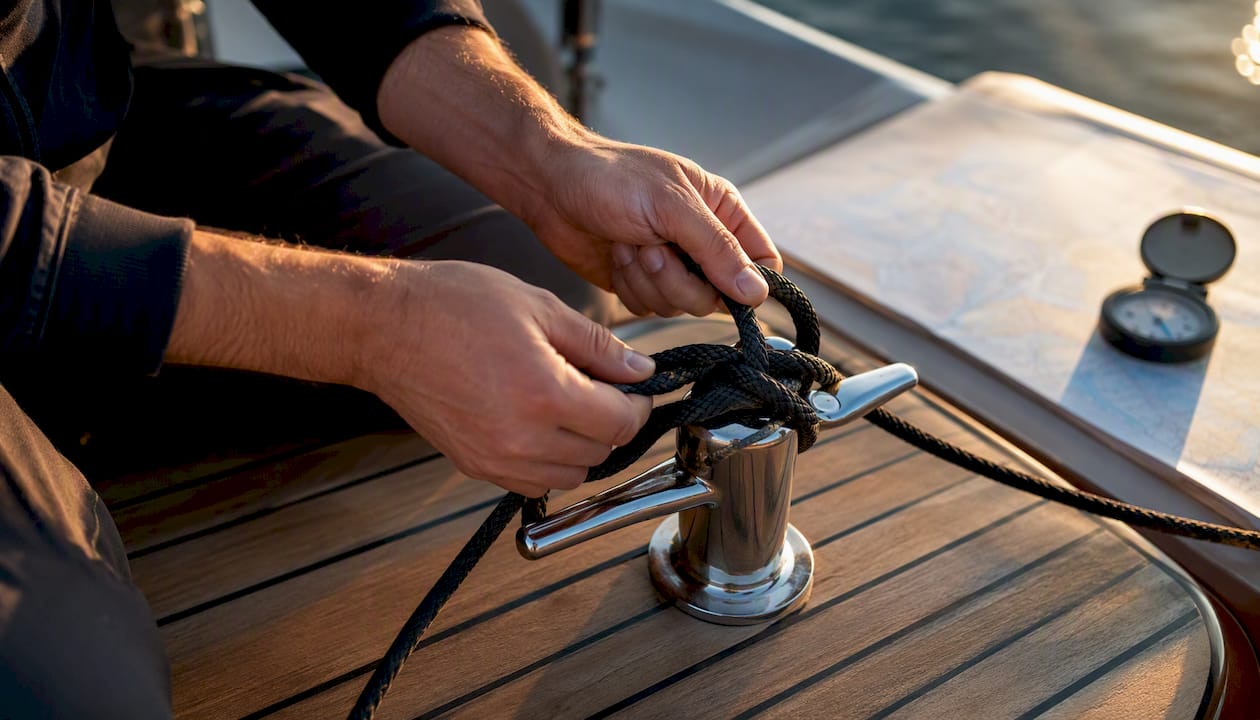
Stage 5: Receive and review your conditional offer. A conditional offer typically comes with contingencies attached: passing a medical exam, clearing a background check, and confirming references. Read every clause. Salary, rotation schedule, notice period, and probation length should all be spelled out before you sign anything.
Stage 6: Complete onboarding. Induction, safety briefings, and contract signing happen in the first days aboard or at base training. What you do in week one often determines how the rest of the season goes.
Pro Tip: Keep digital scans of every certificate, medical, and reference letter in one cloud folder before you start applying. Recruiters move fast during the screening stage, and a same-day document request is common. Being able to send a PDF within the hour, rather than the next day, has moved more than one candidate ahead of an equally qualified competitor.
What Credentials Does Each Crew Role Actually Require?
Certification requirements are non-negotiable, and they differ sharply between yacht and airline roles. Get these wrong and you won’t reach the interview stage at all.
Yacht crew (deck, engineering, interior):
- STCW Basic Safety Training, current and unexpired
- ENG1 or national-equivalent medical certificate
- Certificate of Competency at the appropriate tonnage tier (100GT, 200GT, 500GT, or unlimited) for captains and senior officers
- Vessel-specific endorsements if the role involves specialized systems (tenders, watersports, dive operations)
Airline flight crew (pilots):
- Commercial pilot license and current type rating for the aircraft in question
- Class 1 medical certificate, renewed on the schedule your civil aviation authority requires
- Simulator currency documentation, since lapsed recency checks can disqualify an otherwise qualified applicant
Cabin crew:
- Airline-specific safety and emergency procedures training
- Security background clearance, which can include criminal record checks across multiple countries of residence
- Health screening or vaccination records depending on route network and destination requirements
- Height, reach, and swim-test criteria some carriers still apply
Before applying anywhere, verify every credential directly with its issuing authority. Flag state registries confirm Certificates of Competency, aviation authorities confirm license and medical class status, and STCW records can be checked against the training center that issued them. A commercial yacht license that’s technically valid but poorly documented still slows down a background check, so keep original certificates, not just photocopies, accessible.
How Do You Write a CV That Gets Past the Screen?
A generic CV gets filtered out before a human ever reads it. Crew recruiters scan for specific data points, and if those points aren’t visible in the first ten seconds, your application moves to the reject pile.
Structure your CV in this order:
- Contact details and a one-line summary of your role and seniority
- Certificates, listed with certificate numbers and expiry dates, not just names
- Sea time or flight hours, broken down by vessel or aircraft type
- Specific vessel classes or aircraft types you’ve worked, with dates
- Two to three references with direct phone numbers or emails, not “available on request”
Your cover letter should do one job: explain why you fit this specific role, on this specific vessel or with this specific carrier. Generic cover letters that could apply to any employer read as low effort. If you have an employment gap, address it in one sentence. Recruiters worry more about unexplained gaps than about gaps with a clear reason attached.
Common CV mistakes that trigger rejection:
- Certificate names listed without numbers or expiry dates, which forces a recruiter to chase you for verification
- References with no working phone number, which reads as a reference you’re hoping nobody actually calls
- Vague date ranges (“2022 to 2024”) instead of months, which suggests you’re hiding a short tenure
- Missing STCW or medical status entirely, forcing the recruiter to assume the worst
Dos and don’ts specific to yacht and airline recruitment: do quantify everything (tonnage, passenger count, flight hours), don’t pad your CV with unrelated hospitality jobs unless directly relevant, do tailor your cover letter to the specific yacht or carrier, and don’t submit a CV longer than two pages. Crew recruiters read dozens of these a day.
What Do Assessments and Interviews Actually Test?
Online tests and in-person assessments aren’t obstacles designed to trip you up. Each format measures something specific, and understanding what makes preparing for it far more effective than generic “interview practice.”
Personality and aptitude tests measure how you handle routine and stress, not whether you’re smart. Situational judgment tests present a workplace scenario and ask you to rank responses by effectiveness. There’s no universally “correct” answer, but employers are looking for responses that show judgment, not the response that sounds most heroic.
Assessment center exercises put you in a room with other candidates and watch how you behave. Group exercises test whether you listen, contribute, and defer appropriately, since crew work is fundamentally a team activity. Role-play scenarios, common for cabin crew and interior staff, test how you de-escalate a difficult guest or passenger interaction in real time.
Technical and skills checks are where preparation pays off most directly. Pilots face full-motion simulator sessions. Yacht crew face practical seamanship tests, docking exercises, or a working sea trial where a captain evaluates real decision-making rather than rehearsed answers. Interior crew may face a live service or basic galley task.
Use the STAR structure (Situation, Task, Action, Result) to prepare for competency-based interview questions. Practice answering prompts like:
- “Describe a time you had to make a fast decision without your supervisor available.”
- “Tell me about a conflict with a colleague and how you resolved it.”
- “Walk me through a mistake you made and what you changed afterward.”
- “Describe handling a difficult guest, passenger, or owner request.”
Scenario-based questions, like handling an anchoring emergency or a passenger medical situation, tend to reveal far more about real decision-making than generic competency questions do, since they force you to draw on specifics instead of rehearsed phrasing.
Preparation checklist before assessment day:
- Run timed practice tests for psychometric and situational judgment formats
- Confirm simulator or sea trial logistics (location, arrival time, what to bring) at least 48 hours ahead
- Rehearse three to five STAR stories covering conflict, error recovery, and pressure decisions
- Review the vessel or aircraft type’s basic specifications so you’re not caught flat on fundamentals
What Happens Between the Offer and Your First Day?
A conditional offer is not a finished contract. Almost every crew hire, in aviation and yachting alike, runs through several checks before the position is locked in.
| Check | Typical duration | Usually arranged by |
|---|---|---|
| Medical exam (ENG1 or Class 1) | 1 to 5 days | Candidate, at an approved clinic |
| Background and criminal record check | 3 days | Agency or employer HR |
| Reference verification | 2 to 5 days, often in parallel | Agency or employer HR |
| Drug and alcohol screening | 1 to 2 days | Employer, at a designated facility |
| Passport and visa validation | 1 to 3 weeks depending on country | Candidate, with employer guidance |
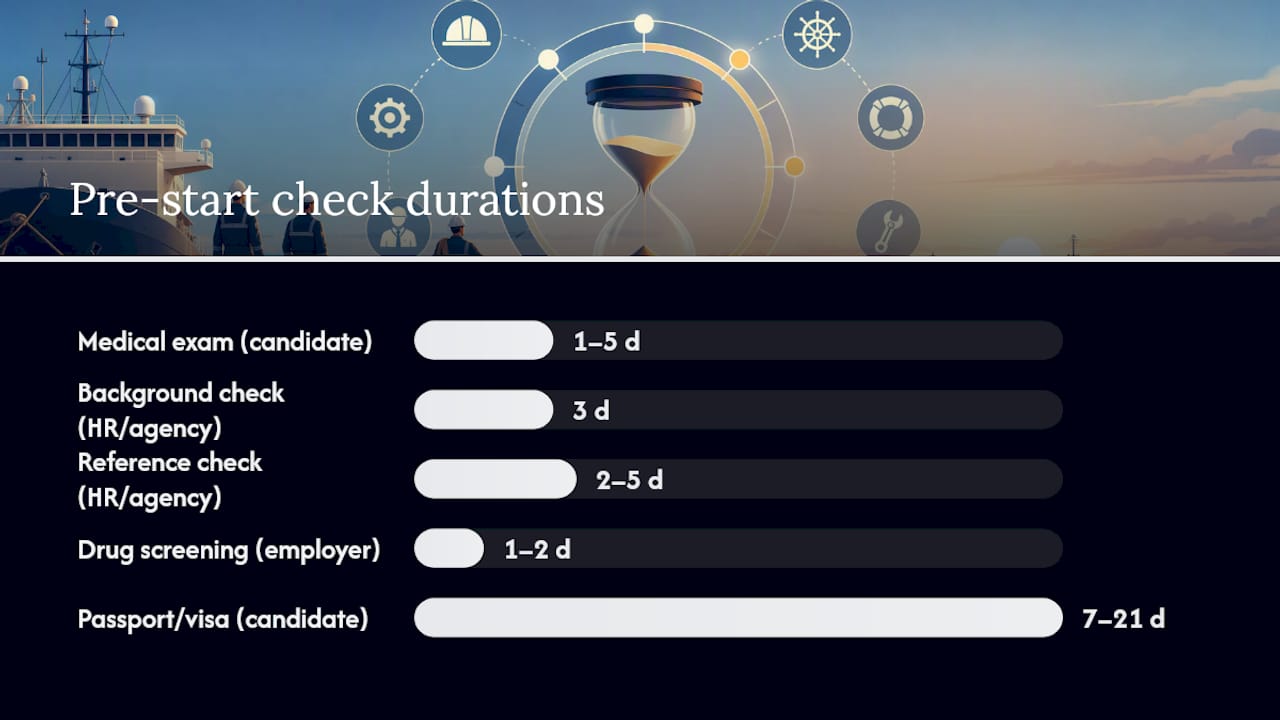
Most of these checks run in parallel rather than sequentially, which is why a well-organized candidate can clear conditions within one to two weeks of receiving an offer. If a check raises an issue, such as a discrepancy on a criminal record or a reference who doesn’t respond, don’t wait for the employer to chase you. Contact the recruiter directly, explain the situation, and offer to submit supplementary documentation immediately. Silence reads worse than an explained problem.
Once conditions clear, onboarding begins. A well-run induction covers safety briefings, a walkthrough of the vessel or aircraft-specific procedures, contract signing, and travel logistics. Ask specifically who arranges and pays for your travel to the vessel or base, since this varies by employer and should be confirmed in writing before you pack a bag.
How Much Time and Money Should You Budget for Recruitment?
Realistic expectations save you from panicking when a process takes longer than you hoped. End-to-end timelines vary by seniority: junior ratings and entry-level roles typically clear in two to three weeks, mid-level positions run three to four weeks, and senior officers or captains often take four to six weeks given the added scrutiny on references, background checks, and licensing verification. Airline pilots and senior cabin crew frequently see similarly extended windows once simulator scheduling and medical class currency enter the picture.
Costs that candidates commonly cover out of pocket:
- Medical exams (ENG1 or Class 1), which vary by clinic and country
- STCW refresher courses if your certification has lapsed
- Travel to assessment centers, simulator sessions, or sea trials
- Visa and document fees for international placements
- Any legitimate, transparently disclosed agency processing fee, where local law permits one
Going through a reputable agency versus applying direct changes both the timeline and the cost structure. Agencies often absorb some administrative burden and can shorten sourcing time meaningfully, but you should always verify an agency’s license before paying anything. To reduce delay, pre-book your medical and any certificate refreshers before you start actively applying, use clinics your target employer already recognizes, and keep every document as a scanned digital copy so you’re never waiting on a physical mail delay.
How Do You Spot a Recruitment Scam or a Bad Hire?
The crew recruitment industry attracts a meaningful number of scams, particularly targeting candidates new to the field or eager to relocate quickly. Recognizing the pattern protects both your money and your safety.
Red flags candidates should watch for:
- Any request for an upfront fee to “secure” a placement, which is illegal or against best practice in most jurisdictions
- Agencies that can’t produce a verifiable license number when asked
- Job offers that arrive unsolicited with unusually generous salary promises
- Contract terms that shift between the initial offer and the paperwork you’re asked to sign
- Pressure to wire money or travel immediately without a documented, verifiable employer
In regulated markets, candidates should check an agency’s licensing status against the relevant government registry before engaging further. A legitimate agency will never object to that scrutiny.
Employers face a parallel set of risks. Fake or inflated CVs, references who turn out to be friends rather than former supervisors, and certificates that don’t check out against the issuing authority’s database are the most common problems. The fix is straightforward but often skipped under hiring pressure: verify certificate numbers directly with the issuing body, call references and ask specific questions rather than accepting a generic endorsement, and treat unexplained employment gaps as a topic to raise directly rather than ignore.
For in-person interviews or sea trials, confirm in advance who arranges and pays for travel, and never make a payment to secure an assessment slot. If something feels off, report it to the relevant licensing authority rather than simply walking away quietly. Reactive hiring under time pressure is exactly when these mistakes happen; keeping a continual pipeline of vetted candidates, as Nicholson Yachts points out, is one of the most reliable defenses against a rushed, poor decision.
How Baranofyachts Structures Crew Onboarding for New Builds
Owners commissioning a new build face a distinct challenge: there’s no existing crew culture to slot a new hire into, and no ship’s history to reference. We treat onboarding as a conductor’s score, not a checklist. Every subsystem, from navigation to interior service, needs its cue, and a well-timed onboarding sequence prevents the knock-on delays that come from training gaps discovered too late.
Our practical workflow breaks into five phases:
| Phase | Timing | Focus |
|---|---|---|
| Pre-boarding admin | 2 to 4 weeks before delivery | Document verification, certificate checks, PPE issue, training bookings |
| Day-1 induction | Delivery day | Safety briefings, vessel-specific systems walkthrough, contract confirmation |
| Week-1 essential training | Days 1 to 6 | Emergency drills, subsystem familiarization, watch-keeping routines |
| Competence goals in the first weeks | Weeks 1 to 4 | Independent operation of assigned systems, guest-service standards, first performance check-in |
| Handover and record-keeping | Ongoing | Digital logbook entries, maintenance handover notes, continuity documentation |
Our preboarding checklist covers documents (passport, certificates, ENG1 or equivalent), PPE assignment, and confirmed training bookings before anyone steps aboard. A training matrix maps each required skill against a check-off date, so gaps surface early rather than at the worst possible moment, mid-charter. Our crew training workflow template gives owners and captains a reusable structure rather than reinventing onboarding for every build.
Pro Tip: Build your handover documentation into the daily routine from day one, not as an afterthought when someone leaves. A digital logbook that captures maintenance notes and operational quirks in real time turns crew transitions from a scramble into a five-minute briefing.
When a short-notice relief hire is needed, whether from illness, a family emergency, or simply a poor fit discovered during a trial period, we draw from a pre-vetted network rather than starting a search from zero, as explained in detail in why luxury yachts use crewed service for seamless charters. That’s the practical value of treating retention and recruitment as one continuous process rather than two separate events; the same principle that governs standard hiring, defining expectations clearly and keeping a visible progression path, is what keeps a relief hire from becoming a repeat problem.
What’s the One Move That Actually Improves Crew Hiring Outcomes?
Most guides tell you to check certificates, run background checks, and follow a structured interview process. All true, and all necessary. But the single highest-leverage decision I’ve seen owners and captains get wrong isn’t in any checklist: they hire to fill an empty berth instead of hiring to fit the program.
A candidate with a flawless CV and every certificate current can still be the wrong hire if their temperament doesn’t match the vessel’s rhythm. A high-tempo charter program with back-to-back turnovers needs a different personality than a private, slow-cruising owner’s yacht with a small, tight-knit crew. Certificates prove competence. They say nothing about whether someone will thrive in your specific operating tempo.
Verifiable sea time and genuine references matter more than the certificate stack looks on paper, because they’re the only evidence of how someone actually performed under real conditions, not just what they’re licensed to do. A candidate with 18 months of documented, verifiable time on a similar vessel type is almost always a safer bet than one with more paper qualifications but thin, unverifiable experience.
My rule of thumb for owners: never recruit reactively. If you’re only starting to look when a berth is already empty, you’ve already lost your negotiating position and your ability to be selective. Keep a warm pipeline of candidates you’ve met, vetted, or at least screened, even when you’re not actively hiring. For candidates, the equivalent rule is just as simple: keep your certificates current and your references warm year round, not just when you’re job hunting. The candidates who move fastest through recruitment are rarely the most decorated. They’re the ones who were already ready when the opportunity appeared.
Let Baranofyachts Handle Onboarding While You Focus on the Yacht
Managing crew recruitment alongside a new build or a busy ownership schedule pulls your attention in too many directions at once. Baranofyachts gives new-build owners a structured alternative: instead of building an onboarding process from scratch or chasing certificate verifications yourself, our team prepares the onboarding plan, verifies credentials against issuing authorities, and coordinates induction training before your crew ever steps aboard.

We fold this directly into our broader project management approach, so crew readiness lines up with delivery timelines instead of trailing behind them. If you’re weighing whether a managed crew model fits your operation, our guide on crew management for luxury yachts walks through what that looks like in practice. And for owners planning a build who want the full picture of what happens before the crew even arrives, our yacht construction management guide covers the sequencing in detail.
Reach out to schedule a consultation, and we’ll walk through your build timeline, your crew needs, and where a managed onboarding plan can save you the guesswork of doing it alone.
Frequently Asked Questions
What is crew recruitment, exactly?
Crew recruitment is the structured process employers use to source, screen, test, and hire personnel for yacht or airline crew positions, typically moving through application, assessment, interview or skills testing, a conditional offer, background checks, and onboarding.
How long does the full crew hiring process usually take?
Junior roles often clear in two to three weeks, while senior officers, captains, and pilots frequently take four to six weeks or more due to added licensing verification and background screening.
Do I need an agency, or can I apply directly?
Both routes work. Direct applications suit candidates with an existing network or a specific target employer. Agencies suit candidates newer to the field, since a reputable manning agency maintains a vetted pool and can move faster on placement.
What’s the biggest CV mistake crew candidates make?
Listing certificates by name without numbers or expiry dates, which forces a recruiter to chase verification and often costs you a spot in the shortlist.
How do I know if a crew recruitment agency is legitimate?
Ask for its license number and verify it against the relevant government registry. A legitimate agency will never ask you for an upfront fee to secure a placement.
What should I do if a background check turns up an issue?
Contact the recruiter or employer immediately, explain the discrepancy, and offer supplementary documentation right away. A prompt, transparent response is treated far more favorably than silence.
Sources
Verifying credentials and agency legitimacy takes minutes and prevents weeks of wasted effort later. Group your research into three categories before you apply.
Certificate verification:
- YPI Crew — Yacht work job qualifications
- Yachtpedia — Yacht Crew Management: Hiring, Training & Retention Guide
- Lighthouse Careers — Complete Guide to Yacht Crew Recruitment Miami Process
- Captains & Crew — Finding Reliable Crew for Your Charter Fleet: Operator’s Guide
- ClavePrep — Cruise Line Jobs Interview Guide 2026: Roles, STCW Rules, and How to Get Hired
Assessment and interview preparation:
Agency and hiring-practice checks:
Recommended
Sold Listings


Design Your Yacht
"*" indicates required fields
Maximus III - PNW
As you step aboard MAXIMUS III, the first impression is her scale.
At 120 feet with an 8-meter beam and 294 GT of interior volume, this 2025 Crescent Custom tri-deck immediately feels open, balanced, and estate-like. A timeless look while still feeling fresh from the shipyard.
Currently Available


Get your yacht value Estimate
"*" indicates required fields