
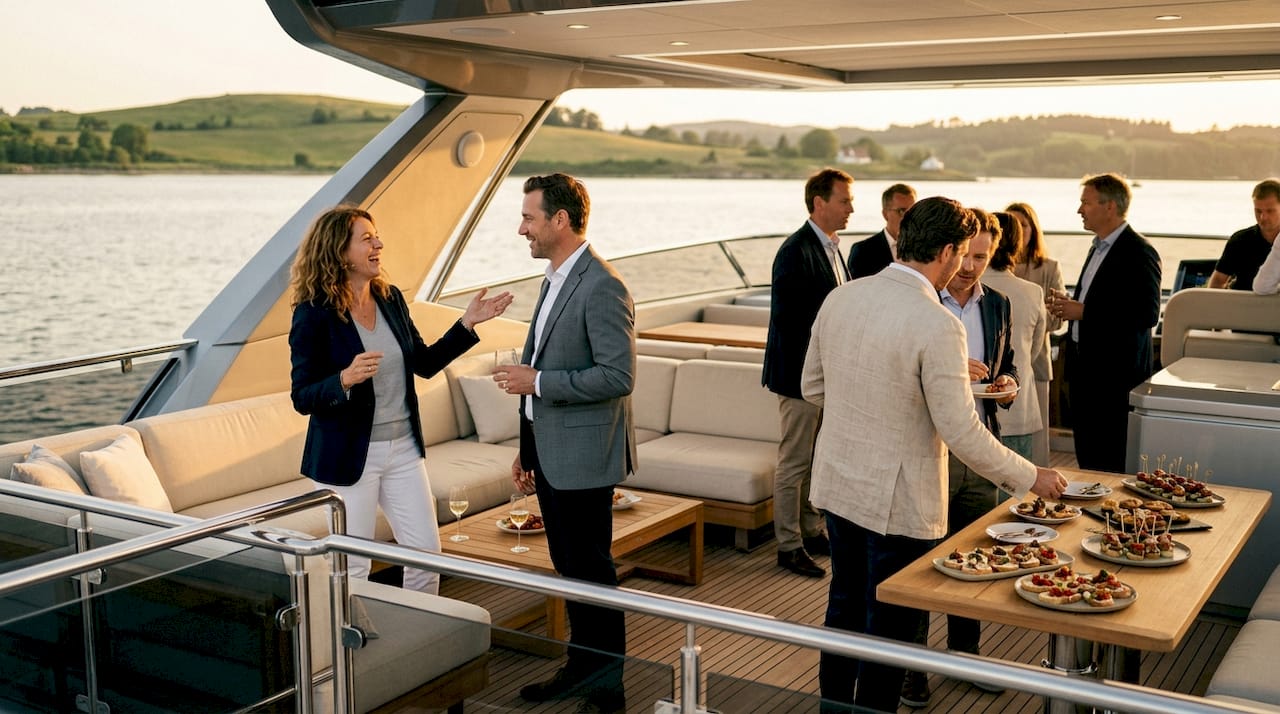
The role of yachts in corporate hospitality is to deliver exclusive, privacy-focused environments where business relationships deepen beyond what any hotel ballroom or restaurant can offer. Known in the industry as “floating boardrooms,” luxury yachts combine confidential meeting space with experiential entertainment, giving corporate planners a venue that works as hard as it impresses. 65% of affluent travelers choose yacht charters primarily for privacy. That single statistic explains why corporate event planners are moving yacht hospitality events from novelty to standard practice. Baranofyachts works with clients who understand this shift and want vessels built to serve both leisure and serious business objectives.
What is the role of yachts in corporate hospitality?
Corporate yacht hospitality is defined as the use of private or chartered vessels to host business events, client meetings, product launches, and team experiences in a controlled, luxury environment. The term “floating boardroom” captures the core idea: a yacht removes participants from the distractions of an office or public venue and places them in a setting where conversation flows more naturally.
Corporate yacht charters are increasingly replacing traditional conference venues with experiential networking and product launches. The shift is not about extravagance. It is about creating conditions where business gets done more effectively. A yacht gives the host complete control over who attends, what the agenda looks like, and how the environment feels from the moment guests step aboard.
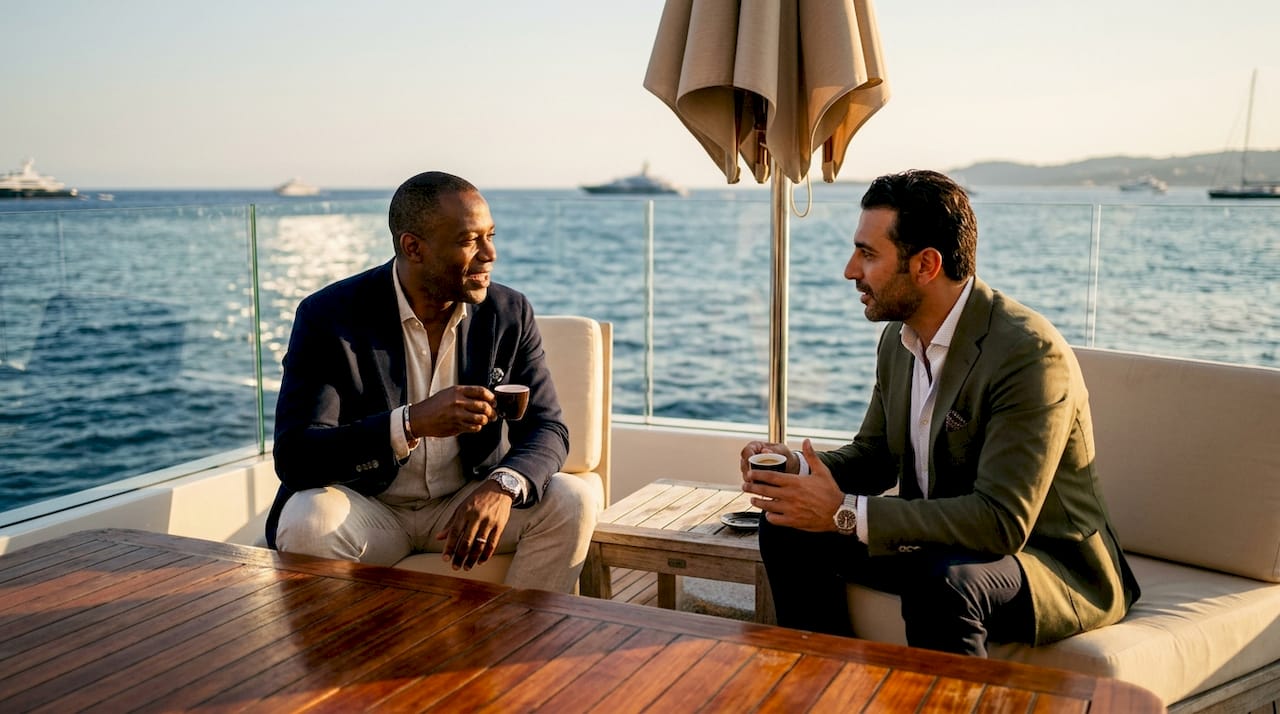
Baranofyachts sees this demand reflected in how clients specify their builds. Conference areas, high-speed internet connectivity, and climate-controlled interiors are now standard requests alongside sun decks and entertainment systems. The vessel becomes a dual-purpose asset: a corporate image enhancer and a fully functional event space.
What event formats work best for corporate yacht charters?
Corporate yacht charter formats fall into two primary structures, each suited to different business objectives.
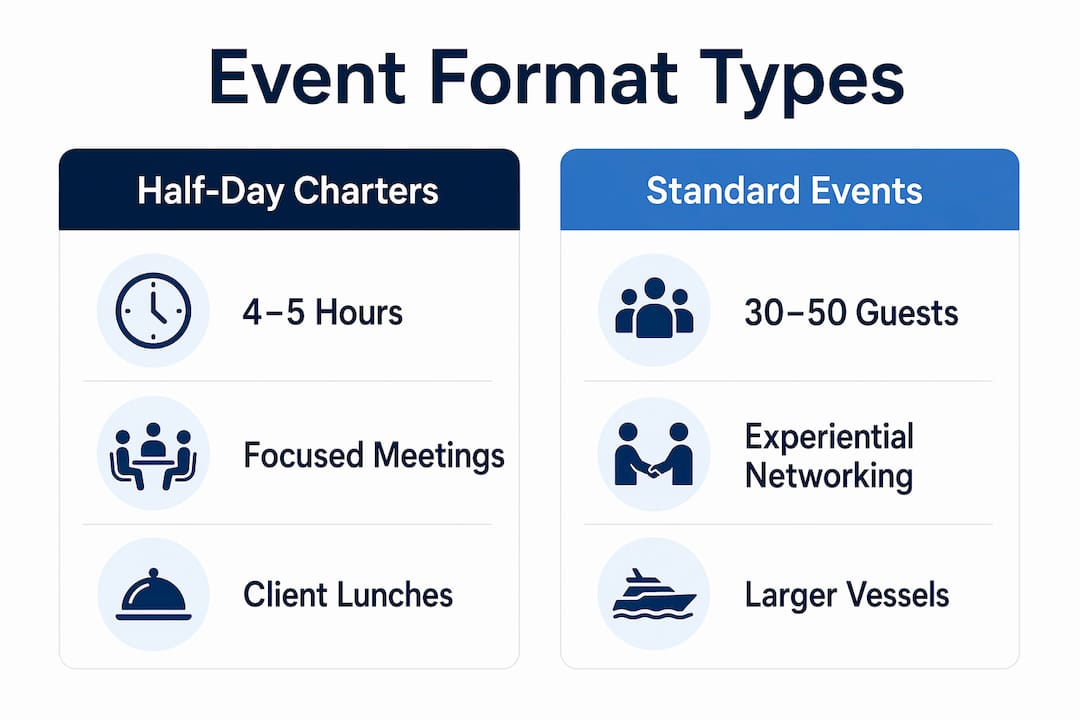
Half-Day Charters (4–5 hours) work well for focused executive meetings, client appreciation lunches, and product previews. The compressed timeline keeps the agenda tight while still delivering the experiential impact of being on the water. Full-Day Charters (6–8 hours) suit team-building retreats, multi-session conferences, and celebration events where the goal is sustained relationship building over several hours.
Standard corporate yacht events host 30–50 guests, with larger vessels accommodating up to 100. For organizations that need more capacity, multi-boat events coordinate several vessels simultaneously. Booking timelines follow a clear pattern: standard events require 3–6 months of lead time, while marquee events at major industry festivals or regattas need 12–24 months of advance planning.
Catering packages range from bar service and appetizers to full-day custom menus with live entertainment. The most attentive operators maintain a dedicated concierge ratio of 1 staff member per 15 guests. That level of service is difficult to replicate in a hotel banquet room.
Common event types on corporate charters include:
- Board meetings and executive retreats requiring confidential discussion space
- Product launches using the vessel as a branded stage
- Client appreciation events designed to reward key accounts
- Team-building activities such as sailing challenges or water sports
- Cocktail receptions for industry networking during conferences or trade shows
The format you choose shapes every downstream decision, from vessel size to catering complexity. Planners who define the event objective first select the right charter format far more efficiently.
How do yachts enhance privacy and exclusivity for corporate events?
Privacy is the defining advantage of yacht hospitality over land-based venues. A yacht creates a physically bounded environment where the guest list is fixed, access is controlled, and no uninvited party can walk in. Hotels, restaurants, and conference centers cannot offer that level of containment.
Luxury yachts provide privacy without isolating guests. The setting softens the meeting mindset and shifts the tone from transactional to personal. That shift matters enormously when the goal is to close a deal, deepen a client relationship, or have a candid conversation with a board member.
“Yachts foster honest dialogue more effectively than traditional office or restaurant hospitality. The hosted atmosphere, combined with physical seclusion, creates conditions where people speak more openly and connections form more naturally.”
The operational control a host gains on a yacht extends beyond the guest list. You control the pace of the event, the sequence of conversations, the catering timing, and the ambient environment. No neighboring table overhears your negotiation. No hotel lobby interrupts your client’s attention. The strategic environment of a well-appointed yacht consistently produces more productive relationship-building outcomes than conventional venues.
Key privacy and exclusivity benefits include:
- A fixed, vetted guest list with no public access
- Physical separation from competing events or distractions
- Full control over event pacing and atmosphere
- A setting that signals genuine investment in the guest experience
- Confidential meeting space that hotels and restaurants cannot match
What logistical factors must planners consider for yacht events?
Successful corporate yacht events depend on infrastructure decisions made weeks before guests arrive. The most common planning failure is treating the vessel as a backdrop rather than an operational venue with specific technical requirements.
-
Confirm charter stability. Not every yacht handles open-water conditions equally. Planners hosting board meetings need a vessel with stabilizers and calm anchorage capability. A rough crossing undermines every agenda item that follows.
-
Verify IT and AV infrastructure. High-speed Wi-Fi, AV connectivity, and presentation systems must be confirmed in writing before booking. Assuming a luxury vessel includes business-grade connectivity is a mistake that produces disconnected, ineffective events.
-
Schedule around tides and traffic. Departure and return times affect guest comfort and event flow. Early morning departures avoid harbor congestion. Sunset returns create a natural, memorable close to the event.
-
Align catering and entertainment with the event type. A board meeting calls for restrained, high-quality catering with minimal interruption. A client celebration supports live entertainment, cocktail service, and water sports. Mismatching the catering style to the event type sends the wrong signal to guests.
-
Assess crew qualifications. The captain and crew set the tone for the entire experience. A professional crew trained in corporate hospitality manages guest flow, handles technical requests, and maintains discretion throughout.
Pro Tip: Request a full vessel walkthrough before confirming the booking. Confirm the location of AV connections, the capacity of the main salon for seated presentations, and the crew’s experience with corporate events specifically. A luxury yacht tour planning checklist prevents the most common infrastructure surprises.
Planners who treat the vessel selection as a venue decision, not just a transportation decision, consistently deliver better events. The right yacht for a 20-person executive retreat looks very different from the right vessel for a 100-person cocktail reception.
How do yachts integrate branding and marketing for corporate impact?
Yachts function as brand platforms when used intentionally. Custom branding on vessels and tenders during industry events maximizes brand visibility in ways that a trade show booth or hotel suite cannot replicate. The vessel itself becomes a visual statement visible from the dock, the water, and social media.
Product launches on yachts generate a level of exclusivity that drives media attention and guest engagement. The limited guest capacity creates genuine scarcity. Attendees feel selected, not just invited. That emotional dynamic produces stronger brand recall and more authentic word-of-mouth than mass-market launch events.
Brand activation strategies for corporate yacht events include:
- Vessel and tender wraps displaying brand colors, logos, and campaign messaging
- Branded welcome kits, menus, and onboard collateral aligned with the event theme
- Exclusive product demonstrations in a controlled, distraction-free environment
- Social media content creation using the vessel as a premium visual backdrop
- Named event series that build brand equity across multiple charter seasons
| Activation type | Primary business objective |
|---|---|
| Vessel branding and wraps | Visibility at industry festivals and regattas |
| Exclusive product launch | Scarcity-driven media and guest engagement |
| Client appreciation charter | Loyalty reinforcement and relationship deepening |
| Executive networking event | Deal facilitation and partnership development |
| Team-building retreat | Culture building and retention |
Luxury transportation logistics integrated with yacht arrival and departure sequences extend the brand experience from the moment guests leave their offices. The full journey, from car service to gangway, communicates the same level of care and attention. Planners who coordinate ground transport with the onboard experience deliver a coherent, memorable event rather than a series of disconnected moments.
Key Takeaways
Yachts serve as the most controllable, privacy-focused corporate hospitality venues available, combining branded environments, confidential meeting space, and experiential programming that land-based venues cannot replicate.
| Point | Details |
|---|---|
| Privacy drives corporate adoption | 65% of affluent travelers cite privacy as the primary reason for choosing yacht charters. |
| Format determines vessel selection | Half-day charters suit focused meetings; full-day charters support retreats and multi-session events. |
| Infrastructure must be confirmed | Wi-Fi, AV systems, and vessel stability require written confirmation before any corporate booking. |
| Yachts function as brand platforms | Custom vessel branding and exclusive launches generate visibility and guest engagement beyond traditional venues. |
| Lead time is non-negotiable | Standard events need 3–6 months of planning; marquee events require 12–24 months of advance booking. |
What I’ve learned from watching yacht hospitality done right and wrong
Corporate yacht events fail in predictable ways. The host books an impressive vessel, invites the right people, and then forgets that the boat is a venue with operational requirements. The Wi-Fi drops during the presentation. The catering arrives between the two most important conversations. The vessel rocks through the harbor entrance and half the guests spend the first hour finding their sea legs.
The events that work share one characteristic: the planner treated the vessel with the same rigor they would apply to a conference center booking. They confirmed every technical specification. They walked the boat. They briefed the crew on the event agenda and the guest list. They thought about the emotional arc of the day, not just the logistics.
What yachts do better than any land venue is compress the social distance between host and guest. When you are on the water together, the normal hierarchies of a business meeting soften. A CEO who would never linger after a hotel dinner will stay on deck for another hour watching the sunset. That extra hour is where relationships actually form.
The future of corporate yacht hospitality is moving toward purpose-built vessels. Clients are specifying conference rooms, satellite connectivity, and dedicated crew quarters for hospitality staff at the design stage. The yacht launch event itself becomes a corporate hospitality moment. The vessel is no longer just a tool for entertaining clients. It is a long-term asset that pays dividends in relationships, brand equity, and deal flow across its entire operational life.
— Jason
Baranofyachts and corporate yacht hospitality
Corporate event planners who want a vessel that performs as well as it looks need to think about the build before the booking. Baranofyachts works with corporate clients from the concept stage, specifying conference-grade interiors, business-ready connectivity, and crew quarters that support professional hospitality operations.
Whether you are planning a single charter or evaluating yacht ownership as a long-term corporate asset, the vessel specification determines the quality of every event you host aboard it. Baranofyachts guides clients through every decision, from hull selection to interior configuration, with the same conductor’s eye we apply to every custom build. Read our full breakdown of yacht marketing strategies to understand how a well-specified vessel becomes a brand platform that works year-round.
FAQ
What is a floating boardroom?
A floating boardroom is a yacht configured for corporate meetings, featuring conference space, AV equipment, and high-speed internet. The term reflects how luxury yachts replace traditional office venues with a private, distraction-free environment on the water.
How many guests can a corporate yacht charter accommodate?
Corporate yacht events typically host 20–100 guests, with multi-boat configurations available for larger organizations. Vessel selection depends on the event type, with smaller groups suited to focused executive formats and larger groups to cocktail receptions.
How far in advance should you book a corporate yacht charter?
Standard corporate charters require 3–6 months of lead time. Marquee events tied to industry festivals or major regattas need 12–24 months of advance planning to secure the right vessel and crew.
What infrastructure should planners confirm before a corporate yacht event?
Planners must confirm high-speed Wi-Fi, AV connectivity, vessel stabilization, and calm anchorage capability in writing before booking. Failing to verify these specifics is the most common cause of underperforming corporate yacht events.
How do yachts support corporate branding?
Custom branding applied to vessels and tenders during industry events extends brand visibility beyond the guest list. Product launches, named event series, and branded onboard collateral all reinforce corporate identity in a setting that signals genuine investment in the client relationship.
Recommended
Sold Listings
Design Your Yacht
"*" indicates required fields
Maximus III - PNW
As you step aboard MAXIMUS III, the first impression is her scale.
At 120 feet with an 8-meter beam and 294 GT of interior volume, this 2025 Crescent Custom tri-deck immediately feels open, balanced, and estate-like. A timeless look while still feeling fresh from the shipyard.
Currently Available


Get your yacht value Estimate
"*" indicates required fields