
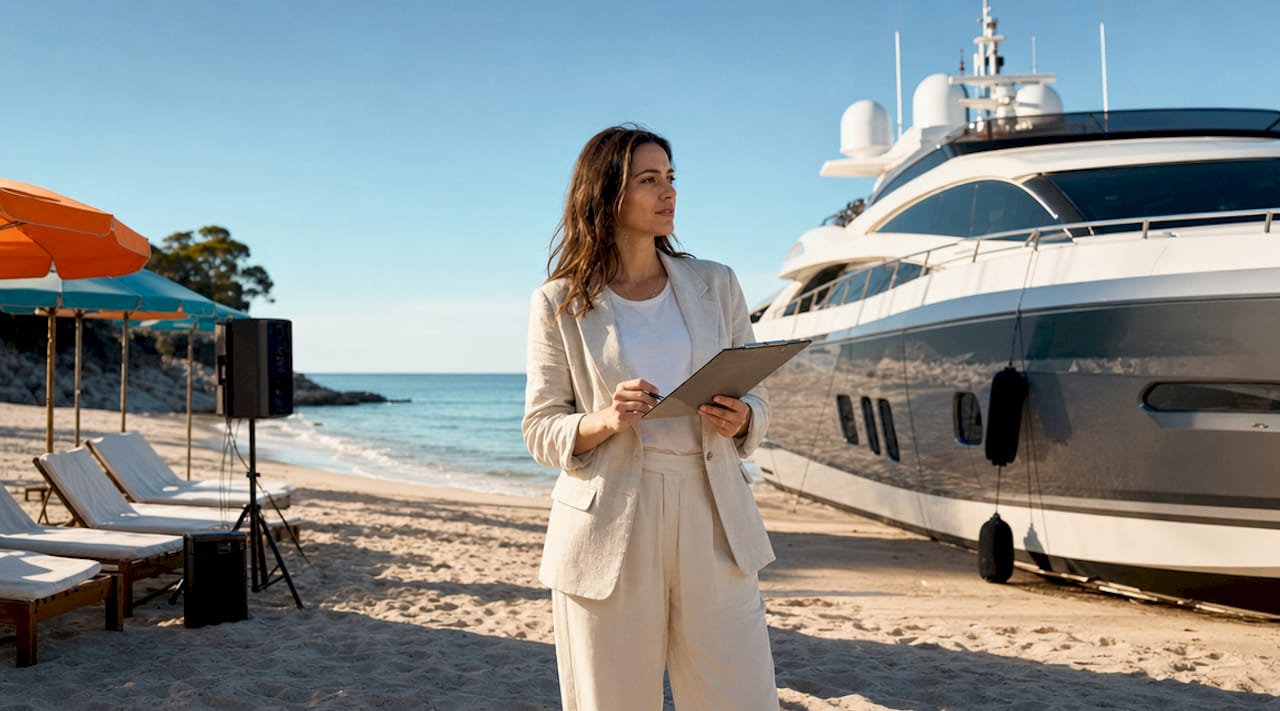
A yacht launch event is defined as a purpose-built brand activation staged aboard or alongside a vessel to generate media coverage, buyer engagement, and measurable post-event inquiries. Knowing how to orchestrate yacht launch events with precision separates a forgettable dockside gathering from a brand moment that resonates for months. Well-orchestrated yacht launches can increase brand visibility and follow-up inquiries by up to 50% compared to traditional venues. That figure reflects a fundamental truth: the yacht itself is the venue, the story, and the product simultaneously, which means every planning decision carries double the weight.
How to orchestrate yacht launch events: venue and vessel selection
The venue decision in yacht launch event planning is not secondary to programming. Choosing the right venue contributes to 40% of an event’s success, enhancing the yacht’s profile and brand prestige. That means before you finalize a caterer or a lighting rig, you need the right hull in the right berth.
Matching the reveal format to the vessel
The reveal format determines everything downstream. A staged reveal, where guests experience the yacht progressively from bow to stern, requires clear circulation paths, controlled sightlines, and a deck layout that supports sequential discovery. An interactive reveal, where guests move freely and explore at their own pace, demands a vessel with multiple social zones, open sightlines, and crew positioned to guide without crowding. Reveal format determines yacht configuration and deck utilization needs, so confirm this decision before you commit to a vessel.
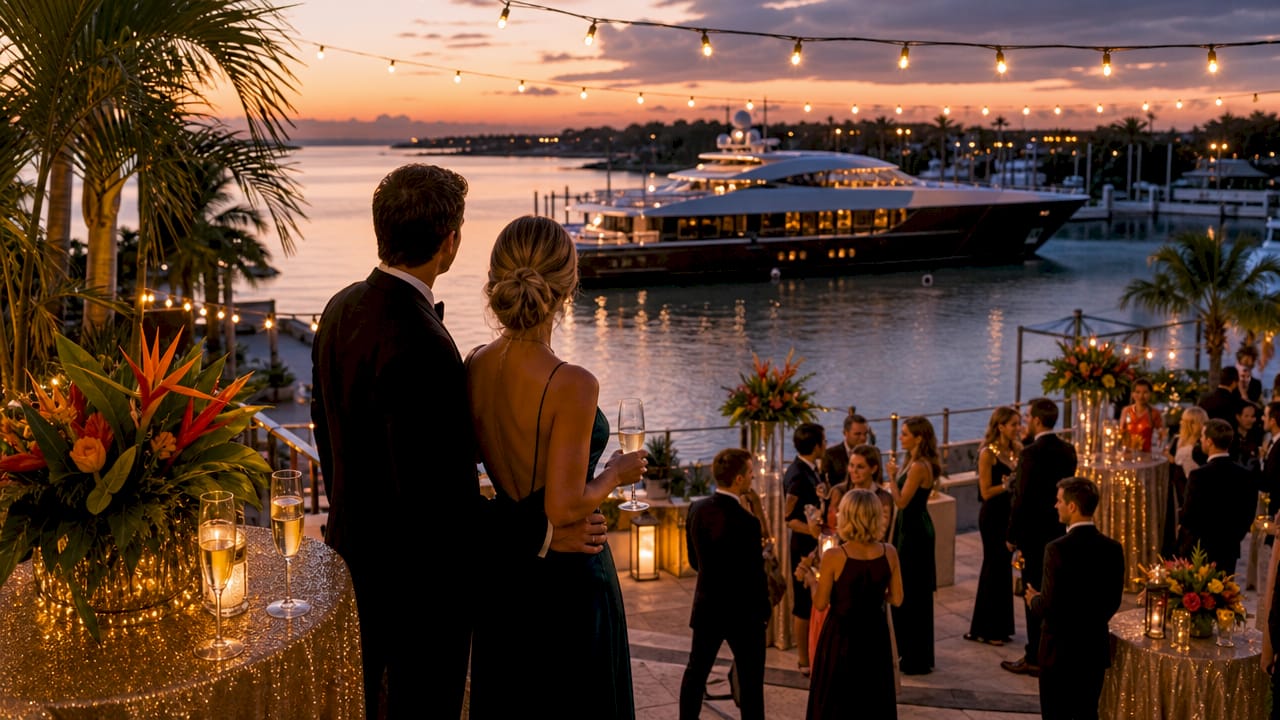
Marina positioning and dock logistics
Marina choice shapes the arrival experience before guests ever step aboard. A berth with clear water views, minimal industrial backdrop, and sufficient dock width for branded staging creates an immediate visual impression. Consider dock positioning relative to prevailing wind and afternoon sun, since both affect guest comfort during outdoor programming. The following factors should guide your venue shortlist:
- Water access and tender approach: Does the marina support branded tender arrivals from a nearby anchorage or hotel waterfront?
- Dock clearance: Is there sufficient clearance for AV rigging, catering vehicles, and floral delivery without congesting the gangway?
- Permitting timeline: Some premium marinas in Monaco, Miami, and Sydney require event permits 6 to 8 weeks in advance.
- Security perimeter: Can the dock be cordoned to maintain exclusivity without disrupting neighboring berths?
- Power supply: Does the marina provide shore power adequate for AV loads, or will you need a generator?
Pro Tip: Book your vessel 8 to 12 weeks in advance for summer and fall dates. 84% of successful launches rely on pre-planned on-site blueprints with confirmed guest lists at least 3 weeks before the event.
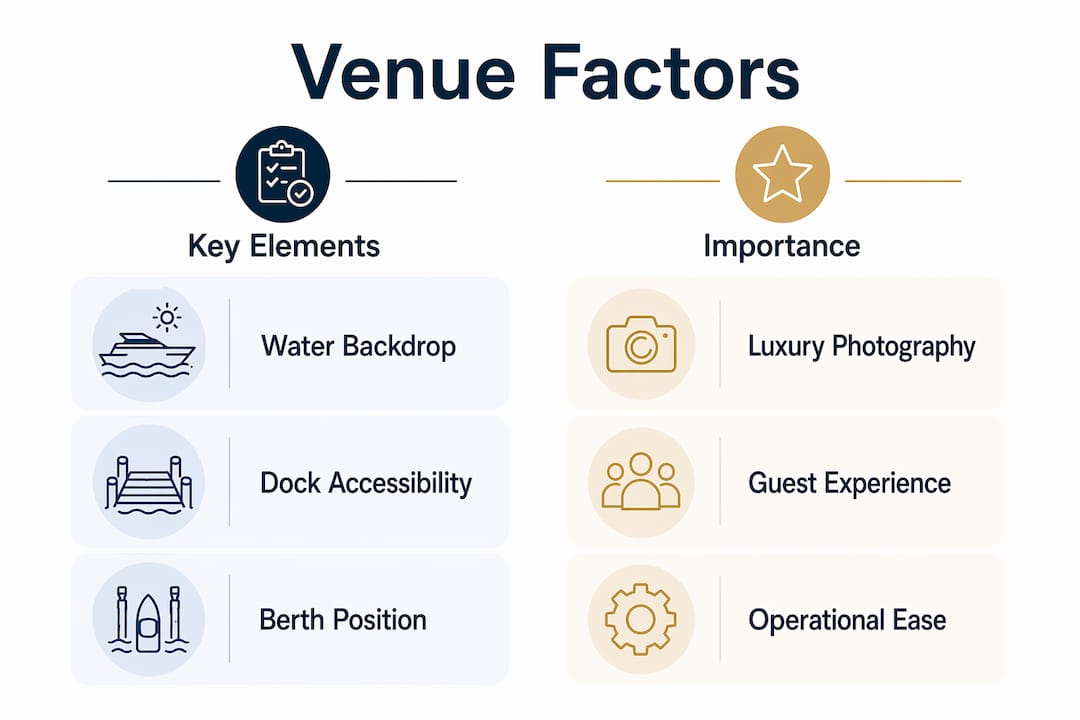
| Venue factor | Why it matters |
|---|---|
| Water backdrop | Reinforces luxury aesthetic in photography and media coverage |
| Dock width | Determines staging capacity for branded arrivals and AV equipment |
| Shore power access | Reduces generator noise that disrupts ambient programming |
| Permit lead time | Varies by port authority; delays can compromise your booking window |
| Tender access | Enables branded water transfers that extend the luxury narrative |
Who should be on your guest list and how to manage their arrival
Guest curation is the single most underestimated variable in organizing yacht launches. The vessel capacity is a hard ceiling, and exceeding it creates safety and comfort problems that no amount of premium catering can offset. Crew management practices and vessel capacity compliance are non-negotiable starting points for any guest list build.
The guest list for a yacht launch event should be built around four categories, each serving a distinct purpose:
- Qualified buyers and prospects: These guests represent direct commercial return. Limit their numbers to allow meaningful one-on-one time with your sales team and the vessel itself.
- Media and maritime press: Journalists from publications like Boat International, Robb Report, and Yachting World extend your reach far beyond the event itself. Prioritize those with digital and print audiences in your target market.
- Brand partners and collaborators: Watchmakers, fashion houses, and hospitality brands that share your positioning amplify the event’s prestige through co-promotion.
- Influencers and content creators: Select creators whose audiences align with the buyer profile, not simply those with the highest follower counts.
Once the list is set, the arrival experience must match the caliber of the guests. Branded tender arrivals and coordinated guest logistics maintain exclusivity and elevate the launch experience from dock to yacht. Personalized boarding cards, a crew member assigned to each tender transfer, and a welcome ritual at the gangway all signal that every detail has been considered. The Blend Group’s Cannes Film Festival superyacht activation demonstrated this principle at scale, using branded water taxis from the Croisette to the vessel as the opening act of the brand story.
Pro Tip: Send invitations in two waves. The first wave, 6 weeks out, goes to media and VIP buyers. The second wave, 3 weeks out, fills remaining capacity with partners and influencers. This sequencing protects your most important relationships from last-minute capacity conflicts.
What makes on-board programming genuinely immersive
On-board programming is where organizing yacht launches moves from logistics into artistry. Event technology adoption has increased by 35%, with AV setups enhancing brand storytelling in ways that static venues simply cannot replicate. The yacht’s geometry, its curves, its reflective surfaces, and its movement on water, creates a canvas that rewards creative production design.
The most effective programming layers work across three registers simultaneously:
- Sensory environment: Thematic lighting that shifts from cool blues at arrival to warm ambers during dinner, paired with a curated sound design that complements rather than competes with conversation.
- Narrative technology: 3D projection mapping onto the hull or superstructure, holographic product reveals in the main saloon, and spatial audio distribution across decks create moments guests photograph and share organically.
- Culinary storytelling: Custom menus developed with a Michelin-recognized chef, timed to the event arc, with each course introduced by a brief narrative connecting the dish to the yacht’s provenance or the brand’s heritage.
Crew collaboration during setup is where many events lose ground. Schedule all installations with yacht crew to avoid damage and confirm that all heavy equipment is safely handled without marking the vessel. Teak decks, polished stainless fittings, and lacquered surfaces require protective coverings during load-in, and this must be written into the production schedule, not left to on-the-day discretion.
Pro Tip: Work with your AV supplier to conduct a full technical rehearsal at least 24 hours before guests arrive. Acoustic behavior changes significantly when a vessel is fully loaded with people, and sound levels that work in an empty saloon will feel overwhelming during the event.
| Programming element | Staged reveal format | Interactive reveal format |
|---|---|---|
| Lighting design | Sequential, zone-by-zone reveal | Ambient, consistent across all decks |
| AV technology | Centralized projection at key reveal moment | Distributed screens and audio throughout |
| Catering timing | Structured courses aligned to reveal sequence | Continuous service at multiple stations |
| Crew positioning | Guided, escort-based flow | Stationed at key points for guest-led discovery |
How do you manage real-time operations during a yacht launch?
Flawless execution depends on preparation that guests never see. Teams holding detailed pre-event staff briefings improve event operational performance by 20%, and effective on-site management with real-time problem solving can reduce event disruptions by up to 30%. Those numbers reflect a simple reality: improvisation is expensive, and briefed teams make better decisions under pressure.
The operational framework for a yacht launch event should follow this sequence:
- 48-hour pre-event briefing: Assign every staff member a named role, a communication channel (typically a dedicated radio frequency or group messaging platform), and a decision tree for the three most likely problems in their zone.
- Load-in supervision: Designate one production manager whose sole responsibility is protecting the vessel during setup. This person has authority to halt any installation that risks damage to yacht finishes.
- Guest flow management: Map the maximum number of guests permitted on each deck simultaneously, and assign crew to monitor and redirect flow without making guests feel managed.
- Service quality checkpoints: Schedule two internal quality checks during the event, one at the 45-minute mark and one at the 90-minute mark, to assess catering pace, bar service, and AV performance.
- Departure logistics: Brief the tender crew on departure sequencing 30 minutes before the event closes. Staggered departures prevent dock congestion and preserve the luxury impression through the final moment.
“Successful yacht launches require seamless background orchestration, allowing guests to experience effortless luxury while the production team manages every variable out of sight.” — The Blend Group, Cannes superyacht activation
Post-event strategies that sustain brand momentum
The event itself is the beginning of the brand story, not the end. Post-launch KPI reviews conducted 4 to 6 weeks after the event ensure sustained momentum and data-driven improvements for future activations. Without this discipline, even a spectacular launch produces only a short-term spike rather than compounding brand value.
The post-event phase should cover four areas:
- Wash-up meeting within 72 hours: Gather the core planning team while details are fresh. Document what worked, what failed, and what required real-time improvisation. This meeting produces the institutional knowledge that makes the next launch better.
- Content distribution from event assets: Professional photography, drone footage, and highlight reels should be distributed to media partners within 5 business days. Delayed content loses relevance in fast-moving luxury media cycles.
- Attendee follow-up: Send personalized communications to qualified buyers within 48 hours of the event. Reference a specific moment from their experience aboard to demonstrate attentiveness.
- KPI review against pre-set benchmarks: Measure media impressions, post-event inquiry volume, social reach, and qualified lead conversion. Compare against the 30% increase in post-event inquiries that well-executed maritime launches consistently generate, and use the gap or surplus to calibrate future investment.
Integrating launch insights into your yacht marketing strategies ensures that event assets continue working across digital channels long after the vessel has left the berth.
Key takeaways
A yacht launch event succeeds when venue selection, guest curation, immersive programming, and real-time operations are planned with the same precision applied to the vessel itself.
| Point | Details |
|---|---|
| Venue selection drives 40% of success | Choose marina and berth position before finalizing any other event element. |
| Book vessels 8 to 12 weeks out | Peak season demand makes late bookings a significant risk to event quality. |
| Branded arrivals extend the luxury narrative | Tender transfers and personalized boarding rituals set the tone before guests step aboard. |
| Pre-event briefings reduce disruptions by 20% | Assign named roles and decision trees to every staff member before load-in begins. |
| Post-event KPI review compounds brand value | Conduct a wash-up meeting within 72 hours and distribute content within 5 business days. |
What I’ve learned from watching yacht launches succeed and fail
After years of working alongside event teams in the luxury maritime sector, the pattern is consistent. The launches that generate sustained inquiry and genuine media coverage are not the ones with the largest budgets. They are the ones where the production team treated the vessel with the same respect the shipyard did.
The most common failure point is not AV or catering. It is the gap between the event planner’s vision and the yacht crew’s operational reality. I have seen beautifully designed lighting rigs installed without consulting the captain, only to discover they interfered with navigation equipment. I have seen catering teams use the engine room corridor as a staging area, creating safety hazards and damaging finished surfaces. These are not edge cases. They are predictable consequences of treating the yacht as a passive venue rather than a living, crewed vessel with its own operational requirements.
The second pattern worth naming is the underinvestment in arrival experience. Planners spend months on what happens aboard and 48 hours on how guests get there. Managing branded tender transfers maintains the luxury narrative from dock to onboard experience, and that narrative begins the moment a guest sees your branded tender at the hotel waterfront. The World Superyacht Awards and similar industry recognition programs consistently honor vessels and events that demonstrate this end-to-end attention to detail.
My honest advice: spend 20% more time on your pre-event crew briefing than you think you need, and 20% less time debating décor options. The crew briefing is where operational excellence is built. The décor is where it is decorated.
— Jason
Plan your next launch with a vessel built for the moment
At Baranofyachts, we work with event planners and brand marketers who understand that the vessel itself is the most powerful event asset in the room. Our custom build and project management process means you can configure your ideal yacht with deck layouts, saloon dimensions, and technical specifications designed specifically for high-impact brand activations. Whether you are selecting from current listings or commissioning a bespoke build, our team brings a conductor’s eye to every detail, from dock clearances to AV power distribution. If you are ready to plan an event-ready vessel, start the conversation with our project management team today.
FAQ
What is a yacht launch event?
A yacht launch event is a branded activation staged aboard or alongside a vessel to generate media coverage, buyer engagement, and post-event inquiries. It functions simultaneously as a product reveal, a networking event, and a brand experience.
How far in advance should you book a vessel for a launch event?
Book your vessel 8 to 12 weeks in advance for summer and fall dates. Peak season demand at premium marinas in locations like Monaco, Miami, and Sydney makes later bookings a significant risk to both availability and event quality.
What is the most important factor in yacht launch event planning?
Venue and vessel selection account for 40% of an event’s overall success. The marina, berth position, and vessel configuration must align with your reveal format and brand ethos before any other planning element is finalized.
How do you protect the yacht during event setup?
Schedule all installations in coordination with the yacht crew, use protective coverings on teak decks and polished surfaces during load-in, and designate one production manager with authority to halt any installation that risks damage to vessel finishes.
How do you measure the success of a yacht launch event?
Track media impressions, post-event inquiry volume, social reach, and qualified lead conversion against pre-set benchmarks. Conduct a wash-up meeting within 72 hours and a full KPI review 4 to 6 weeks after the event to inform future planning.
Recommended
Sold Listings
Design Your Yacht
"*" indicates required fields
Maximus III - PNW
As you step aboard MAXIMUS III, the first impression is her scale.
At 120 feet with an 8-meter beam and 294 GT of interior volume, this 2025 Crescent Custom tri-deck immediately feels open, balanced, and estate-like. A timeless look while still feeling fresh from the shipyard.
Currently Available


Get your yacht value Estimate
"*" indicates required fields